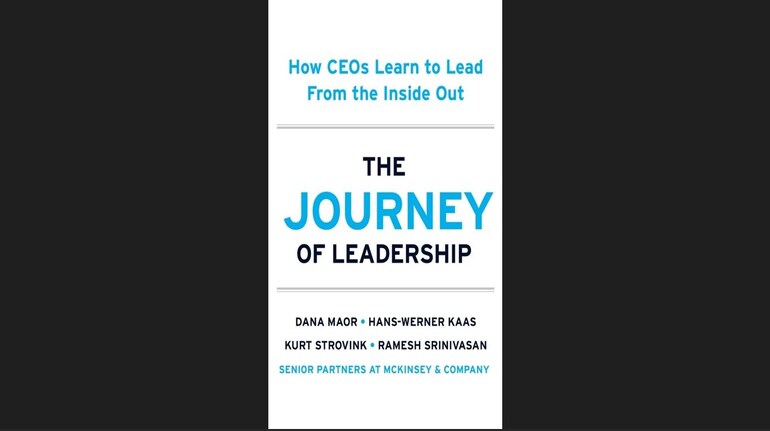
A constant mantra of many self-help and business-oriented books is listen. Listen to yourself, know who you are but equally importantly, listen to those around you, put aside your prejudices, be humble, and listen. You will learn constantly. The inbuilt argument in this is that expressing empathy and understanding people is as important as viewing it in business terms that investment in human capital is a profitable venture.
McKinsey & Company’s prestigious two-day workshop Bower Forum is a unique platform for a small group of CEOs or Chairpersons to discuss goals, challenges, and role-specific issues, while counselling and learning from one another. Till date, the forum has counselled more than 500 CEOs in the past decade. It is a journey that helps leaders hone the psychological, emotional, and, ultimately, human attributes that result in successful leadership. The Journey of Leadership: How CEOs Learn to Lead from the Inside Out is the first-ever explanation of McKinsey's step-by-step approach to transforming leaders both professionally and personally, including revealing lessons from its legendary CEO leadership programme.
The book is divided into two sections: It Starts with You & Moving Beyond Yourself. Each part has commonsensical chapter titles such as: You’s Not the Smartest Person in the Room, You Really Do Belong Here, Stop Trying to Prove Yourself, Its Okay to be Yourself, So you Failed. Now what?, Learn to Be Agile, The Impossible Begins with You, Take Fear out of the Driver’s Seat, Control is an Illusion, Everyone Keeps Things from the Boss, Practice Making Mistakes, and For People to Care, Show Them You Care. In every chapter, there is a case study shared followed by questions to ask yourself pertaining to the learnings gleaned. Many of these questions are forensic in nature and can be discomforting to say the least. In all likelihood, many of these questions are posed in the Bower Forum interactions as there are references to participants being quite distressed after being set exercises. Nevertheless, if you can answer them truthfully, even if it is in solitude, as scribbles in the margin of the book, it is a reflection on your personal challenges that will have a massive impact in your professional expertise and definitely in your growth as an individual. The writers say, “That is what this book attempts to do—to describe, explain, and codify a leader’s inner journey, in essence leading from the inside out. This is the key ingredient to make a lasting impact as you lead your teams and the broader organization.”
The Journey of Leadership has been co-authored by four senior partners at McKinsey & Company. They are: Dana Maor, Hans-Werner Kaas, Kurt Strovink, and Ramesh Srinivasan.
Dana Maor is the global cohead and European leader of McKinsey's People & Organizational Performance Practice and serves as a member of the McKinsey Knowledge Council. She is a senior partner at McKinsey, working with leaders globally to transform their organization and themselves. She has been co-dean of multiple McKinsey leadership programmess.
Hans-Werner Kaas is the co-dean of the CEO leadership programme "The Bower Forum," a former member of its Global Client Council, and is a senior partner emeritus at McKinsey. In 1991, he joined McKinsey's Frankfurt office, moved to the Cleveland office in 1997 and co-founded the Detroit office in 1998. He works with and counsels CEOs and leaders across multiple industry sectors globally.
Kurt Strovink leads McKinsey's CEO special initiative globally. He works at the intersection of strategy, personal leadership, mission building, and enterprise transformation. A Senior Partner in the New York Office, he has expertise in CEO transitions and the role of the CEO as catalyst. Kurt is a member of McKinsey's Board of Directors, has led its global insurance practice and its New York office as managing partner.
Ramesh Srinivasan is the co-dean of the CEO leadership programme "The Bower Forum" and a senior partner at McKinsey, which he joined in 1994. Ramesh began his career at McKinsey in Mumbai and moved to New York in 2005. Beyond his client work serving healthcare and social sector institutions, Ramesh leads McKinsey's social responsibility efforts in North America.
The four authors recognise that there is a perceptible shift to a more humble and open form of leadership and it is happening because circumstances demand it. The terrain is shifting rapidly. For example, leaders are expected to master complex issues such as digital transformation, inflation, disrupted global supply chains, scarce talent, a lack of diversity, cybersecurity, and climate change, as well as an awakened search for purpose in employment. Hence, no matter how intelligent, brilliant, or capable a CEO maybe, it is impossible for them to tackle all these challenges. Their jobs are in a far more precarious position than in previous years.
Human leadership has attained significance also due to the rapid emergence and adoption of artificial intelligence (AI) and generative AI (GenAI) in the workplace. Many tasks involving repetitive and analytical management in the workplace such as market analysis, project management, budgets, customer service, decision making, and fact finding will be (if not already are) handled by AI algorithms. In fact, it is being whispered that many of the current jobs done by humans will no longer be in existence in less than a decade from now — probably earlier given the short life cycles in the digital world. Going forward, the key differentiating factor will be human leadership that gives people a sense of purpose and inspires them, and that cares about who they are and what they’re thinking and feeling.
The Journey of Leadership is packed with insightful and never-before-heard reflections from leaders, including Ed Bastian (CEO of Delta Air Lines), Makoto Uchida (CEO of Nissan Motor Corporation), Mark Fields (former CEO of Ford Motor Company), Reeta Roy (CEO of Mastercard Foundation), Anju Patwardhan (MD of CE Innovation Capital), and Stéphane Bancel (CEO of Moderna). It is a book that many practitioners will be referring to, underlining extensively, and reflecting upon the advice, including changes in micro practices, that have been discussed. Ultimately, keep an open mind in the constructive criticism of yourself after having read this thought-provoking book. Decide for yourself.
The following extract has been taken with permission from the opening pages of the first chapter. YOU’RE NOT THE SMARTEST PERSON IN THE ROOMAt a Bower Forum meeting held in Frankfurt, Germany, the CEO of an Asian tech giant explained how he had an extremely com-plicated relationship with his board. The chairman had been the previous CEO for twenty years and had helped build the company into a powerhouse. The trouble was that the chairman was still heavily in-volved in running the company, making it very difficult for the CEO to do his job. The CEO knew he needed to make major changes in the company, but he was struggling to get any agreement from the chairman, who ruled with an iron fist. While the CEO felt shackled, he also was conflicted because the chairman was his mentor and he wanted to stay loyal and figure out a way to work collaboratively with him.
One of the other CEOs in the room said, “You can’t do this on your own. First off, to work more collaboratively with your chairman you have to understand him better and figure out who are his influencers on the board and who are his friends. You need to talk to these people and get useful input on what the chairman is thinking and then figure out how to influence him.” The first CEO explained to the group that an Indonesian investment fund, which controlled some 30 percent of the company, had a strong relationship with the chairman and influenced his views. The CEO, however, didn’t have any sort of relationship with them. The other CEOs at the forum told him he needed to fly to Indonesia and start reporting quarterly results in person to the fund managers. That way he could get to know them and ask for their help in persuading the chairman to work with him to make the changes he needed.
Then another CEO chimed in: “Once you understand what your chairman is thinking, you should have a frank conversation with him where you lay out the facts and arguments for your strategic plan. But don’t hit him all at once. Have a series of discussions laying out your agenda in bite- sized chunks and tell him, ‘Here’s what I’m thinking about at this point in time.’ Then tell him you’d like to come back in another week and talk more, and then keep doing that until he’s won over.”
Over the next several months, the CEO reached within himself, realizing that he indeed couldn’t go it alone. He sought out investors, friends of the chairman, and others, asking their advice on what the chairman was thinking and the best ways to approach him. Eventually the two rivals began to see eye-to-eye on the company’s strategy and worked together to move the business forward.
The CEO of this Asian tech giant is a great example of a leader who benefited from the first element of the Bower Forum process. He took an unbiased look at himself and realized that he was stalled at his job and didn’t have all the answers. He realized he needed to become a better listener and reach out to those who could help him perform better. He then built an outside network of advisers to help him figure out how to work with his chairman to form a mandate for change. He had been trying to go it alone, but after feedback from other CEOs he came to realize that he is not expected to go it alone. He wasn’t always the smartest one in the room.
As this CEO proved, personal change is possible. After much self-assessment, he became more open and humble, seeking input from his management team, outsiders, and the board, who had a broader sense of the business context or knew the thinking of the company’s chairman. He learned how to embark on a never-ending learning journey, one where he had the courage to reach out and listen to the advice of others.
One of the key reasons CEOs come to the forum is to address their isolation and their loneliness. No one likes to feel lonely, but when you get the top job, that’s just what happens. Sometimes no one talks to you because you act like you’re the smartest one in the room, and no one wants to say the wrong thing or bring bad news to the boss. As a New Yorker cartoon that showed a CEO addressing his team put it, “I am more than willing to acknowledge my mistakes if someone is stupid enough to point them out to me.”
Discover the latest Business News, Sensex, and Nifty updates. Obtain Personal Finance insights, tax queries, and expert opinions on Moneycontrol or download the Moneycontrol App to stay updated!
Find the best of Al News in one place, specially curated for you every weekend.
Stay on top of the latest tech trends and biggest startup news.