







Book Extract
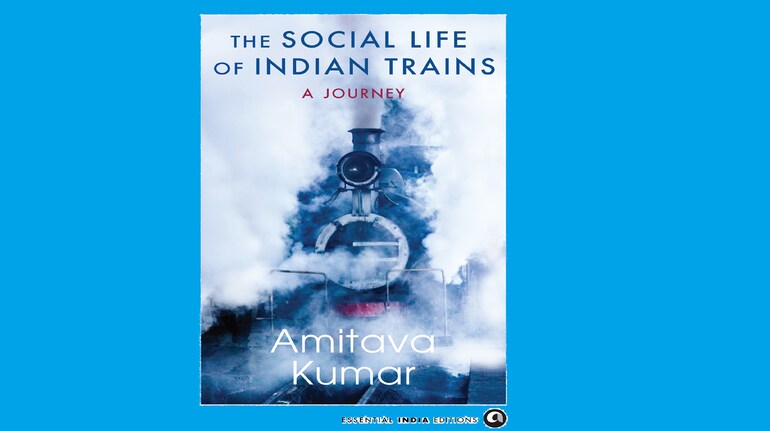
Excerpted with permission from the publisher The Social Life of Indian Trains, Amitava Kumar, published by Aleph Book Company.
******
There are a few public spaces where private selves stand more clearly revealed. Temples are one example. I’m thinking of temples where women prostrate themselves and rub their hands on the shivlings or the Sufi shrine in Srinagar where devotees find themselves shedding uncontrollable tears. Trains too offer a particular kind of space for the performance of a private self. The fact that people on Indian trains watch screechy TV dramas or carry out loud conversations on their phones isn’t particularly unusual; instead, what always appears more remarkable to me is the patient forbearance of the other passengers. I look at the people seated around me and notice how accepting they are of their fellow travellers. Their behaviour makes me feel a bit ashamed of my own intolerance. During a recent trip on the Rajdhani Express, there was a boy, maybe four years old, who was screaming repeatedly. His cries were shrill and extremely loud, and they were emitted with ferocious frequency. While I couldn’t suppress a sigh of annoyance, no one else in the train car seemed to mind. Certainly, no one protested. It took me a long time, perhaps an hour, to realize that this was a special-needs child—and that the people travelling with me were better humans than I was.
Some years ago, I came across a passage in a memoir by a bureaucrat about a train journey he had undertaken as a child. The writer’s name was Ashok Lavasa. When he was nine, his father was taking Lavasa to his boarding school in Belgaum. This would have been in the late 1960s. The father-and-son duo had travelled by train from Baroda to Bombay and had now boarded the train which would bring them to Poona. From Poona, there would be two more changes before they reached Belgaum.
But there was a problem. Lavasa’s thirteen-year-old sister was in hospital back in Baroda, sick with typhoid. It was possible that she might not make it. What was the father to do? Years earlier, Lavasa’s parents had lost their first child. Now, Lavasa’s mother was alone with the sick daughter in hospital. The train was about to leave the station. In his memoir, Lavasa writes that his father asked a stranger who was sitting across from him where he was going. The man answered, ‘Belgaum.’ Hearing this, Lavasa’s father implored the stranger to take the boy with him, and then he got off the train so that he could return to his sick child. The boy grew up to be a senior administrator and, late in life, he recalls the strange fact that his father didn’t even ask the stranger for his name or address. In his memoir, Lavasa records the unassuming kindness of the man who took him to Belgaum and also what he calls his father’s goodness and credulity. But ever since I first read this passage when a friend had posted it on his Facebook page, I have marvelled at how trains offer the possibility of an exchange that strengthens our social contract. I’m not denying the fact of crimes and acts of deception on trains, no, I’m only saying that our vulnerabilities become exposed during our travels on trains and, as it happened in Lavasa’s case, these vulnerabilities that we can think of as wounds are also covered and healed by kind acts.
The railway is a part of the public wealth, perhaps among our most shared precious resource, and when we are travelling on trains, we are not just passengers but also fellow members of the republic. We cannot only see ourselves as mere individuals, and, for instance, see Lavasa’s father only as a good character. Instead, I’m trying to argue that we must also see clearly the reality of large institutions and the kinds of individuals they produce. The railway is one such institution; it creates conditions for particular kinds of interaction between individuals. In a book published in 2013, Rescuing Railway Children by Malcolm Harper and Lalitha Iyer, we learn that across fifty main railway stations in India, at least 70,000 and perhaps up to 120,000 runaway children arrive on railway platforms each year. Why do they do this? The authors write that the railways in India remain the ‘dominant form of long-distance transport’: ‘If you want to get away, to be free, to see life beyond the narrow confines of a small community, or merely to hide and disappear into the masses of India, you take the train.’ Trains offer not only a means of transport but also a means of livelihood: kids can steal, or beg, or sing songs and dance, or they can work for vendors who sell foods and drinks. Trains and railway stations also offer a more secure space for runaway children. The authors argue that it is easier to spot or detect exploitation of children on the station platforms than it is in the urban jungle. So, as we saw represented in the 2023 film Laapataa Ladies, the railway platform becomes a refuge for a lost and helpless young woman and allows her to cultivate new social bonds. Railway stations are thus the place where vigilance turns out to be fruitful in such matters. When I was talking yesterday to ASI Dipendry Singha of the Railway Protection Force, she told me that just the previous week at the New Jalpaiguri station, she had rescued fifty-six girls who were being trafficked to Bengaluru.
**********
Julian Treasure, The Social Life of Indian Trains , Aleph Book Company, 2025. Hb. Pp.152
The history of Indian trains is older than India itself. For over 150 years, the train has been part of the lives of most Indians. Today, Indian Railways transports hundreds of crores of passengers, about five times the current population of India. And, the railway lines that criss-cross the country, and are even longer than our majestic rivers, bind the landscape into a whole and give it a sense of a nation.
To explore just how trains in India have seeped into the national psyche, and to explore the gigantic enterprise that is Indian Railways, acclaimed writer Amitava Kumar took several journeys on some of the country’s celebrated trains, from the Himsagar Express, which traverses one of the world’s longest rail routes, a distance of 2,335 miles, from Kashmir to Kanyakumari, to the legendary Darjeeling mountain railway that has been praised in movies, literature, and songs. He then goes into the history of Indian trains, extols the magic of train travel, and explains how the importance of the railways will only grow as more and more Indians use a variety of trains to travel out of (and between) their villages, home towns, and cities to various destinations in pursuit of work and leisure activities.
Amitava Kumar is the author, most recently, of My Beloved Life, a novel that Salman Rushdie called ‘extraordinary’. Kumar is also the author of A Time Outside This Time, Writing Badly is Easy, The Lovers, A Matter of Rats: A Short Biography of Patna, Home Products, and A Foreigner Carrying in the Crook of His Arm a Tiny Bomb. His writing has appeared in The New Yorker, Guardian, Caravan, New York Times, Vanity Fair, and Harper’s. His essay ‘Pyre’, first published in Granta, was selected by Jonathan Franzen for Best American Essays 2016. He is the recipient of a Guggenheim Fellowship and the Cullman Center Fellowship at the New York Public Library. Kumar has been awarded residencies at Yaddo, MacDowell, and the Hawthornden Foundation. He is Professor of English at Vassar College.
Discover the latest Business News, Sensex, and Nifty updates. Obtain Personal Finance insights, tax queries, and expert opinions on Moneycontrol or download the Moneycontrol App to stay updated!
Find the best of Al News in one place, specially curated for you every weekend.
Stay on top of the latest tech trends and biggest startup news.





