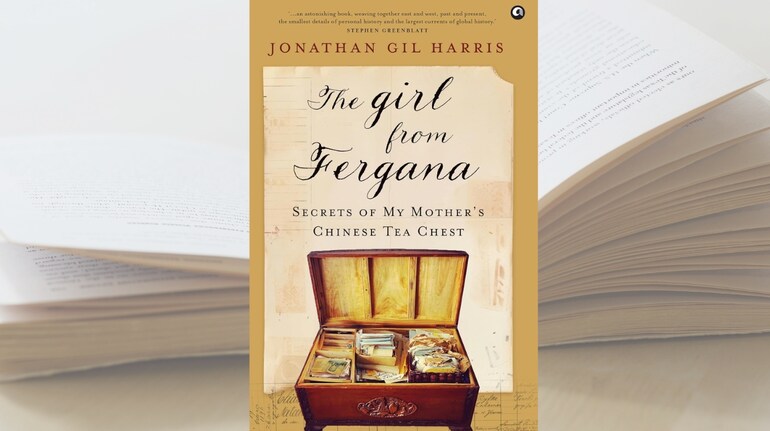
Excerpted with permission from the publisher The Girl from Fergana: Secrets of My Mother’s Chinese Tea Chest, (Eds.) Jonathan Gil Harris, published by Aleph Book Company.
**************
A CHINESE TEA CHEST
When I was a child living in New Zealand, one piece of furniture dominated my family’s otherwise sparse living room: a large Chinese tea chest built of sturdy teak and scented camphor. Its sides and lid featured bas-relief wood carvings of what, I presumed, were monks. At its edges were deep crenellated grooves containing intricate patterns. As a small boy I spent a lot of time gazing at the monks, tracing the patterned lines absent-mindedly, and smelling the chest’s faint but distinctive scent. All these sparked in me an inchoate longing. At the time, my only conscious wish was to know what was hidden inside the chest. But I never opened it. Rather, I almost never opened it.
My mother had forbidden me to do so. The chest was one of the few heirlooms that connected her to her pre-war childhood in Warsaw. It didn’t come from there: her Uncle Joe had bought it on one of his trips to the east—in Shanghai perhaps, or Hong Kong. Tea chests of this style were made in China from the nineteenth to the early twentieth centuries; they were used not only for storing tea, but also for conveying small goods as cargo in ships that sailed from China to Southeast Asia, India, Persia, Arabia, the Levant, and Europe. Uncle Joe had shipped the tea chest back to Tel Aviv in Palestine when my mother went to live with him after the war had ended. But when he died in August of 1963, she inherited the chest, and it travelled to our home in Auckland.
First Uncle Joe, and then my mother, had crammed the tea chest full of memories of their Polish Jewish family: photos, documents, notebooks, paintings, and countless letters written in a variety of languages. There were photos of family members I had never met, some of them exterminated in the Nazi death camps. The letters were all folded and kept inside envelopes; the photos were stuffed in other smaller envelopes, which had been tucked into the envelopes containing the letters, and then put in shoeboxes that were stuffed with shredded paper inside the tea chest. Folded memorabilia hidden in receptacle within receptacle within receptacle, stranded in a limbo between remembrance and oblivion.
I knew all this because I had stolen a few peeks inside the chest when my mother was not looking. Its contents were a jumbled mess: the shoeboxes with the envelopes and their hidden contents were buried willy-nilly in shredded paper and naphthalene, like items in a lucky dip. I was dissuaded from excavating too much as the stench of naphthalene would stink out the entire living room if the lid was left ajar even for a moment. I have a vague memory of opening the lid and my mother—summoned like a horrified genie from a lamp—running in, within seconds, with a cry to slam it shut again.
The chest became for me a mute emblem of my mother’s childhood trauma. It was a highly public container of her most private secrets—souvenirs from worlds now closed off to her and us. I longed to know what those secrets were, to better understand the worlds she’d lost. The psychic cost of doing so, however, seemed huge. Her trauma, like the tea chest, was always undeniably, forcefully present in my life. Yet its contents, like those of the tea chest, were beyond scrutiny.
Until my mother began to lose her memory.
**********
Jonathan Gil Harris, The Girl from Fergana: Secrets of My Mother’s Chinese Tea Chest, Aleph Book Company, 2026. Pb. Pp. 344
When seven-year-old Stella flees her elegant Warsaw apartment with her family in 1939, little can she imagine that this is the last time she’s seeing her home. After crossing the Bug River to escape Nazi-occupied Poland and narrowly escaping deportation to Auschwitz, she endures a series of harrowing incidents before her journey brings her to the Fergana Valley—the heart of the ancient Silk Roads. There, among the ghosts of once-thriving trade routes where cultures intertwined and coexisted from China to Persia and India, the story of Stella becomes part of a much older one.In The Girl from Fergana: Secrets of My Mother’s Chinese Tea Chest, Jonathan Gil Harris opens the lid of his mother’s treasured tea chest to uncover a life shaped by displacement. In this memoir, Harris intertwines a moving portrait of his mother with a sweeping chronicle of 2,500 years of Jewish presence and cultural exchange along the Silk Roads.Blending personal memory with the history of the Silk Roads, the book describes lives belonging beyond borders, and laments the disappearance of a once connected world now fractured by hostile nation states. A book that is, at once, a poignant family memoir, a rediscovery of the author’s rich and complex Jewish heritage, and an elegy to the vanished cosmopolitan spirit of the Silk Roads, The Girl from Fergana is a triumph of storytelling and remembrance.
Jonathan Gil Harris was born in New Zealand, completed his PhD at the University of Sussex in England, and taught in the US for more than 20 years. He now lives in India. He is the author of several books on English Renaissance literature, drama, and culture, including Foreign Bodies and the Body Politic, Sick Economies, Marvellous Repossessions, Shakespeare and Literary Theory, and Untimely Matter in the Time of Shakespeare, which was selected by Choice magazine as an Outstanding Academic Title for 2009. Harris also served as associate editor of Shakespeare Quarterly. Since moving to India, his work has focused on the cultures of the subcontinent before the age of British colonialism. His most recent books are Indography (2012) and The First Firangis: How to Be Authentically Indian (2014).
Discover the latest Business News, Sensex, and Nifty updates. Obtain Personal Finance insights, tax queries, and expert opinions on Moneycontrol or download the Moneycontrol App to stay updated!
Find the best of Al News in one place, specially curated for you every weekend.
Stay on top of the latest tech trends and biggest startup news.