






Book Extract
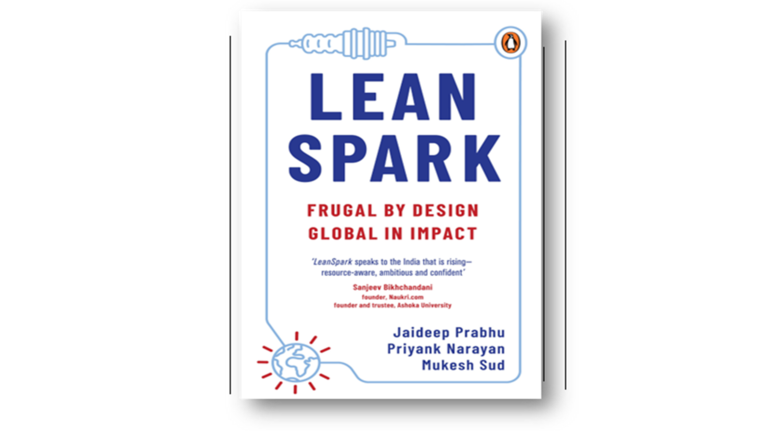
Excerpted with permission from the publisher LeanSpark: Frugal by Design, Global in Impact, Jaideep Prabhu, Mukesh Sud, Priyank Narayan, published by Penguin Business.
JLF
The Festival That Made Literature a Movement
It’s a crisp February morning in Jaipur. The kind that makes you linger outdoors, chai in hand, soaking in the winter sun. Outside the gates of Hotel Clarks Amer, there’s a quiet buzz turning into a hum. Music, laughter, the chatter of a thousand voices. Banners flutter. Cameras click. JLF is about to begin.
Sanjoy Roy stands near the entrance, watching the crowd pour in. Around him, Namita Gokhale and William Dalrymple exchange greetings with friends, authors, schoolchildren and scholars. It’s the festival’s twentieth year.
Two decades since a small, makeshift stage hosted a modest set of talks in 2006. Two decades since an idea that almost no one bet on grew into the ‘greatest literary show on Earth’. Back then, it wasn’t a glitzy set-up. Just a handful of writers, a patchy sound system and empty chairs. What followed was a masterclass in creative problem-solving and cultural entrepreneurship. The team behind JLF found ways to grow the festival without growing its budget. They leaned on community, improvisation and relentless energy to build something far bigger than any one of them had imagined.
This chapter traces that journey from the first uncertain steps to the global phenomenon that JLF has become. It’s more than a festival. It’s about taking an idea rooted in scarcity and turning it into abundance. And how you build a world-class festival without losing your soul.
The Genesis of JLF
Sanjoy Roy started out in television. In 1989, he co-founded Teamwork Arts (TWA) with Mohit Satyanand, producing everything from soap operas to puppet shows. ‘By 1995 we had about fifteen weekly shows running forever,’ he recalls. But the grind took its toll. ‘At a Saturday meeting, two of our senior colleagues said, “You know, we’re brain dead.” That was the turning point.’
Six years later, Sanjoy shut down TV production and returned to the arts. TWA platform Friends of Music supported bands like Indian Ocean and Parikrama. They backed new work in dance and theatre, giving artists a shot at projects they otherwise couldn’t do.
Then came a visit to the Edinburgh Fringe Festival in 1999. ‘Edinburgh is made up of seven different festivals,’ Sanjoy says. ‘I was convinced that’s where we needed to set up our first platform.’ TWA created a cross-festival programme showcasing India. Soon they were invited to Singapore, Australia and New Zealand.
Back home, Sanjoy was drawn into the Jaipur Heritage International Festival (JHIF), thanks to John and Faith Singh of Anokhi, who had seen his work in Edinburgh. In 2006, a small literature segment was added, with Namita Gokhale and William Dalrymple as directors. But by 2007, the festival was running out of funds. The Singhs asked TWA to take over.
‘We signed the agreement on 9 December,’ Sanjoy says. ‘The festival was scheduled for 19 January. We had no money. No plan. Nothing. Somehow, we pulled it off in three weeks. I came down to the durbar hall and saw 200 chairs. I said, “Who’s coming? Remove 100.” But people came, you know. People came.’ And they have kept coming.
JLF became a place where anyone could listen to the world’s greatest writers without VIP barriers. ‘No reserved seating for the baba log, safed log,’ Sanjoy says. At the heart of it all was his core belief: not ‘make do’, but ‘make possible’. ‘In India,’ he says, ‘you’re always getting an edge off. You’re always trying to find your way around.’
Sanjoy’s journey from television to theatre to global literature was never part of the plan. But it was guided by instinct, purpose and the belief that great ideas can bloom, even on a shoestring. ‘We didn’t set out to do what we eventually did,’ he says. ‘We just created platforms for people to explore, enjoy and spread culture.’
Building JLF
JLF’s rise from being a small segment of a heritage event to a global literary powerhouse is a story of lean, smart management. A big part of its success lies in the teamwork behind the scenes. Namita Gokhale focused on Indian languages and emerging writers. William Dalrymple brought in global literary stars. Together, they struck a powerful balance.
As Sanjoy puts it: ‘William had an international list, Namita an Indian list, and we were eclectic with our programmes. People knew Jaipur, it was a place for retail. All this made the proposition sexy. We added a touch of glamour and that got everyone’s attention.’
That blend of depth and dazzle helped JLF stand out. It became a festival where bestselling authors and first-time poets shared the same stage. Where language, geography and fame didn’t matter. Nothing captures this better than the story of a rickshaw driver who became a literary star, proof of how the festival opened doors for voices from every walk of life.
Manoranjan Byapari is a Bangladeshi Dalit who arrived in an Indian camp as a kid pre-1971. He was abused in the camp and ran away and joined the Naxal movement. Eventually he was captured and thrown in jail for twenty years. ‘In jail,’ says Sanjoy, ‘the superintendent took a shine to him and trained him to read and write. He learned to read the notices on the prison walls and used a stick in the dust to write.’
In jail, Byapari must have read about 200 books. When he left jail, he was rehabilitated as a rickshaw puller. One day a lady got into his rickshaw, and he asked her the meaning of a difficult Bengali word. Where did you come across this word, she said. In a Mahasweta Devi book, he replied. At the end of the journey, she said: Show me the book. He pulled it out and showed it to her. She looked at it and said: ‘I’m Mahasweta Devi.’
‘So,’ says Sanjoy, ‘Manoranjan wrote a book. We heard about it and invited him to JLF. Back then he was a cook in a government school for Dalits in Howrah. He couldn’t stand the abuse there and came to Jaipur for a respite. Meanwhile, he got some good press. The next year he came back with the English rights sold. By now he was a librarian in the school. The English launch happened, and notices appeared in the Washington Post and the New York Times. This led to translations into more languages.’
The book was translated into ten languages. Next, Byapari was appointed head of all libraries in West Bengal. Finally, when his second book came out, Mamata Banerjee, the chief minister of West Bengal, gave him a ticket to represent the Trinamool Congress. In 2021, he won the elections, becoming an MLA from Balagarh.
Challenges with Building JLF
When faced with unexpected challenges, Roy learned to improvise and find creative solutions. ‘One year,’ he recalls, ‘there was a cloudburst in the middle of the night, and all the tents collapsed. This happened around two in the morning, and by 3.30 a.m., the entire site was in chaos. There was no standing structure left. It was a disaster zone. But our attitude was simple: yes, it’s a disaster, we don’t have electricity, no facilities, but we still have to start on time. So, the next day, we did everything we could to get things back in order. We explained the situation to our audience, and it created an entirely different atmosphere at the festival, earning us a lot of goodwill from those who attended.’
On another occasion, Sanjoy wanted the renowned percussionist Vikku Vinayakram to inaugurate their festival in Singapore. The plan was for Vinayakram to travel by seaplane from Reunion Island to South Africa, then fly to Hong Kong, and from there to Singapore: all connections within a forty- five-minute window. Naturally, nothing went as planned. The seaplane was cancelled, so Vinayakram took a boat instead. Without a transit visa, Roy’s team had to work with South African officials and then send precise instructions to Hong Kong and Singapore. ‘Vikku, for his part, said he wouldn’t eat until he was on stage with us!’ Sanjoy laughs. ‘And of course, in the end, everything came together.’
Reflecting on these experiences, he muses, ‘At some level, the question is: Do you believe that something is possible? And once you do, you must invest that belief with not just hope, but also process, effort and common sense. Without those, nothing meaningful can happen.’
The mindset of building systemic sustainability has shaped JLF at every step. It didn’t expand by chasing growth for its own sake. What truly sets JLF apart is how it has scaled without selling out. From day one, it has held on to its core values—free access, cultural inclusivity, literary democracy. That’s systemic sustainability: not just growing wide but growing right.
Using Tech to Scale JLF
As the Jaipur Literature Festival grew, the team had to find smart ways to stay inclusive and sustainable without ballooning costs. A big issue was freeriding on food. People would pick up a plate, then pass their badge onto someone else. ‘We were feeding 8000 people a day at our expense,’ recalls Sanjoy Roy.
‘So, we introduced a zapping mechanism; once you’d served yourself, your card couldn’t be reused. This cost us `7 lakh to set up but saved us `14 lakh that year.’
Technology soon became central to the festival’s functioning. ‘We number crunch everything,’ says Sanjoy. ‘But we don’t share our data. We’re also moving towards zero waste; carbon offsets, no printed brochures. Tech helps make things affordable in the long run. It’s expensive at first but gets cheaper down the road. So, we co-develop solutions with our tech partners, and they grow with us.’
This long-term, co-creative mindset of building scalable systems that are enduring pays off in the end. Maintaining accessibility while staying financially viable is a constant balancing act, however. ‘Raising general ticket prices would exclude most of our audience,’ says Sanjoy. ‘And so, TWA introduced premium experiences through the Friends of the Festival programme to fund the rest of the event.’
Despite growing costs, the festival remained a democratic space. ‘You could be sitting shoulder to shoulder with a Nobel Laureate or a Vikram Seth,’ says Sanjoy. Namita Gokhale ensured the same diversity reflected on stage. ‘There was a perception,’ she says, ‘that nothing was happening in Indian languages. But India was having a literary moment. It just needed a space for English and Indian-language writers to talk to each other.’ Sessions on Dalit and tribal literature became a key part of the programme, giving space to voices often overlooked. As Sanjoy puts it, ‘We made literature sexy. Now over 300 festivals have taken inspiration from us.’
Not every impact story from JLF is about scale. Some are about the reach. Sanjoy recalls one such moment: ‘Some years ago, a tall guy came up to me and said, “I come from a small village 40 kilometres from Gorakhpur. I follow everything you do. I come here by train. I sleep at the railway station waiting room, and I come every day. And I’m so fascinated.”’ Moved by what he experienced at the festival, this village teacher returned home and started a small library with books he had picked up at JLF. He would teach children by day and read to adults in the evening. A few years later, he came back, this time not alone, but with eight or ten others from his village. Inspired by his journey, they had launched six more community programmes of their own in the village. This quiet ripple is at the heart of JLF’s mission: democratizing access to literature and inspiring people to build cultural spaces of their own, no matter how modest the means.
Addressing Global Challenges through Culture
The global expansion of JLF reflects both its success and TWA’s knack for adapting across contexts. As Sanjoy puts it, the idea was always ‘to take India to the world and bring the world to India’.
The international journey began as a way to de-risk the main event. ‘Around 2011–12, we realized we needed to de-risk Jaipur. One way was to move to London,’ says Sanjoy. A partnership with the Southbank Centre followed, opening doors abroad. Oprah’s visit had already put JLF on the global radar. ‘Because of Oprah, all of America followed. We realized there was an opportunity in the US.’
But the team also encountered cultural blind spots. ‘Post- COVID, we met Wells Fargo executives in Washington. One senior manager pointed to her notes and asked, “What is Delhi?” It’s a city, I said. She asked, “Where is it?”’
‘That’s the opportunity!’ Sanjoy adds. ‘We obsess over the West, but they’re not always thinking about us. So how do we introduce India to the world?’
The international expansion of JLF wasn’t just about taking the festival abroad. It was about finding scalable ways to make it work. The team built touring circuits for performers.
‘If we took Indian Ocean to the Perth International Festival, we’d follow it up with Melbourne, Sydney and New Zealand,’ explains Sanjoy. This approach helped the team manage costs, increase revenues and extend reach without added managerial burden. A classic lean execution strategy.
The South Africa Story: From Violence to Vibrance
JLF’s expansion into South Africa is an example of how culture can be used to solve local problems. As Sanjoy recounts: ‘The city of Johannesburg had an issue. When apartheid ended and South Africa opened up, everyone from the rest of Africa arrived at the bus stop at Newtown, their central business district. This led to unemployment, violence and businesses moving out.’
Stephen Sachs, then head of the city, approached Sanjoy after hearing about TWA’s earlier work in New York. Sanjoy’s response was simple but bold: ‘You arrange lighting and policing, and I’ll walk around with a mobile in my hand and won’t get mugged.’
The team outlined a plan. They marked out a precinct, brought in partners rent-free and helped establish museums. The result? ‘Today, Newtown is one of the most dynamic, fastest- growing spaces in Jo’burg,’ Sanjoy says.
This project showed how cultural interventions, when designed with intent, can revitalize urban spaces, reduce violence and spark economic renewal. A real-world case of culture being not just entertaining but transforming.
The Australia Story: Addressing Incarceration through Art
In Western Australia, JLF’s approach helped to address a pressing social issue: the high incarceration rate of Aboriginal people. ‘2.2 per cent of Australia is aboriginal,’ explains Roy. ‘But Aborigines make up 98 per cent of the prison population. How do we reduce this? In Kalgoorlie, which has the largest open-cast mine, from cradle to grave, everyone goes to prison at some point.’
The team turned to art as a powerful tool for change. ‘We asked community leaders to share their stories,’ Roy says. ‘It could be about the sun, the moon—anything that connected to their traditions, using desert materials as installation art. Each tribe had one core story, expressed in different ways, about how they understand the land, find water or survive on cactus.’
This creative project not only helped reduce incarceration rates but also became a way to preserve and celebrate Aboriginal heritage.
JLF’s global journey shows how cultural platforms can be thoughtfully adapted to local realities while staying true to their core values. With creative thinking and sensitivity to community needs, the festival has managed to inspire real change in places far beyond its origins.
As Sanjoy says, ‘JLF isn’t just about song and dance. It’s about creating value, both visible and invisible. It’s about making a difference that spans generations, helping young people heal from trauma. That’s been one of our biggest learnings.’
Controversies and Challenges
Over the years, JLF has had its share of controversies, testing its resolve to uphold free expression while operating within India’s complex political and social climate. From as early as its third edition, JLF began attracting criticism, often for featuring voices that challenged prevailing political sentiments.
Roy notes that such challenges soon became routine. ‘Every year, there was some controversy.’ But instead of retreating, the team leaned into their values. ‘We’ve never backed off. We have processes in place, and we try to be as compliant as possible,’ he explains. That careful balance between courage and compliance has allowed JLF to preserve its identity without getting shut down. One incident was in 2012, when Salman Rushdie’s planned appearance triggered protests and security threats. Though Rushdie ultimately didn’t attend, the controversy drew global attention. In a twist of fate, it also led to one of JLF’s most high- profile moments. As Roy recounts, Deepak Chopra emailed to ask if Oprah Winfrey could attend instead. She did—and all of America followed.
Rather than being derailed, JLF used the moment to grow. ‘There’s nothing like bad press,’ Roy reflects. In fact, many of these flashpoints, contentious statements and political tensions only increased the festival’s global profile.
JLF didn’t just survive controversies, it absorbed the shocks and emerged stronger. By staying true to its mission of free speech and cultural exchange, the festival transformed challenges into global visibility and long-term credibility.
* * *
While JLF has redefined how stories are shared and celebrated, it’s not the only cultural platform reshaping India’s creative landscape. Across the country, another bold experiment in accessibility and artistic ambition has been quietly gaining momentum. The Kochi-Muziris Biennale (KMB), rooted in the coastal heritage of Kerala, is showing how contemporary art can move beyond gallery walls and speak directly to the public. If JLF made literature democratic, the biennale is doing the same for visual art. But how did it rise so quickly to become one of Asia’s most influential art festivals?
‘Flexing Assets’ at Kochi Biennale
In the bustling city of Kochi, where the backwaters meet the Arabian Sea, a bold idea took root in 2012. It was a vision to transform the city into a living canvas, showcasing art from around the world while celebrating local culture and community. This vision became the KMB, an art exhibition unlike any other, and a testament to the power of LeanSpark in the world of art.
The story began with a handful of artists, curators and cultural enthusiasts led by Bose Krishnamachari and Riyas Komu. They believed in the transformative potential of art and also in the need for a new approach to creating cultural experiences. One that didn’t require vast sums of money or extravagant infrastructure. They wanted to challenge the idea that art exhibitions had to be confined to glossy, white-walled galleries or expensive venues. Instead, they saw the historic town of Kochi, rich with colonial architecture, bustling markets and scenic waterfronts, as the perfect backdrop. They wanted to create a space where local culture could meet global contemporary art in a meaningful, accessible way. Their frugal approach, prioritizing collaboration over capital, allowed them to transform Kochi into a living, breathing art hub without the need for costly new venues, showing the world that true creativity thrives when it is grounded in resourcefulness and community involvement.
By leveraging the city’s existing public spaces, such as old warehouses, schools and even defunct spice factories, the biennale was able to keep costs low while creating a truly immersive experience for visitors. The beauty of this approach was that it didn’t just reduce the financial burden; it also brought art directly into the heart of the community. These spaces, once unused or underutilized, were transformed into vibrant galleries where visitors could wander through installations, sculptures and performances that spoke to the past, present and future of art.
KMB was more than just a festival of international art: it was a living, breathing collaboration. Local artists and communities were integral to the event, with their voices and stories woven into the fabric of the biennale. This wasn’t just art on display; it was art that engaged with its audience. It invited conversations, evoked emotions and reflected the diverse cultural layers of Kochi. In doing so, it ensured that the art was relevant and resonated with the people who lived there.
One of the core principles behind the biennale’s success was the idea of ‘flexing assets’. Instead of building new, expensive venues, the organizers chose to work with what was already available. This was not only a cost-effective decision, but also an environmentally conscious one as it reduced the need for additional resources and construction. The use of repurposed buildings created a sense of historical continuity, where modern art sat alongside centuries-old architecture, blending the old and the new in unexpected ways.
Another key element was the concept of ‘making innovative friends’. The biennale didn’t operate in isolation. It tapped into a network of local businesses, government bodies and international artists to bring the event to life. By forging partnerships with local eateries, hotels and transport services, the event boosted the local economy while fostering a sense of community involvement. International artists were eager to be part of the biennale, drawn by its unique approach and its focus on grassroots collaboration. The result was an event that felt both global and local, where diverse cultures met in unexpected and exciting ways.
From its humble beginnings, KMB has grown into one of the largest contemporary art festivals in Asia. It has become a model for sustainable and community-driven art initiatives, demonstrating that innovation doesn’t always require grandiose plans or hefty budgets. Instead, by rethinking how to use available resources, fostering local collaborations and embracing community engagement, the biennale has created a platform where art is not just seen but experienced in a way that is accessible, meaningful and sustainable.
Today, the biennale attracts artists and art lovers from around the globe, all eager to witness how frugal innovation can transform a city into a canvas, while simultaneously making art more accessible to everyone. Through ingenuity and collaboration, it has proven that creativity can flourish even in the most unlikely of places, and that sometimes the most profound impact comes from the simplest ideas.
* * *
The spirit of LeanSpark can be seen in different streams of the cultural revolution in the country. Film makers too have leaned into the spirit of frugal to create, scale and promote their films.
From iPhone to the Oscars: The Elephant that Roared
As a child, Guneet Monga was drawn to films. The spark came when she saw her mother’s friend working on an international production. That brief encounter was enough for her to know that she wanted to make movies.
A neighbour suggested she start by filming local children. But Guneet thought bigger. ‘Give me fifty lakhs,’ she countered, ‘and I’ll go to Mumbai and make a film.’ She was just twenty- one.
In Mumbai, she began the hard way. She convinced cameramen and light boys to connect her to directors. Nothing clicked, so she tried something bolder. She set up a stall in the food court of a mall. She put up signs and told passersby that she had `50 lakh but needed more funding to find a story and produce a film on it.
That audacity paid off. She teamed up with a director to create Say Salaam India, a feel-good cricket film timed to coincide with the 2007 World Cup. Funding came in through ad rights and cross-branding. But fate intervened. India crashed out of the Cup in the first round. Theatres, fearing angry fans and riots, refused to screen her film.
For Guneet, failure wasn’t an option. She remembered how her school once charged students fifty rupees to watch a movie. She pitched an idea to her old Principal: let kids pay `50 to watch her film. She then struck a deal with a local theatre called Sapna for the morning slot. ‘I will pay you double if you give me the hall,’ Guneet promised them. She then got students to pay, collected `50,000 and gave Sapna `10,000. ‘The profit was mine,’ says Guneet.
The children loved the film, cheering and dancing during the film, and spreading the word afterwards. Guneet then scaled the model, hiring interns to pitch to schools across the city. ‘That’s how I became a producer at twenty-two,’ she recalls. ‘This is hustle. Saying, I have to solve this. And finding every way possible to solve it.’
Over fifteen years, Guneet’s persistence broke barriers. She was one of the first Indians inducted into the Academy of Motion Picture Arts and Sciences. The Hollywood Reporter named her among the top twelve women in global entertainment. In 2023, she brought home her second Oscar, for The Elephant Whisperers.
That film began when Kartiki Gonsalves, a wildlife photographer, was driving through Mudumalai sanctuary, in the southern state of Tamil Nadu. On the side of the road, Kartiki noticed a frail baby elephant being looked after by a mahout and his wife. When she stopped her car, the mahout beckoned to her. The calf had been separated from his mother and was being brought up by the elderly couple. Kartiki was struck by the tenderness with which the mahout and his wife cared for the calf who was named Raghu.
Over several months Kartiki returned to the forest to get to know the couple better. She developed a bond with Raghu and the other elephant that the couple were nurturing. It was then that she decided to make a documentary about them. Unlike regular film-making that follows a strict timeline, Kartiki allowed the elephants and nature to establish the rhythm and flow of the filming.
Initially using just the camera on her iPhone, Kartiki followed Raghu and filmed his daily routine. It was only later that a professional crew was brought in. ‘We did not have any sets; there were no actors and all we went in with was a lot of patience. It was unpredictable; we had to be there and not be there. We had to capture things and yet not go in with a large presence,’ says Kartiki.
When Kartiki showed Guneet the raw footage, Guneet immediately saw what it could become. Sikhya Entertainment, the company Guneet had founded, stepped in, Netflix picked it up and history was made. The Elephant Whisperers became the first Indian film to win an Oscar for Best Documentary Short.
The process of making The Elephant Whisperers began with lean execution. Start with what you have: an iPhone, natural light and trust built slowly in the forest. And this was followed by purposeful simplicity with no elaborate sets or complex machinery; just the essentials, stripped to their core. Kartiki and Guneet turned scarcity into strength, and a local story into global history.
When Gatherings Become Movements
From the pink sandstone courtyards of Jaipur to the salt-laced air of Fort Kochi, India is rewriting the global playbook on culture. JLF and KMB are not just festivals, they are blueprints for how ingenuity, community-rooted vision and creative risk- taking can build institutions that last. Both began with limited resources and limitless ambition. Both chose access over elitism, dialogue over dogma. And both demonstrate the power of LeanSpark—purposeful simplicity, adaptive scalability, systemic sustainability and a relentless belief in lean execution. These are not just cultural gatherings and experiments.
They are movements. From shooting on an iPhone to winning an Oscar, that too is a movement. It is proof that simplicity, when executed with intent, can echo across the world.
**********
Jaideep Prabhu, Mukesh Sud, Priyank Narayan, LeanSpark: Frugal by Design, Global in Impact, Penguin Business, 2026. Pb. Pp.264
India is entering a decade where ingenuity under constraint will decide who leads and who falls behind. LeanSpark shows how India’s 'high-tech jugaad' is turning scarcity into an innovation superpower―across drones and EVs, fintech and AI, sports, space and public policy. It distils a decade of research and fieldwork into a practical playbook for doing more with less, and for doing it at scale.
The authors write in their introduction to the book that the “LeanSpark” is both the name of their book and the approach that they believe is essential for the future. It is a contemporary framework for innovation that is rooted in frugality, adaptability and powerful ingenuity. While it carries forward the spirit of jugaad – the Indian ethos of improvisational problem solving – LeansPark moves beyond makeshift fizes to solutions that are lean, scalable and sustainable.
LeanSpark is the intentional spark of innovation that emerges under constraints. It is about resourceful problem-solving that does not compromise on functionality, ethics or long-term impact. Instead, it thrives not despite limitations, but because of them. It is proactive rather than reactive, embedding sustainability and replicability at the heart of innovation. And this mindset is not unique to India or the developing world. In an age of climate crises, resource inequalities, digital disruption and geopolitical conflict, LeanSpark is a universal language of resilient ingenuity.
At its core, the approach is defined by four key attributes: lean execution, purposeful simplicity, adaptive scalability, and systemic sustainability. This approach marks a strategic shift from jugaad. Where jugaad is improvisational. LeanSpark is intentional and strategic. Where jugaad delivers temporary fixes, LeanSpark aims for long-term, robust solutions that are scalable. Jugaad often circumvents systems and is hyperlocal, while LeanSpark works within ethical and regulatory boundaries and is designed for scaling and adaptation. Jugaad often ignores externalities: LeanSpark seeks to minimize environmental and social costs. According to the authors, India is now at an inflection point, moving from a culture of jugaad to an era of high-tech, frugal ingenuity.
The book extract that has been published here includes case studies of the Jaipur Literature Festival (JLF), the Kochi Biennale (KB) and its founder Bose Krishnamachari (who in mid-Jan 2026 announced his exit from the event), and the Oscar-winner Guneet Monga. The authors argue that JLF and KB are fine examples of LeanSpark as they began with limited resources and limitless ambition. Both demonstrate the power of LeanSpark and integrating its four key attributes. These are now movements. As is the illustration of Guneet Monga shooting on an iPhone to win an Oscar. “It is proof that simplicity, when executed with intent, can echo across the world.”
Jaideep Prabhu is professor of marketing and Nehru Professor of Indian Business at Cambridge Judge Business School, University of Cambridge, where he is also director of the Centre for India and Global Business and vice dean for faculty. A specialist in innovation, strategy and international business, his research on high-tech and frugal innovation spans both emerging and developed economies. He is the co-author of Jugaad Innovation, an international bestseller; Frugal Innovation, winner of the CMI (Chartered Management Institute) Management Book of the Year award; and How Should a Government Be? He is a fellow of the British Academy and has played cricket at Lords.
Mukesh Sud, a former faculty at IIM Ahmedabad (IIMA), was previously an entrepreneur. A visiting fellow at the Judge Business School at the University of Cambridge, he continues to teach both at IIMA and Ashoka University. His co-authored book, Leapfrog: Six Practices to Thrive, is a national bestseller and has been translated into many languages. His next book, Simple Thinking: Solving Problems with Simplicity, is due for release in early 2026. Mukesh is currently working on a collection of short stories.
Priyank Narayan is a faculty member at the department of entrepreneurship and management at Ashoka University, where he also serves as the founding director of the InfoEdge Centre for Entrepreneurship. Before joining Ashoka, he spent many years as an entrepreneur and worked as a management consultant. He is a recipient of IBM’s Global Faculty Award and teaches as guest faculty at IIT Delhi, IIM Ahmedabad and HEC Paris. Priyank is the co-author of Leapfrog: Six Practices to Thrive, a national bestseller, and holds a PhD from IIT Delhi. He is also a visiting fellow at the Judge Business School, University of Cambridge, UK.
Discover the latest Business News, Sensex, and Nifty updates. Obtain Personal Finance insights, tax queries, and expert opinions on Moneycontrol or download the Moneycontrol App to stay updated!
Find the best of Al News in one place, specially curated for you every weekend.
Stay on top of the latest tech trends and biggest startup news.




