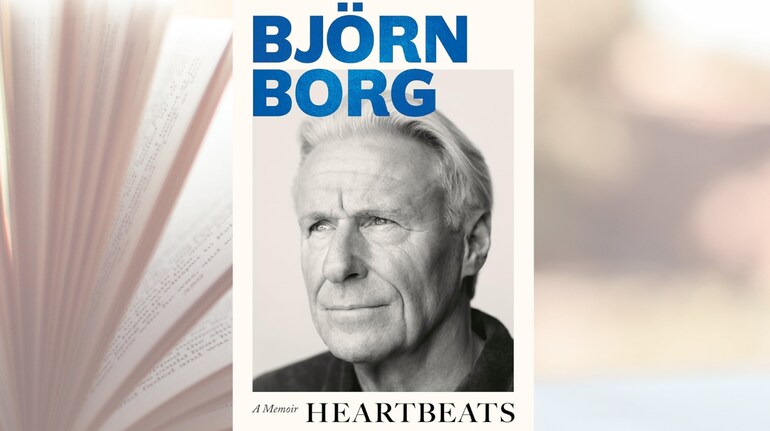
Excerpted with permission from the publisher Heartbeats: A Memoir, Björn Borg, published by Little, Brown/Hachette India.
*****
When I look back on the most successful years of my career, 1978 to 1981, strangely, the memories are fewer.
I can hardly tell one year from the next. It was just tennis, tennis, tennis, around the clock. As usual, I trained four hours a day, travelled, played matches, stayed at one hotel, then moved on to the next. Eat at the restaurant, get a massage, take a shower, go to sleep, wake up for breakfast, then it was time for another training session. I was never picky about food or service. I eat pretty much anything and I’ve always been an early riser. But during tournaments, I absolutely needed a cool, dark room to sleep in.
It was one match after another. Win after win. As soon as I won a match, my eyes were already on the next one. If I won a tournament, my focus instantly shifted to the next. Every Grand Slam win just made the next one feel even more important.
That’s how it went, non-stop, at a crazy pace. I coped with all the attention from fans and the press by keeping a low profile. I never enjoyed the spotlight much and I had no interest in putting my personal life on display. For me, standing in front of cameras and talking at press conferences was torture, I avoided it as much as I could. It wasn’t the attention itself that bothered me, people were generally kind and meant well, but it was harder with certain journalists. Some of them asked the same questions over and over again and tried to dig up stories that weren’t even true. That’s what really drained me.
The fans were different. Many were devoted, and I wanted to give them as much as I could, but even there, I had to start setting boundaries. I wanted to focus on playing my best tennis and spending time with my family and friends.
Was I able to enjoy my success? Yes and no. In one way, it gave me energy and a hunger to win the next match. I did take a moment to enjoy each win, but then I quickly moved on. Same with every point, I was always looking ahead. If I lost a point, I let it go immediately and focused on winning the next. It was the same with every ball – if I lost one, I immediately let it go and focused on winning the next. That ability to move on was my mental strength. Like after a perfect passing shot or a winning volley, I’d enjoy the feeling for a split second, then turn my attention to the next ball.
I was still a sore loser. I could sulk for ages and promise myself I’d never lose again, especially not to certain players. I hadn’t forgotten my vow to never lose to Ilie Năstase.
The crowd wasn’t just drawn to the game or the players any more. Now the tension between us had become part of the entertainment, and it was one reason tennis was booming. The rivalries and drama created headlines. First there was my battle with Jimmy Connors, when we were fighting for the top spot in the rankings between 1977 and 1979. Then came John McEnroe, challenging both Jimmy and me for the number one spot. Jimmy’s playing style was more like mine, while John was a classic serve-and-volley guy. Off court, they had completely different personalities.
Around 1979, some sort of unique relationship started form- ing between the three of us. But in those early years, Jimmy and John were my rivals more than my friends. It wasn’t until the senior tour in the ’90s that a real friendship grew between us, a warm and genuine one that’s lasted ever since.
But back then, during our playing years, Jimmy and John also had a rocky relationship with each other. In the beginning, Jimmy didn’t even like me much, either as a player or a person. The first time we’d met was in the semi-finals at the Royal Tennis Hall in 1973. He later told me that everything about me annoyed him, my appearance, my mannerisms, even the way I walked. But he accepted me somehow, and it blew over pretty quickly.
With John McEnroe, it was different. He burst onto the scene at Wimbledon in 1977, seemingly out of nowhere. Jimmy barely managed to beat him in the semis, this young slugger from New York. The fact that both were American made their dynamic even more interesting. At first, Jimmy was only mildly irritated, like you’d be with a cocky teenager – which John actually was. But around 1978, things escalated. It became clear John wasn’t just some flash in the pan, he was seriously challenging Jimmy’s dominance. The Americans have always cared about hierarchy, who’s ranked highest in the world, but this was also about who was number one in the US. That was tough for Jimmy. The competition at home was fierce.
They grew more and more annoyed with each other, and I, having got to know them both, somehow ended up playing the middleman. I was the calm and collected one. Whenever one of them started acting up, I was there to calm things down. I think they got used to me being the buffer between them, maybe they even liked it, because it allowed them to keep acting out. That was fine by me. I liked them both equally.
After I’d spent Christmas and New Year with Mariana and the family, the 1979 season kicked off. I was in good shape and went to the US to play a couple of tournaments: Richmond and New Orleans. While we were there, we also ramped up the search for a house. We wanted a place of our own on Long Island, just outside New York.
In Richmond, I faced John McEnroe again in the semi-finals. I was in real trouble – he had three match points against me in the final set – but I somehow managed to claw my way back and win. When we shook hands after the match, it was clear John was devastated by how things had flipped. I was unusually satisfied. It was sweet revenge after losing to him at the Stockholm Open the previous autumn.
After the semis, Labbe and I went back to the hotel to get ready for the final against Vilas. As soon as we arrived, I realised I’d forgotten my shoes at the arena. Being superstitious, I obviously wanted to wear the same pair in the final, so Labbe kindly offered to go back and get them. It was tough for him to get in, everything was locked and shut down, but Labbe doesn’t give up easily. He eventually tracked down someone who got hold of a janitor who let him into the locker room. To his sur- prise, the lights were still on, and there was John, sitting alone. He was deep in thought, clearly going over every detail of the match he had just lost.
Labbe, always thoughtful, asked if he was okay, but John didn’t even respond. When Labbe came back with the shoes, he told me John had been so lost in his thoughts he didn’t ac- knowledge him at all. I instantly knew what he must’ve been thinking about, sitting there by himself. Outwardly our rivalry looked fierce, but despite all the intense matches, we had huge respect for each other.
I won the final against Vilas – it was my first title of the year and the fortieth singles title of my career. I was on a roll. But as always, the celebration was short-lived. New Orleans was next, with pretty much the same field. I faced John again, this time in the final. He’d been on his best behaviour in the previous tournaments, but maybe that loss from the week before was still haunting him, because now it was like the demons had taken over. He went completely nuts, like someone had let him out of an asylum, as we used to say. It wasn’t fun for anyone, not for him, not for me, and definitely not for the crowd. But we kept playing, and I was up 4–1 in the final set. I just wanted to finish the match and get out of there. Then he had another meltdown, yelling, smashing his racket, muttering, complaining about every call.
I walked up to the net and motioned for him to come over. He must’ve thought I’d lost my mind. Why would I call him over? But he trudged up in that trademark way of his, and I calmly said: ‘John, it’s only a game.’
It was advice I could’ve just as easily given myself. And maybe I shouldn’t have said it, because from that point on, the match turned. He saved three match points on his serve and eventually won. Still, I think that’s when I earned John’s respect. Maybe that was the moment our lifelong friendship really began.
**********
Björn Borg, Heartbeats: A Memoir, Little, Brown/Hachette India, 2025. Pb. Pp.304
No one had ever played tennis quite like Björn Borg. With his incredible athleticism, powerful shot-making and distinctive style, he became a sensation after he burst onto the scene aged just 15. As he ascended to the pinnacle of men's tennis, Borg experienced unprecedented stardom and success that changed the game forever.
Hailed as one of the most talented players to ever step onto a tennis court, Borg collected the game's highest honours, including eleven Grand Slam titles - with five consecutive Wimbledon titles — establishing himself as one of the greatest of all time. Then he stunned the sporting world by announcing his retirement at the age of 26 and disappeared from tennis.
After all these years of silence, Borg is ready to share everything. In this candid memoir, Borg takes us through all the major moments in his career, shares insights into his rivalry with John McEnroe — considered one of the best in the sport's history — and their legendary 1980 Wimbledon final, and explains his shock retirement. Borg writes candidly about his personal life — for so long kept under wraps - including his childhood, his early stardom and his uncomfortable relationship with fame, alongside all the highs and lows of his unmatched career.
For the first time, readers will get Borg's own account of his career, his choices, and the experiences that shaped him as a person, from his childhood right up to today. This look behind the curtain at an enigmatic player who has fascinated generations of tennis fans, is ultimately a fascinating look at the making of sporting legend and, for readers who know nothing about tennis, a rare glimpse into an extraordinary, compelling life.
Björn Borg is a Swedish former professional tennis player. He was ranked as the world No. 1 in men's singles for 109 weeks. Borg won 66 singles titles during his career, including 11 majors (six at the French Open and five consecutively at Wimbledon). A teenage sensation at the start of his career, Borg experienced unprecedented stardom and consistent success that helped propel the rising popularity of tennis during the 1970s. His rivalries with Jimmy Connors and John McEnroe became cultural touchstones beyond the world of tennis, with the latter rivalry peaking at the 1980 Wimbledon final, considered one of the greatest matches ever played. This is his first memoir.
Discover the latest Business News, Sensex, and Nifty updates. Obtain Personal Finance insights, tax queries, and expert opinions on Moneycontrol or download the Moneycontrol App to stay updated!
Find the best of Al News in one place, specially curated for you every weekend.
Stay on top of the latest tech trends and biggest startup news.