
The Fino Payments Bank stock has taken a bit of a knock after the Reserve Bank of India earlier this month granted it in-principle approval to convert into a small finance bank (SFB). While this is a leg up for the company, the stock market hasn’t taken the development kindly considering the stress SFBs are going through.
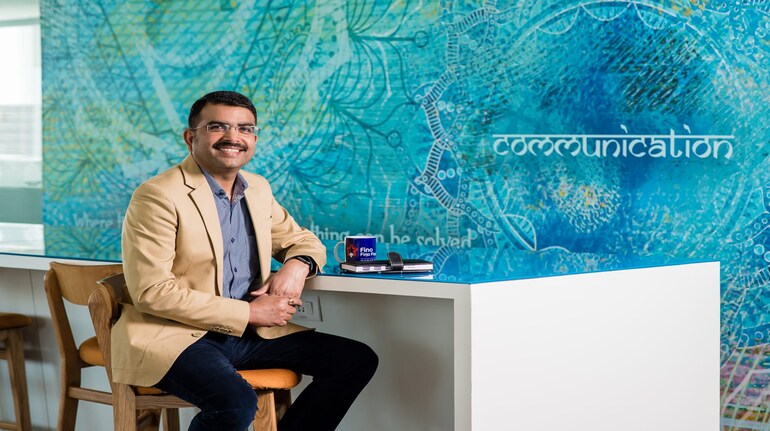
In an interview to Moneycontrol, Fino Payments Bank managing director and chief executive officer Rishi Gupta tries to address some of investor concerns, including difficulty in mobilising liabilities, potential asset quality issues and capital raise. Edited excerpts:
Your stock price didn’t initially take the news of SFB approval kindly. Did it surprise you?
Yes. It did. In the run-up to the SFB licence, we could see the stock moving up. But after the in-principle approval for SFB was granted, we were expecting that it will continue to move up, but we understand may be some profit booking is happening at this stage. As the market starts to understand us better, people will start to see that Fino SFB will be differentiated. It’s going to have a very vibrant payment ecosystem with base of Rs 1700 crore of fee based revenue, and will offer lending along with it.
One of the concerns for investors is that you have a potent business correspondent model making reasonable margins and net profit. When you convert to a bank, there would fight for deposits, growth and your return ratios may look very different. How do you want to address this concern?
Fino’s story has always been very different from the time we moved from a BC to a payments bank. We have not followed the standard path as such and we have always figured out what is the best from a bottom-line point of view. Fino will not digress or move away from the profitability agenda and not become lending only institution.
We will continue to push on the bottom-line thought process. One of our DNA is that we are very profit-centric and we want to continue to relate to the value that the ecosystem and not going to be a pure play SFB.
We had roughly about Rs 1,800 crore of topline last year from transactions. That business is not going away and will continue to grow. In the next three years, post-operationalisation of the bank, 75 percent or so of the business is likely to come from our existing network of branch, merchants and transaction platform. We are not trying to build a very standard SFB.
How you would you differentiation yourself from other SFBs?
One is that we have a variable cost structure through our extensive distribution network. I don't think any SFB would have such a vast distribution covering the entire country.
Secondly, our technology mindset. We are moving away from our old core banking system (CBS) to our new Finacle platform. A lot of our existing lines of technology, which are inside the CBS, are now moving away and outside the core, so that will give us the speed, scale, security, and the ability to build lot of APIs around it.
Third is our digital mindset. We have our FinoPay mobile banking app and nearly 60 lakh of our 1.6 crore customers are on UPI platform. It is probably the largest customer base of any bank on a UPI platform. If I add technology and digital together, I think we are trying to build a lot of tools.
The fourth differentiation is our ability to raise liabilities. We have a liability base of Rs 3,000 crore of deposits, which is a very good start. We add about Rs 600-800 crore of deposit every year. We have already started to paddle a lot on liability because we have been working on it for the last two years.
Our fifth differentiation is the cost of funds. Most SFBs operate at a cost of funds of 7.5-8.5 percent. Our cost of fund is about 2 percent. Going forward if I take a three year horizon, it will probably double to 3.5 – 4 percent. Yet, our average cost of fund will be about 3.5–4 percent lower than existing SFBs. Fixed deposit in the overall scheme may be about 25 percent of the total deposit. So even at 7 percent FD rate, the blended cost will still be low.
We don't want to build up a very heavy fixed asset, fixed cost kind of a structure. Good part with Fino is that we have liability experience and have a zero MFI experience. We don't want to go into MFI and the ecosystem is now moving towards secured loans. We don't want to offer much unsecured loans and our concentration on the secured asset products is expected to be 70-80 percent of our portfolio.
The seventh differentiation is in terms of the way we are going to build up that ecosystem. We are not starting from zero in the initial phase and we have done the data journey. Our data shows that nearly 33 – 40 percent of our customers and merchants already in some form have a loan from some other entity. Our existing customer and merchant ecosystem, therefore, will be our first go to customer.
What is the loan book you are targeting in Year 1 of the SFB getting operational?
In three-four years from operationalisation as SFB, we are aiming at Rs 8000-10,000 crore of loan book. Largely about two-thirds or more would be secured and our ability to raise liabilities will be around Rs 13,000-15,000 crore. We don't expect to cross more than 70-75 percent of credit deposit ratio.
The bank’s RoA will be 2-2.5 percent and RoE of 20 percent plus. Fino has been very good on executing its strategy in the past.
The in principle-approval has come at a time when you are collapsing the holding company structure. What happens to that process?
That will have to wait, because under the SFB scenario, as it is a new licence, there is a condition that for five years the promoter has to hold a minimum 40 percent share in the bank, and in the subsidiary. Right now, our holding company has 75 percent shareholding in the bank. The structure cannot be collapsed because of the minimum 40 percent shareholding requirement. We have to out that process on.
A recent report mentioned that some investors have to reduce their stake because of the SFB in-principle approval. Can you explain that?
I think it was not properly understood. No investor has to reduce their stake and there will be no change at the bank level. Fino Paytech holds 75 percent of Fino Payments Bank and 25 percent of Fino Payments Bank is with public, and we are a listed company. There is no change at the shareholding level of Fino Payments Bank. Fino Paytech will continue to hold 75 percent and public will hold 25 percent.
RBI regulation says that for at least five years, Fino Paytech should hold a minimum of 40 percent. There is no direction to reduce it from 75 percent to 40 percent now or anytime. That is a business decision. The only change will be from within Fino Paytech. There could be some shareholder change which will happen, but nothing to do with the bank.
Are you considering a capital raise?
From a regulatory point of view, we don't need capital. Our capital adequacy ratio now is at 75 percent. SFBs need a minimum of Rs 300 crore of networth. We have upwards of Rs 700 crore. So, regulatory requirement to raise capital is taken care of.
In terms of business requirement, for the first three years of operations we are adequately covered. During the journey, if from a growth point of view, there is an opportunity to raise capital we will explore it.
The biggest issue with SFBs is lack of scale. Considering the size you are aspiring, you won’t have the advantage of scale. How do you address this issue?
I think this is something which the existing SFBs have to answer more than I should. We will always have a very cautious approach when it comes to lending. Just to build up scale we are not going to take reckless decisions, and we are not going to do anything in haste.
What we want to build is a quality bank and dovetail cautious lending our running engine of payment products. Scale will come over a period of time.
Would you be open to acquisitions within the SFB space?
Every bank company, has their own DNA, and many times, in the zeal to have a big balance sheet, you do M&A, and then you struggle for the next two-three years to master the DNA. We are coming from a very different DNA compared to the existing SFBs. We don't think there is any possibility of an inorganic option within the SFB space. We may explore options like tech companies who have gone into lending. They have a good stack, but don’t understand business well. That is something which can come up.

Discover the latest Business News, Sensex, and Nifty updates. Obtain Personal Finance insights, tax queries, and expert opinions on Moneycontrol or download the Moneycontrol App to stay updated!
Find the best of Al News in one place, specially curated for you every weekend.
Stay on top of the latest tech trends and biggest startup news.