
Artificial Intelligence (AI) is no longer being framed as experimentation but as execution. That's the big takeaway in an otherwise largely muted December quarter for Indian IT giants.
Across the top five, management commentary reiterated this: while traditional discretionary tech spending is still sluggish and clients remain cautious on non-essential projects, AI is moving from experimentation to operational deployment, shaping deal pipelines, delivery models, and hiring priorities.
“If you look at the AI revenues, the growth is coming from across verticals, and these are business-impacting programs that we are delivering for our customers. If you really look at 2025, I think the adoption in our customer landscape has significantly increased, where we have now shifted from experiment PoCs (Proof of Concepts) and pilots to really RoI (Return on Investment)- led, scaled implementations, and that's what is driving this growth,” said the Chief Executive of India’s largest IT services company, Tata Consultancy Services (TCS), K Krithivasan on January 12.
The above statement makes it crystal clear that without AI is the biggest force multiplier now and will be going forward.
He was seconded by India’s second-largest IT services company’s chief, Salil Parekh.
“The way we have become the AI partner of choice with our largest clients, we see a good outlook even as we look into the next financial year, and that's in part helped us to increase the guidance,” Salil Parekh, CEO, Infosys, said while addressing the post-earnings press conference.
This is visible in numbers, too: Infosys, HCLTech, and Wipro have either revised or raised their revenue guidance in this. Although TCS and Tech Mahindra do not provide revenue guidance, their management commentary is betting big time on AI.
To be sure, the guidance is still below 5 per cent, and the sector is still not out of the woods, but one can imagine what the condition would be had AI not been in the picture.
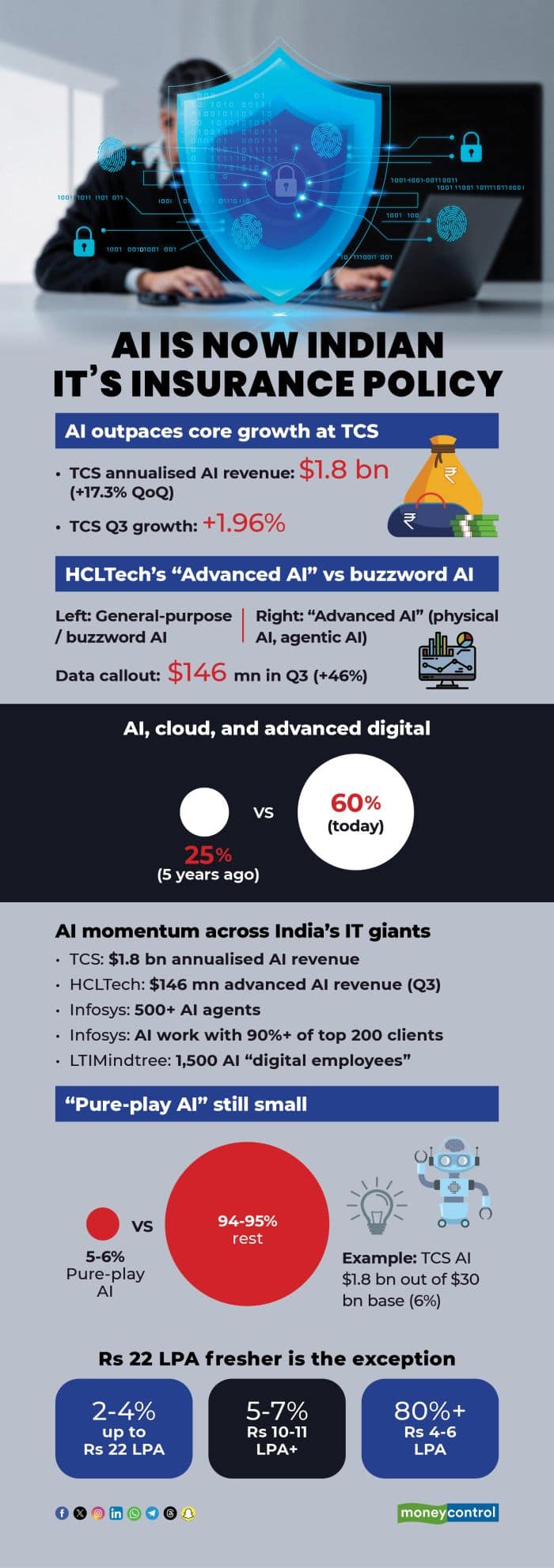
Overall, the revenue mix from AI, cloud, and advanced digital services has risen sharply, from about 25 percent five years ago to nearly 60 percent today, according to data accessed by Moneycontrol from staffing firm Quess Corp.
Also read: Five years of Techade: AI lifts productivity, caps headcount, reshapes IT cost structures
Wipro Chief Executive Officer Srinivas Pallia, on January 16, captured that tone directly, saying organisations are “reshaping priorities as AI influences how they plan, invest, and operate”, and that AI is now a “standing board level mandate led by CEOs” who see it as the lever to “unlock productivity” and create lasting competitive advantage.
In Q3, that framing has become crucial for the sector at a time when the traditional drivers of revenue expansion, like large discretionary transformation programs, remain uneven.
AI revenue grows faster than core business
The contrast was most visible in Tata Consultancy Services’ numbers. The company’s annualised AI revenue jumped 17.3 percent sequentially to $1.8 billion, the IT services firm said on January 12, outpacing its December quarter growth of 1.96 percent by a wide margin.
This jump was not a sudden spike but the latest sign of an expanding runway. During the company’s Analyst Day 2025 in December, Krithivasan said TCS had clocked $1.5 billion in annual AI revenue and had worked on over 5,500 AI projects to date.
HCLTech, meanwhile, has drawn the line between ‘Advanced AI’ and buzzword AI as Q3 revenue increased by 46 percent to $146 million. In contrast, its revenue increased a little over 13 percent from a year earlier to Rs 33,872 crore in the quarter.
The Noida-headquartered firm has sought to differentiate its AI story from the general market hype, saying its growth is being driven by what it calls “Advanced AI” rather than the broader, general-purpose AI that much of the industry is currently talking about.
Though other major IT firms did not disclose AI revenue in the same way, their commentary suggested that AI adoption is broadening and that enterprises are shifting from experiments to implementation across core operations.
India’s second-largest IT services firm has not offered standalone AI revenue numbers, but it has highlighted adoption depth and AI-led execution across its largest accounts. Infosys said it now has over 500 AI agents and is doing AI work with more than 90 percent of its top 200 clients, pitching itself as an “AI partner of choice” for large enterprises.
“They’re (clients) using agents in several of our service lines to help enhance either growth or productivity,” Parekh said during the company’s post-earnings press conference on January 14.
He added that Infosys’ usage of agents is spreading across its service lines and that the company sees a strong base of AI work among its largest clients. He also pointed to Generative AI’s role in delivery output, saying Infosys has generated over 28 million lines of code using Gen AI so far, a 12 percent increase sequentially.
Also read: From 4 weeks to 5 days: How Infosys’ AI agents are boosting enterprise operations
Beyond the top three, the AI-first messaging is also showing up in companies such as LTIMindtree, which has built about 1,500 AI-powered “digital employees”, deploying them across finance, infrastructure operations and customer service, as it pushes for nonlinear growth in the AI era.
CEO Venu Lambu told Moneycontrol earlier that the company has created “digital personas” that come with an employee ID, a persona and an AI-generated face.
AI is everywhere, but “pure-play AI revenue” is still small
One of the most persistent questions around the AI surge is deceptively simple: how much money is AI actually bringing in, and is it meaningful relative to overall IT services revenue?
Gaurav Vasu, founder and CEO of tech research and advisory firm UnearthInsight, estimates that pure-play AI revenues remain a small share of overall IT services revenues, typically under 5 to 6 percent. He points to TCS as an example: $1.8 billion in AI revenue against a revenue base of $30 billion implies about 6 percent contribution.
Similar proportions were earlier visible at Accenture before it stopped reporting standalone AI revenues.
But Vasu argues this does not reflect weak AI demand. The real story, he says, is that AI and Gen AI are increasingly embedded across deals from digital transformation, application development, infrastructure support and managed services, which makes it structurally harder to separate AI as an independent revenue stream.
That view is echoed by another analyst firm tracking the IT services market closely.
Gaurav Parab, Principal Research Analyst at NelsonHall, told Moneycontrol that there is no consistent way to define or report “pure-play AI revenue” today because AI is being embedded across application development, testing, operations and platform services rather than being sold as a standalone line item.
Moreover, Gen AI is influencing the entire delivery lifecycle, similar to how automation and traditional AI were absorbed earlier, making attribution difficult.
Also read: How AI is helping Indian IT do more with less
Further, Tech Mahindra has highlighted a similar challenge of attribution, with the company pointing to the way Gen AI is increasingly embedded into delivery, making it harder to define “pure-play AI” as a separate revenue bucket.
Over the next two years, Parab expects AI to be discussed less as a separate revenue bucket and more as a productivity and margin driver embedded within core services.
The hidden change: Project teams are getting leaner, more skill-dense
The operational impact of AI for Indian IT is likely to be as significant as the revenue opportunity. While the sector is not signalling a collapse in demand for human engineers, it is signalling a shift in skill requirements and productivity expectations.
Project teams are becoming leaner and more skill-dense, with fewer junior resources and a higher proportion of experienced engineers overseeing AI-assisted workflows, analysts say. There is reduced dependence on large junior teams, greater use of AI copilots, and agentic tools for coding, testing and documentation, and stronger emphasis on human-in-the-loop governance and validation.
Also read: Cognizant calls time on the IT era, bets future on AI built delivery
Tech Mahindra has also signalled early experimentation with hybrid delivery models where human teams work alongside AI agents, sometimes reflected in hybrid pricing constructs.
The common thread is that AI is not just making delivery faster but is changing what delivery looks like.
Hiring shifts from volume to value, but the Rs 21-22 LPA fresher remains rare
The talent impact of AI is becoming visible in how companies hire and how they pay.
Also read: Infosys hikes entry-level salaries, offers up to Rs 21 lakh for graduates in specialised roles
Neeti Sharma, CEO of TeamLease Digital, says the focus for most of the IT industry is moving away from volume hiring to value hiring, with demand increasing month-on-month for data engineering, cloud, cybersecurity, MLOps and domain experts coupled with domain skills.
However, Sharma flags a supply-side constraint. She estimates that there is only one qualified engineer for every ten generative AI roles available in India.
Also read: Bengaluru AI engineers earn up to Rs 48 LPA with 8 years of experience
Because of this gap, she says companies are being selective about external hiring and are investing heavily in training their existing teams. This is also where the high-fresher salary headlines come in.
Fresher salaries up to Rs 22 lakh per annum exist, but apply to a very small proportion of freshers, roughly 2 to 4 percent.
These offers are typically for specialised roles in AI, deep tech, or advanced engineering, sourced from select campuses or through tough screening and internal assessments.
She estimates that about 5 to 7 percent manage to get offers above Rs 10 to 11 lakh, largely for niche AI, cloud or product engineering roles, while the majority, over 80 percent, still start in traditional IT roles with packages in the Rs 4 to 6 lakh range.
UnearthInsight’s Vasu gives a similar assessment, estimating that only around 3 to 5 percent of fresher hiring across the top five Indian IT services firms falls into digital, AI and specialist engineering tracks that command Rs 9 to 22 lakh per annum.
The bulk of hiring, he says, remains in core IT delivery roles with salaries typically between Rs 3 to 7 lakh.
The bigger shift: AI
The Q3FY26 quarter is less about a single quarter’s growth rate and more about where momentum is building.
AI is not being positioned as an add-on; it is becoming the layer through which companies are trying to defend relevance, protect margins, and find new growth curves.
Also read: Infosys, HCLTech CEOs call for an overhaul in IT business models amid AI disruption
In 2026 and beyond, the winners may not be the firms that merely deploy AI tools, but those that reshape delivery, talent, and pricing models fast enough to capture AI’s value before clients push the productivity gains back into cost cuts.
“As digital transformation accelerates, IT service providers are expected to see strong revenue growth, with AI spending projected to increase by 44% in 2026,” according to Biswajit Maity, Sr Principal Analyst at Gartner.
Also read: From IT legacy to AI future: Inside Covasant’s Agentic AI ambitions



Discover the latest Business News, Sensex, and Nifty updates. Obtain Personal Finance insights, tax queries, and expert opinions on Moneycontrol or download the Moneycontrol App to stay updated!
Find the best of Al News in one place, specially curated for you every weekend.
Stay on top of the latest tech trends and biggest startup news.