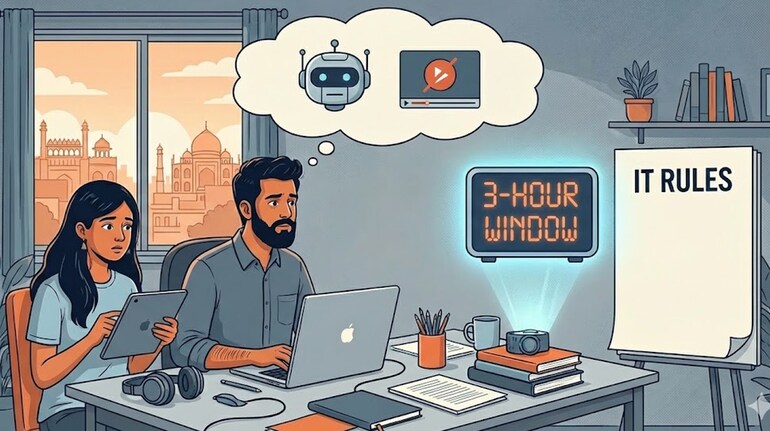
A new three-hour deadline to remove flagged content is sending ripples of concern through India’s creator economy.
On February 11, the Ministry of Electronics and IT notified amendments to the Information Technology (Intermediary Guidelines and Digital Media Ethics Code) Rules, 2021, slashing the earlier 36-hour takedown window to just three hours. The move is aimed at curbing the rapid spread of unlawful content, particularly AI-generated deepfakes and harmful material — but creators say the compressed timeline leaves little room for nuance or error.
Content creator Ekta Makhijani calls the new deadline “incredibly tight.”
“If my video gets wrongly flagged during a brand campaign launch, I could lose the entire campaign window,” she said. “Automated systems make quick calls, and mistakes will happen.”
She warned that false positives are a real risk, especially in categories like parenting content. “Posts about sleep deprivation, toddler tantrums, or breastfeeding struggles can be misinterpreted by AI moderation. I’ve had innocent breastfeeding education content flagged before — and that was with a 36-hour review window. Now imagine having only three hours to respond.”
For creators dependent on time-sensitive brand campaigns, wrongful removal could mean missed deliverables, contractual disputes and revenue losses.
Influencer and founder of apparel brand akute Akanksha Kommirelly echoed similar concerns. “What if a product campaign gets wrongly reported during a crucial launch? Three hours isn’t enough for proper review. This could directly impact sales and brand reputation.”
She also pointed to operational challenges. “As a founder juggling multiple responsibilities, responding to a 2 AM notice within three hours is unrealistic. Larger brands may have 24/7 legal teams. Small businesses don’t.”
Speed vs due process
Creators like Kommirelly said that they support swift action against genuinely harmful content such as deepfakes, child sexual abuse material (CSAM), or non-consensual imagery. The concern, however, is applying a blanket three-hour rule across all content categories.
Creator Deepak Wadhwa acknowledged that while the objective is to limit harm from illegal content spreading quickly, the compressed timeline could create stress, especially when automated systems flag content incorrectly.
The three-hour takedown window increases the pressure on platforms to act quickly, which may lead to precautionary removals in cases where content appears synthetic or is misinterpreted, Rohit Goyal, Director, Taggify Media, said.
Industry executives argue that platforms will likely overcorrect to avoid liability, potentially suppressing legitimate content including satire, parody, political commentary and creative expression.
With India’s linguistic diversity — 22 official languages and countless dialects — automated moderation systems trained largely on English may struggle with regional nuance, noted Ritesh Ujjwal, Co-Founder, Kofluence. "A satirical Tamil video or Marathi parody, experts say, could be misread and removed before context is understood."
“The incentive becomes: take down first, ask questions later,” said Raj Mishra, MD and CEO of Chtrbox. “That’s especially problematic for satire or investigative content. By the time any review happens, the news cycle has moved on.”
Suyash Lahoti, Partner at Wit Chai Group, said the rule forces creators to shift from reactive to preventive thinking. “Pre-publication checks, clearer sourcing, and avoiding grey-zone formats like impersonation or misleading lookalikes will become essential.”
The chilling effect
Beyond immediate financial risks, agencies warn of a broader chilling effect. When content can disappear within hours, creators may self-censor, particularly those working in social commentary or advocacy.
Micro and nano influencers may be especially vulnerable, lacking legal representation or dedicated compliance teams, Mishra said.
AI labelling: Another layer of complexity
Alongside the takedown rule, mandatory AI labelling requirements are also reshaping workflows.
Kommirelly noted that prominent AI labels could dilute campaign aesthetics. “For fashion brands, branding is highly visual. A permanent AI tag doesn’t differentiate between 5% AI assistance and 95% AI-generated content.”
Mishra warns that algorithmic treatment may pose a bigger risk than viewer perception. " If platforms start de-prioritizing AI-labeled content that will impact the reach of a content more than audience sentiment," he said.
Agencies step in
Agencies are now scrambling to build compliance infrastructure.
Kofluence is developing guides defining AI-generated content, compliance checklists, workflow templates and faster communication channels with platforms. It has also introduced a Risk Mitigation Framework that includes documentation protocols, pre-upload compliance reviews, legal support networks and even exploring insurance options for campaign disruptions.
Chtrbox is rolling out creator education programmes to make compliance “seamless rather than burdensome,” Mishra said.
A regulatory balancing act
The creator community largely agrees on the need to curb harmful and illegal content. The debate lies in balancing speed with fairness.
As Mishra put it, there is a need for a calibrated approach: emergency timelines for clearly illegal content, but reasonable review processes for contested speech. "Right now, the system prioritizes speed over fairness with minimal accountability."


Discover the latest Business News, Sensex, and Nifty updates. Obtain Personal Finance insights, tax queries, and expert opinions on Moneycontrol or download the Moneycontrol App to stay updated!
Find the best of Al News in one place, specially curated for you every weekend.
Stay on top of the latest tech trends and biggest startup news.