

co-presented by
ASSOCIATE SPONSORS
co-presented by


ASSOCIATE SPONSORS







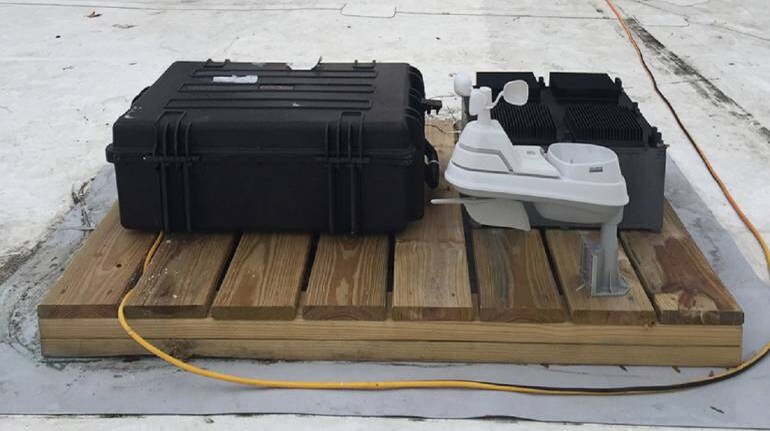
A team of researchers and students from Massachusetts Institute of Technology has developed a novel thermoelectric device which converts temperature fluctuations into electrical power.
The system of devices called thermal resonator, which has three components—a weather monitoring system (white in picture), a black boxed test device and an equipment to monitor its performance (bigger black box in picture)—takes advantage of the swings in ambient temperature that occur during the day-night cycle. This is unlike the other thermoelectric devices which require two different temperature inputs at the same time.
Though the power generated by the device is not significant, it could enable continuous, years-long operation of remote sensing systems, for example, without requiring other power sources or batteries, the researchers say.
“We basically invented this concept out of whole cloth,” Michael Strano, one of the members of the team working on it, says. “We’ve built the first thermal resonator. It’s something that can sit on a desk and generate energy out of what seems like nothing. We are surrounded by temperature fluctuations of all different frequencies all of the time. These are an untapped source of energy.”
Interestingly, the device can be kept virtually anywhere as it does not need direct sunlight and generates energy from ambient temperature changes, even in the shade.
That means it is unaffected by short-term changes in cloud cover, wind conditions, or other environmental conditions, and can be located anywhere that’s convenient — even underneath a solar panel, in perpetual shadow, where it could even allow the solar panel to be more efficient by drawing away waste heat, the researchers say.
The thermal resonator, during testing, outperformed an identically sized, commercial pyroelectric material by a factor of more than three in terms of power per area, according to Anton Cottrill, lead author of the study.
The team created a carefully tailored combination of materials to make the device work. The component of the material includes a metal foam, made of copper or nickel, which is then coated with a layer of graphene to provide even greater thermal conductivity.
A test showed that with a 10-degree-celsius temperature difference between night and day, the tiny sample of material produced 350 millivolts of potential and 1.3 milliwatts of power — enough to power simple, small environmental sensors or communications systems.


Discover the latest Business News, Sensex, and Nifty updates. Obtain Personal Finance insights, tax queries, and expert opinions on Moneycontrol or download the Moneycontrol App to stay updated!
Find the best of Al News in one place, specially curated for you every weekend.
Stay on top of the latest tech trends and biggest startup news.