Liu Miao once sold thousands of dresses on Amazon to wholesale buyers in the United States. But in the span of a few weeks, the business he built over five years has crumbled, undone by a sweeping shift in US trade policy under President Trump, the New York Times reported.
From his small garment factory in Guangzhou—long the heart of China’s clothing manufacturing sector—Liu watched his profit margin shrink from $1 per item to just 50 cents after Trump’s latest tariffs and tax rules kicked in. “You can’t sell anything to the United States right now,” Liu said, gesturing toward workers packed into a labour market near his motorbike. “The tariffs are too high.”
Tariffs upend Guangzhou’s e-commerce export boom
Online platforms like Amazon, Shein, and Temu once made Guangzhou’s apparel makers global players. These services allowed thousands of Chinese factories to bypass traditional retail channels and sell directly to American shoppers, exploiting a tax exemption that let packages under $800 enter the US duty-free.
That loophole helped fuel a boom in Chinese exports and supported millions of factory jobs. But now, the very supply chain that made China an e-commerce powerhouse is under strain. The new US policy not only imposes steep tariffs but also ends tax-free entry for low-value shipments, drastically increasing costs for sellers.
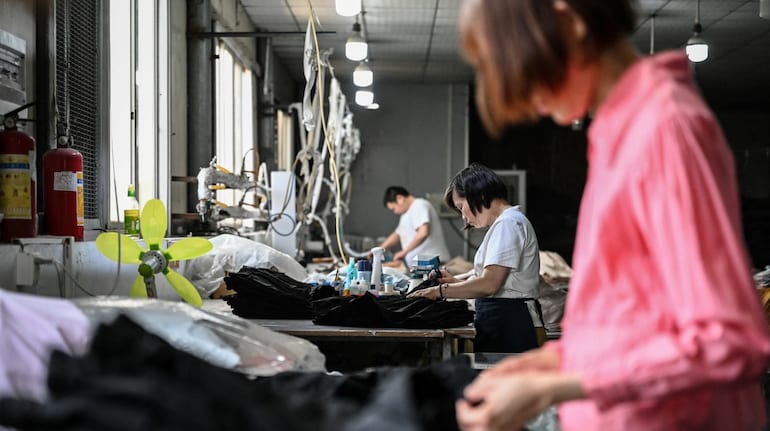
Guangzhou’s garment district, once bustling with activity and lined with foreign luxury cars, now tells a different story. As US orders collapse, many manufacturers are slashing production, closing operations, or relocating to cheaper provinces like Jiangxi or Hubei. Some are even eyeing countries like Vietnam—until they too became subject to new US tariffs.
‘A tipping point’ for Chinese small factories
Zhang Chen, a former retail store owner from Hubei, shuttered his six shops after foot traffic dried up post-COVID. Now, he earns a living delivering garments to Shein drop-off centres near Guangzhou’s airport, making about $100 a day. “By 2022, it looked like [business] was never coming back,” he said.
For Liu Bin, who specialized in beach dresses and date-night tops for Shein, the situation became dire in April when orders halved. His sprawling factory—where Shein once bought up to 100,000 pieces a month—had to be shut down. He has moved his production to Jiangxi, where rents are lower.
“Shein offered incentives to move to Vietnam,” Liu said. “But then the tariffs on Vietnam got even higher, too.”
Domestic demand can’t fill the gap
With US sales plummeting and export lifelines disappearing, Beijing is now urging factories to pivot to the domestic market. But that’s easier said than done.
China’s consumers are spending cautiously after the real estate collapse, and factories accustomed to exporting are struggling to generate local demand. “It’s very difficult to make the same money selling in China,” Liu said.
Temu announced Friday it would stop shipping directly from China to US customers, acknowledging the scale of the disruption. Meanwhile, Shein declined to comment.
At Guangzhou’s Canton Fair, Han Junxiu, who sells fluffy novelty socks online, remained sceptical. “I just don’t think it’s that realistic,” she said, referring to the US’s ability to process millions of new low-cost imports under the new rules. “Where else are they going to buy all this?”
Uncertainty and shutdowns ripple across the city
Nine factory owners and managers interviewed by The New York Times described a bleak mood. Some have paused production lines, others have laid off workers or watched neighbouring shops close. The bustling labour markets, once overflowing with job offers, are now filled with anxious workers and fewer opportunities.
“This used to be a booming business,” Liu said, glancing at the dress sample on his handlebars. “Now we are only waiting and watching.”
Discover the latest Business News, Sensex, and Nifty updates. Obtain Personal Finance insights, tax queries, and expert opinions on Moneycontrol or download the Moneycontrol App to stay updated!
Find the best of Al News in one place, specially curated for you every weekend.
Stay on top of the latest tech trends and biggest startup news.