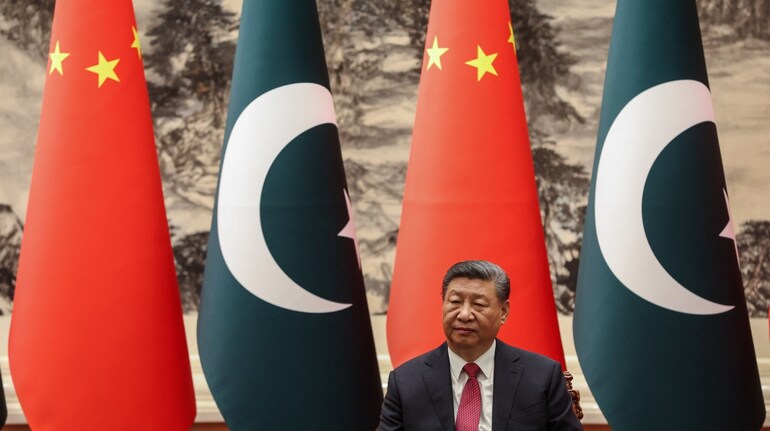

Pakistan Prime Minister Shehbaz Sharif has announced that Chinese President Xi Jinping will visit Pakistan in the near future, a move that underscores Islamabad’s continued dependence on Beijing even as it simultaneously courts Washington. The announcement comes amid Pakistan’s deepening economic distress, mounting security failures, and growing strategic contradictions.
While Islamabad projects the visit as a boost to economic cooperation under the China-Pakistan Economic Corridor, New Delhi sees a familiar pattern of debt-driven promises, questionable sovereignty arrangements, and infrastructure projects that directly challenge India’s territorial claims. The timing of Xi’s proposed visit also highlights Pakistan’s attempt to balance China against improving ties with the United States, a tightrope that has historically left Islamabad diplomatically exposed and strategically unreliable.
Pakistan pitches CPEC 2.0 amid economic stress
Addressing the Pak-China Investment Conference in Islamabad, Sharif said Xi’s visit would focus on CPEC 2.0, calling it a “new chapter” centred on agriculture, information technology, artificial intelligence, mining and youth development. He claimed Pakistan could rapidly transform its agriculture sector by adopting modern Chinese technologies and expertise.
Sharif stressed that with nearly 65 percent of Pakistan’s population living in rural areas, Islamabad must push for higher agricultural yields and competitive exports. He said China had signalled readiness to stabilise bilateral trade at around $1 billion while ensuring Pakistan continues to enjoy a trade surplus, a claim that glosses over Pakistan’s widening external deficits and dependence on Chinese credit.
Security failures cast shadow over China ties
Behind the optimistic rhetoric, Beijing has repeatedly raised concerns about Pakistan’s inability to protect Chinese nationals. Around 90 Chinese citizens working on CPEC-linked projects have been killed in Pakistan since 2014. During the recent China-Pakistan Strategic Dialogue in Beijing, Chinese officials reportedly pressed Islamabad for stronger security guarantees, highlighting Pakistan’s failure to deliver a safe operating environment.
Islamabad’s double game with Washington
Xi’s expected visit coincides with Pakistan’s renewed outreach to the United States, including high-profile engagements by former Pakistan Army chief Asim Munir in Washington. Reports suggest discussions touched on US regional security interests, including Gaza, underscoring Pakistan’s habit of leveraging geopolitical tensions to extract relevance and aid.
India rejects China-Pakistan claims on Shaksgam Valley
The visit also comes amid a sharp India-China exchange over China-backed infrastructure projects in the Shaksgam Valley, a region illegally ceded by Pakistan to China in the 1960s. India has categorically rejected Chinese construction under CPEC in the area, calling it illegal and invalid. The Ministry of External Affairs reiterated that the region is an integral and inalienable part of India and that New Delhi does not recognise the so-called CPEC.
China, in turn, defended its boundary agreement with Pakistan and claimed the right to build infrastructure on what it calls its own land, a position India has consistently rejected as unlawful.
From New Delhi’s perspective, Xi’s proposed visit reinforces a troubling axis built on strategic convenience, territorial violations and economic overreach, with Pakistan acting as a willing conduit and China as the primary beneficiary.
Discover the latest Business News, Sensex, and Nifty updates. Obtain Personal Finance insights, tax queries, and expert opinions on Moneycontrol or download the Moneycontrol App to stay updated!
Find the best of Al News in one place, specially curated for you every weekend.
Stay on top of the latest tech trends and biggest startup news.