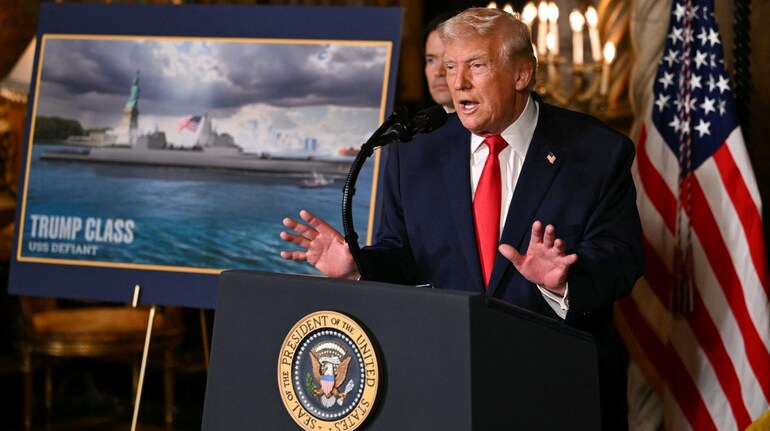
US President Donald Trump and Vice President JD Vance this week insisted that the War Powers Resolution, the 1974 law designed to limit a president’s ability to wage war without Congress, is unconstitutional and always has been. The claim came as the US Senate advanced a resolution that could restrict further American military operations in and against Venezuela.
It is a bold argument. It is also deeply misleading, the New York Times reported.
While some parts of the War Powers law have long been disputed by presidents of both parties, other sections including the one now being used by the Senate have been widely accepted as legal, even by the executive branch itself.
Understanding why requires a closer look at what the law actually says and how it has been interpreted over the past five decades.
A law born out of Vietnam
US Congress passed the War Powers Resolution in 1974, over President Richard Nixon’s veto, in response to the Vietnam War and years of undeclared military conflicts. Lawmakers wanted to reclaim their constitutional role in deciding when the United States goes to war.
The law is not a single rule. It is a package of different provisions, each dealing with a different part of the war powers debate.
One section says presidents should consult Congress “in every possible instance” before sending troops into hostilities. Another says presidents may only use force without congressional approval in very limited circumstances, such as when the US is under direct attack. Another requires the White House to notify Congress when troops are deployed. And one provision says forces must be withdrawn after 60 days if Congress has not approved the mission.
There is also a mechanism that allows Congress to vote to end an unauthorized military operation.
That structure matters because different parts of the law have very different legal histories.
What presidents have really objected to
Two major Justice Department opinions, issued in 1980 and 1993, still serve as the executive branch’s most authoritative legal views on the War Powers Resolution.
Both rejected Congress’s narrow definition of when a president may use force without permission. They argued that this part of the law unconstitutionally tries to limit the president’s powers as commander in chief. Every president since has, in practice, ignored that restriction.
In that narrow sense, Trump and Vance are partly right.
But those same legal opinions also said other parts of the law are constitutional, including the consultation and reporting requirements. They also left open the possibility that the 60-day withdrawal rule could be valid, even though presidents have usually tried to avoid admitting it applies to any specific conflict.
In other words, the War Powers Resolution has never been treated as one big unconstitutional block.
The withdrawal power Congress is using now
The most important issue in the current fight is Congress’s power to force a withdrawal of US forces.
Originally, the 1974 law allowed Congress to do this using a “concurrent resolution,” which does not go to the president for signature. But in 1983, the Supreme Court ruled that such legislative shortcuts were unconstitutional.
Congress responded by rewriting the law that same year. It created a new system using a joint resolution, which the president can veto and Congress can override. President Ronald Reagan signed that fix into law.
The Senate is now using that exact mechanism in a resolution introduced by Senator Tim Kaine to bar further US military action in Venezuela. The move follows Trump’s decision to bomb Venezuelan territory and launch an operation that captured President Nicolás Maduro. About 80 people were reportedly killed, and Trump has said US involvement there could last for years.
Even the Justice Department has endorsed this power
Here is the part the White House does not mention.
The 1993 Justice Department opinion explicitly said that forcing a withdrawal through a joint resolution would be a legitimate exercise of Congress’s constitutional war powers.
“Congress’s power to declare war necessarily includes the power to determine whether the nation is at war or in peace,” the memo argued.
Not all lawyers agree with that view. Some past officials have argued that even this approach intrudes too far into presidential authority. But it is simply false to claim that every president and every Justice Department has treated this part of the law as unconstitutional.
A political argument, not a legal one
What Trump and Vance are doing is collapsing a complex law into a single talking point. They are pointing to the most disputed section and using it to discredit the entire statute.
In reality, the section the Senate is now invoking has long been regarded, even inside the executive branch, as legally sound.
The fight over Venezuela is political. The legal claim that Congress is relying on a “fake” or obviously unconstitutional law is not supported by history, precedent or the government’s own past legal reasoning.
Discover the latest Business News, Sensex, and Nifty updates. Obtain Personal Finance insights, tax queries, and expert opinions on Moneycontrol or download the Moneycontrol App to stay updated!
Find the best of Al News in one place, specially curated for you every weekend.
Stay on top of the latest tech trends and biggest startup news.