






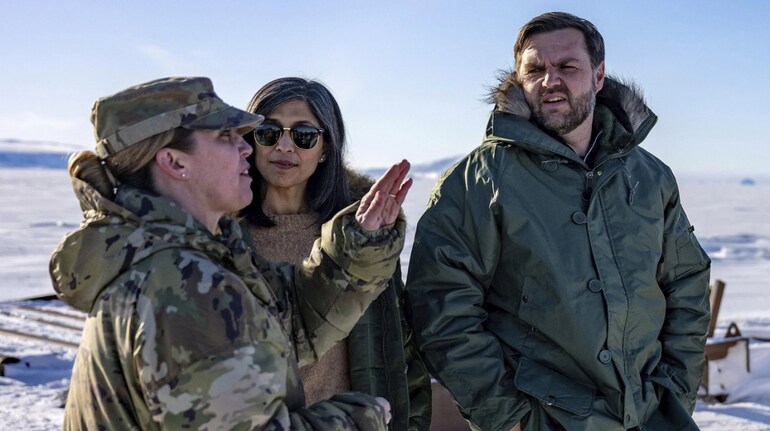

As US President Donald Trump once again talks about buying or even taking Greenland, diplomats in Copenhagen and Nuuk are bracing for another round of tension. The idea has been dressed up in familiar language about national security, Chinese and Russian ships in Arctic waters, and the island’s strategic importance. But beneath the rhetoric lies a simpler and more awkward reality: the United States already has almost everything it wants in Greenland, the New York Times reported.
Under a little-known defence agreement signed in 1951, Washington enjoys remarkably broad rights to operate militarily across the vast, icebound island. The deal allows the US to build and operate bases, station personnel and control air and sea movements, essentially giving it a free hand in military terms.
“The US has such a free hand in Greenland that it can pretty much do what it wants,” said Mikkel Runge Olesen of the Danish Institute for International Studies. “I have a very hard time seeing that the US couldn’t get pretty much everything it wanted, if it just asked nicely.”
A Cold War deal that never really went away
The agreement was born out of World War II, when Denmark was occupied by Nazi Germany and Greenland suddenly became strategically vital. Fearing the island could be used as a stepping stone for attacks on North America, Denmark’s ambassador in Washington, cut off from Copenhagen, struck a deal with the United States to defend it.
American troops eventually drove out German forces and built more than a dozen bases across Greenland, complete with airstrips and radar stations. After the Cold War, most of these were closed. Today, only one major American installation remains: the Pittufik Space Base, which tracks missiles crossing the Arctic.
Denmark maintains only a small presence of a few hundred troops, including elite dog-sled patrols that operate in the far north. In recent months, Copenhagen has said it plans to upgrade surveillance and strengthen its Arctic posture.
So why talk about buying Greenland?
Trump’s renewed fixation — including suggestions that the US could simply take the island — has alarmed both Danish and Greenlandic leaders. Greenland’s prime minister, Jens-Frederik Nielsen, has been blunt: “Our country is not for sale.”
Legally, Denmark cannot sell Greenland anyway. The island now has the right to hold a referendum on independence, and its 57,000 residents ultimately decide its future. A poll last year found 85 per cent opposed to any kind of American takeover.
Trump is not the first US president to float the idea. In 1946, the Truman administration offered Denmark $100 million in gold. It was firmly refused.
A pact with limits but lots of flexibility
The defence agreement was updated in 2004 to include Greenland’s semi-autonomous government and to require consultation before any “significant changes” in US military operations. The amendment also explicitly recognises Greenland as “an equal part of the Kingdom of Denmark.”
On paper, this sounds like a constraint. In practice, Danish analysts say it is more a matter of diplomatic courtesy.
“If the US made reasonable requests, it would always get a yes,” said Peter Ernstved Rasmussen, a Danish defence analyst. “If the US wanted to act without asking, it could simply inform Denmark that it is building a base, an airfield or a port.”
That, say some in Denmark, is precisely what makes Trump’s threats so puzzling. If Washington is genuinely worried about Arctic security, the existing framework already allows it to act.
“The mechanism is there. It’s in place,” said Jens Adser Sorensen, a former senior official in Denmark’s parliament. “Why don’t you use it?”
Politics, nerves and minerals under the ice
Tensions spiked further after US special forces captured Venezuela’s president Nicolás Maduro, prompting Trump aide Stephen Miller to claim that “nobody’s going to fight the United States” over Greenland. Danish and Greenlandic leaders quickly sought talks with Secretary of State Marco Rubio.
European leaders, meanwhile, issued a pointed reminder: Greenland belongs to its people.
Beyond military strategy, there is another reason Greenland looms large in Washington’s thinking. Beneath its ice lie vast deposits of critical minerals. But here too, analysts say, the US does not need to own the island to gain access.
Greenland’s leaders have made it clear they are open to doing business — with many partners.
In the end, Trump may already hold the keys he says he wants. The 1951 agreement gives the United States extraordinary latitude in one of the world’s most strategic regions. Buying Greenland would not change that — but it would change everything else.
Discover the latest Business News, Sensex, and Nifty updates. Obtain Personal Finance insights, tax queries, and expert opinions on Moneycontrol or download the Moneycontrol App to stay updated!
Find the best of Al News in one place, specially curated for you every weekend.
Stay on top of the latest tech trends and biggest startup news.





