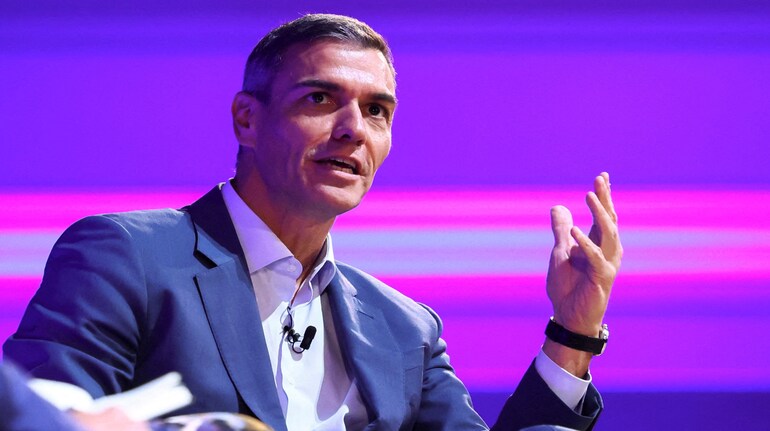
As tensions rise between Europe and Washington over the war with Iran, Spain has emerged as the most visible outlier. While most European governments are cautiously managing relations with the United States, Spanish Prime Minister Pedro Sánchez has chosen a far more confrontational path, openly rejecting pressure from Donald Trump and warning against another war in the Middle East.
The confrontation became public after Trump threatened to cut off trade with Spain when Madrid refused to allow two jointly operated US-Spanish bases in Andalucía to be used for strikes against Iran. In response, Sánchez delivered a 10-minute televised address titled an “institutional declaration” on recent international events, a routine label for a speech that carried unusually direct political messaging.
The Spanish leader framed his decision as both strategic and moral. Another Middle East war, he argued, would deepen global instability, cost lives and inflict economic damage far beyond the region. But the speech also contained a broader critique of the political incentives that often accompany military escalation.
According to Sánchez, governments must prioritise the welfare of their citizens rather than exploit international crises.
“It is absolutely unacceptable that those leaders who are incapable of fulfilling this duty use the smokescreen of war to hide their failure and, in the process, line the pockets of a select few, the same ones as always; the only ones who profit when the world stops building hospitals and starts building missiles,” he said. He also dismissed the idea that deference to powerful allies should be mistaken for leadership.
“It is naive to believe that democracies or respect between nations can spring from ruins. Or to think that practising blind and servile obedience is a form of leadership … We will not be complicit in something that is bad for the world and that is also contrary to our values and interests, simply out of fear of reprisals from someone.” The “someone” he referred to required little explanation.
Domestic politics may partly explain Sánchez’s willingness to take such a public stance. Spanish public opinion remains sceptical of Trump, with surveys suggesting only 15.7 per cent of Spaniards view the US president favourably. The country’s political memory is also shaped by the backlash that followed Spain’s support for the US-led invasion of Iraq in 2003 under former prime minister José María Aznar, a decision that still carries political weight.
Within Spain, Sánchez’s position has energised his left-leaning political base, which has long opposed deeper involvement in US-led military operations. His critics, however, argue the move risks damaging Spain’s strategic relationship with Washington.
Alberto Núñez Feijóo, head of the conservative People’s Party, accused the prime minister of politicising foreign policy and endangering Spain’s ties with the United States. Meanwhile Santiago Abascal, leader of the far-right Vox party, suggested the stance reflected ideological sympathy with Iran and accused Sánchez of attempting to hold on to power despite corruption scandals surrounding figures in his government and Socialist Party.
Yet Sánchez’s rhetoric is consistent with his broader foreign policy approach. Over the past several years he has frequently taken positions that diverge from the mainstream of European politics. He has been one of the most outspoken European critics of Israel’s conduct in Gaza, accusing the country of “exterminating a defenceless people” by bombing hospitals and “killing innocent boys and girls with hunger”. He has also criticised Washington’s role in the armed removal of Venezuelan leader Nicolás Maduro. On migration, where many European governments have adopted increasingly restrictive policies, Sánchez has continued to emphasise the economic and demographic benefits of immigration.
Despite the forcefulness of his position, Sánchez has received little public backing from other major European leaders. Their responses reflect a mix of geopolitical caution, domestic political constraints and economic considerations.
French President Emmanuel Macron expressed “European solidarity” with Spain following Trump’s trade threats, but Paris has largely pursued a balancing strategy. France has criticised aspects of the US and Israeli strikes on Iran while simultaneously acknowledging Iran’s own role in escalating tensions through its nuclear programme and regional activities.
In a televised address, Macron said of the killings of Iran’s supreme leader and senior officials: “History never weeps for the executioners of their own people, and none of them will be mourned.”
France has also reinforced its military presence in the eastern Mediterranean by deploying the aircraft carrier French aircraft carrier Charles de Gaulle alongside additional air-defence capabilities, which Macron described as a “strictly defensive” deployment aimed at supporting regional partners.
Germany’s response has been even more cautious. Chancellor Friedrich Merz has signalled that Berlin is reluctant to publicly challenge Washington while broader strategic issues, particularly Ukraine and trade, remain unresolved.
“Categorising the events [in Iran] under international law will have relatively little effect,” Merz said before a visit to Washington. “Therefore, this is not the time to lecture our partners and allies. Despite our reservations, we share many of their goals without being able to actually achieve them ourselves.”
Germany’s position reflects a combination of economic concerns and domestic political pressures. With the far-right Alternative für Deutschland gaining momentum ahead of several regional elections, Merz faces limited room to escalate tensions with the United States.
Italy has pursued an even more carefully balanced approach. Prime Minister Giorgia Meloni has maintained close personal and political ties with Trump while also avoiding a direct break with European partners.
“We are not at war and we do not intend to enter one,” Meloni said in an interview with RTL 102.5. “The situation is worrying, I would say on several fronts. I am concerned about an increasingly evident crisis of international law. The world is increasingly governed by chaos.”
Italy’s defence minister Guido Crosetto offered a more explicit assessment in parliament, saying the strikes against Iran “of course fell outside, needless to say, the rules of international law”.
“It is a war that was started without anyone in the world knowing,” Crosetto said. “One in which we, like the rest of the world, find ourselves having to manage [the consequences].”
Foreign minister Antonio Tajani said Italy had not received any request from Washington to use Italian bases for operations against Iran.
The diplomatic dispute intensified further when White House press secretary Karoline Leavitt suggested that Spain had reversed its position and would cooperate with the operation. Madrid moved quickly to dismiss the claim.
Spain’s foreign minister José Manuel Albares said the country’s stance remained unchanged.
“Our ‘no to war’ stance remains clear and unequivocal,” he said. “[Leavitt] may be the White House press secretary, but I’m the foreign minister of Spain and I’m telling her that our position hasn’t changed at all.”
For now, Sánchez’s challenge to Washington leaves Spain standing largely alone among Europe’s major powers — a position that reflects both Spain’s domestic political climate and the broader reluctance of European governments to confront the United States directly during a volatile geopolitical moment.
Discover the latest Business News, Sensex, and Nifty updates. Obtain Personal Finance insights, tax queries, and expert opinions on Moneycontrol or download the Moneycontrol App to stay updated!
Find the best of Al News in one place, specially curated for you every weekend.
Stay on top of the latest tech trends and biggest startup news.