






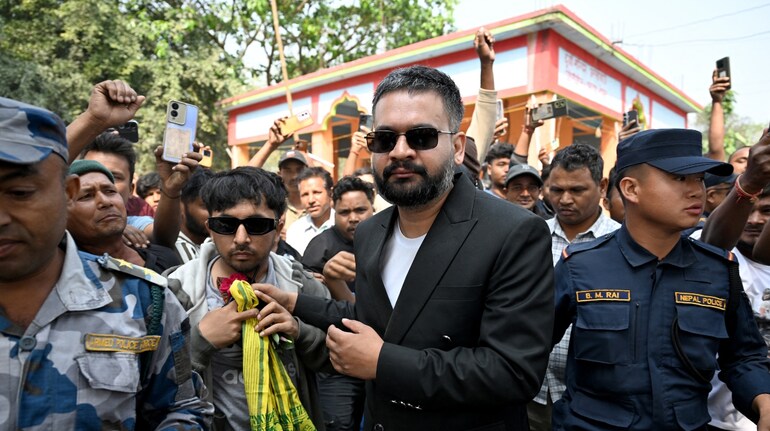
Nepal’s political landscape may be headed for a dramatic shift with 35-year-old engineer-rapper-turned-politician Balen Shah emerging as a frontrunner to become the country’s next prime minister with the counting of votes indicating advantage for his Rastriya Swatantra Party on Friday.
Shah, 35, is currently the mayor of Kathmandu and has become the face of a youth uprising in Nepal, which forced the ouster of former PM KP Sharma Oil.
Several of Shah's statements in the past and his pro-Nepal positioning indicate that China may face a more unpredictable and less accommodating leadership in Kathmandu if RSP comes to power.
A potential new leadership in Nepal will come as a stark contrast to KP Sharma Oli, chairman of the Communist Party of Nepal (Unified Marxist Leninist), who cultivated close ties with Beijing during his tenure.
Shah has regularly raised concerns over China’s growing influence in Nepal.
While he has not projected himself as explicitly anti-China, his remarks on sovereignty issues as well as Beijing's flagship Belt & Road Initiative (BRI) suggest a more cautious approach.
On several occasions, Shah questioned decisions he believes compromise Nepal’s territorial interests on social media.
For instance, during Oli’s visit to China, Shah urged the then prime minister to raise Nepal’s claims over Lipulekh Pass, which has been at the centre of a longstanding territorial dispute with India. India has regularly rejected Nepal's claims, calling them "unilateral".
“The agreement between India and China to conduct trade through Nepal’s Lipulekh Pass has directly affected our sovereignty. Please make sure to convey this message clearly to China,” Shah wrote in a Facebook post.
Shah also cancelled a planned trip to China in 2023 after Beijing released a map that depicted territory claimed by Nepal as part of India. The map contradicted Nepal’s own updated political map. Shah said the decision was taken on ethical grounds and publicly expressed dissatisfaction with the map.
His stance has also extended to economic cooperation with China.
Shah removed a China-funded Belt and Road Initiative (BRI) industrial park project from his election manifesto, citing diplomatic sensitivities amid Indian concerns about its proximity to the Siliguri Corridor. The corridor is a strategically vital stretch connecting mainland India with its northeastern states.
While he has not rejected Chinese investments outright and has defended the need for foreign capital in Nepal’s development, Shah has criticised sections of Nepal’s political elite for maintaining overly close ties with Beijing.
Moreover, unlike the Oli government, Shah comes with limited foreign policy experience and is not naturally aligned with the communist regime in Beijing. This could make cooperation tricky.
Notably, China also holds significant leverage over Kathmandu through infrastructure financing, with Nepal reportedly owing around $3 billion in debt to Beijing.
Managing the Himalayan nation's economic dependence on China while asserting political autonomy could become one of the biggest tests of the government led by Shah.
Meanwhile, Nepal recorded around 60 percent voter turnout in elections to the House of Representatives held on Thursday, the first national polls since the wave of Gen Z-led protests that toppled the KP Sharma Oli-led coalition government last year.
Shah's Rastriya Swatantra Party, founded in 2022, rapidly gained traction among urban and young voters campaigning on anti-corruption and governance reforms.
Shah had first gained popularity as a rapper before entering politics. He quickly became one of the most recognisable faces of this political shift.
Discover the latest Business News, Sensex, and Nifty updates. Obtain Personal Finance insights, tax queries, and expert opinions on Moneycontrol or download the Moneycontrol App to stay updated!
Find the best of Al News in one place, specially curated for you every weekend.
Stay on top of the latest tech trends and biggest startup news.




