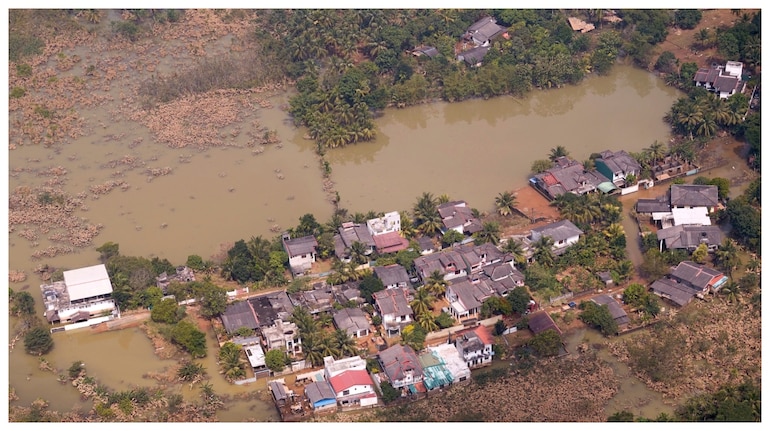
Asia’s latest monsoon season has turned into a rolling disaster. Three cyclones spinning at the same time, landslides crashing through villages, city streets turned into brown rivers and millions of people forced from their homes. From Sri Lanka to Indonesia, Thailand, Vietnam and the Philippines, at least 1,350 people have died and hundreds more are missing.
What is happening this year is not just another bad monsoon. It is a convergence of extreme weather, climate change and weak preparedness across several countries at once, the New York Times reported.
Where the damage is worst
Sri Lanka is at the centre of the emergency. Authorities say more than a million people have been affected, over 15,000 homes destroyed and the death toll has already crossed 400, with many more still unaccounted for. The president has called it the largest and most complex natural disaster in the country’s history, saying its overall impact is broader than even the 2004 Indian Ocean tsunami because this time almost every district has been hit.
Indonesia has been hammered as well. Floods and landslides have affected about 1.5 million people and displaced roughly 570,000, with more than 700 deaths confirmed and over 400 missing. Entire communities in places like North Sumatra have been buried under mud and debris after sudden flash floods.
Elsewhere in the region, the picture is just as stark. Vietnam has already faced 14 typhoons this year, with a fifteenth forming off its coast, and more than 90 people were killed in November alone. Thailand has lost at least 160 lives while more than two million residents have been pushed out of their homes by rising waters. In the Philippines, two powerful typhoons hit within a single week in early November, leaving more than 200 people dead and forcing the military and emergency services into repeated large-scale rescue operations.
Why this monsoon season is different
Monsoon rains and tropical storms are not new to South and Southeast Asia. What stands out this year is their intensity, timing and geography.
A strong La Niña pattern in the Pacific has helped fuel more powerful systems by pushing warm water and moist air towards East and Southeast Asia. That warmth is key. Tropical cyclones feed on warm ocean water, and when sea surface temperatures are higher, even storms that would once have been moderate can now dump huge volumes of rain.
One of the most unusual features of 2025 has been where some storms are forming. Cyclone Senyar developed just a few degrees north of the Equator, in the narrow waters between Indonesia and Malaysia. Normally, storms rarely form so close to the Equator because the planet’s rotation, which helps cyclones spin, is weaker there.
This year’s storms have also overlapped with peak monsoon rains, especially in November and December. In Southeast Asia, late-season typhoons and monsoon bursts sometimes coincide, but the extent and severity of the overlap this year in both South and Southeast Asia is striking.
The climate link behind the extreme rain
Scientists have been warning for years that a warming planet would change the character of tropical storms, and that is exactly what is now visible. Greenhouse gas emissions have trapped more heat in the atmosphere and oceans. Last year was the hottest on record globally, and the oceans have absorbed much of that excess heat.
Warmer seas provide more energy for cyclones to form and strengthen. Warmer air can also hold more moisture. That means that when storms make landfall, they are primed to release extraordinary amounts of rain in a short time, triggering flash floods and landslides even from systems that are not at the very top of the intensity scale.
There are other subtle changes too. Studies suggest that vertical wind shear — the difference between winds at different altitudes, which can disrupt storms — has weakened in some key basins such as the Arabian Sea and parts of the western Pacific. That makes it easier for cyclones in those regions to organise and intensify.
In the Bay of Bengal, the share of storms that turn into extreme cyclones has grown over the past half-century. Put together, hotter seas, moister air and weaker wind shear are creating a background climate in which the monsoon is becoming more erratic and potentially more destructive.
Strained governments and uneven preparedness
The human impact of this monsoon season is not only about rainfall and wind speeds. It is also about where people live, how cities are built and how governments respond.
Sri Lanka is still recovering from a deep economic crisis that began in 2022. Limited resources make it harder to reinforce infrastructure, invest in flood defences or rapidly rebuild shattered homes and roads. With all 25 districts affected, local authorities are stretched thin.
Indonesia, a vast archipelago with more than 270 million people, faces its own mix of pressures. Youth unemployment is high, inequality is widening and the capital, Jakarta, is literally sinking as groundwater is overused and rivers overflow. These stresses leave many communities exposed on riverbanks, hillsides and floodplains that become deadly during extreme rain.
In Vietnam and the Philippines, the financial cost of repeated disasters is mounting. Vietnam’s statistics office estimates that storms and floods have caused billions of dollars in damage this year. In the Philippines, campaigners have accused the government of misusing public funds meant for flood control and climate adaptation, fuelling anger and protests even as new storms arrive.
Across the region, early warning systems, evacuation shelters and recovery programmes exist but are uneven. When several major systems hit in quick succession, gaps in planning, corruption or underinvestment are brutally exposed.
A warning of what future monsoons may look like
Taken together, this monsoon season is a preview rather than a one-off. As global temperatures continue to rise, Asia’s monsoons are likely to become more unpredictable, with longer dry spells punctuated by bursts of very intense rain and stronger cyclones forming in places that once seemed relatively safe.
For the millions living in low-lying cities, hillside villages and crowded river basins, the events of 2025 underline a simple reality: climate change is not a distant threat. It is already reshaping familiar weather patterns and turning seasonal rains into a test of survival.
Discover the latest Business News, Sensex, and Nifty updates. Obtain Personal Finance insights, tax queries, and expert opinions on Moneycontrol or download the Moneycontrol App to stay updated!
Find the best of Al News in one place, specially curated for you every weekend.
Stay on top of the latest tech trends and biggest startup news.