






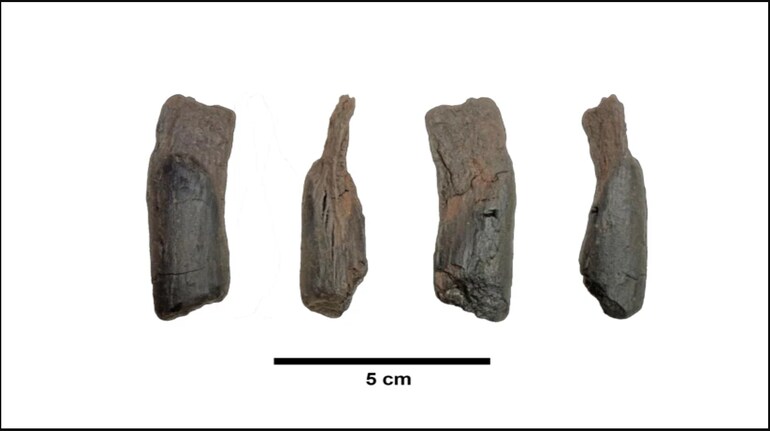

For decades, stone tools have dominated our picture of early human technology. Stone survives. Wood rots. Bone fractures. As a result, archaeology has long told a story skewed toward what lasts, not necessarily what mattered most.
Two new discoveries are now forcing a rethink.
Researchers have identified 430,000-year-old wooden tools from southern Greece and a 500,000-year-old hammer made from elephant or mammoth bone from southern England. Together, they offer rare and compelling evidence that early humans in Europe were working with organic materials in deliberate, skilled ways hundreds of thousands of years earlier than previously confirmed, the New York Times reported.
Why these finds matter
The tools date to a period long before Homo sapiens arrived in Europe. At the time, the continent was home to early Neanderthals or their ancestors, often identified as Homo heidelbergensis. These hominins are typically portrayed as capable but technologically limited, relying mainly on stone implements.
The new evidence complicates that picture.
Wooden tools are exceptionally rare in the archaeological record, not because they were unimportant, but because they decay easily. Their absence has often been mistaken for evidence that early humans did not use them extensively. These discoveries suggest the opposite: that organic tools were likely common, versatile and central to daily survival.
The Greek wooden tools
The wooden artifacts were recovered from Marathousa 1, a former lakeshore site in the Megalopolis basin of southern Greece. The site, dated to the Middle Pleistocene, has already yielded stone tools and the remains of a straight-tusked elephant, along with animal bones from turtles, birds and hippopotamuses.
Among dozens of preserved wood fragments, researchers identified two objects that showed unmistakable signs of human shaping. One was a digging stick made from alder, likely used to extract roots, tubers or other underground resources. The other was a carved twig of poplar or willow, its precise function unclear but its human modification undeniable.
Microscopic analysis and CT scans revealed chopping marks and carved surfaces that could not be explained by natural processes. These were not broken branches. They were tools.
Their survival is owed to the waterlogged conditions of the ancient lakeshore, which slowed decay and preserved organic material in remarkable detail.
The bone hammer from England
The second discovery comes from Boxgrove in West Sussex, a site already famous for early human fossils and stone tools. Excavated decades ago but only recently identified as a tool, the bone hammer was made from the limb bone of an elephant or mammoth.
Roughly four inches long, the fragment bears repeated impact marks and embedded flint flakes, clear evidence that it was used for knapping stone tools. In other words, early humans were not just shaping stone with stone, but using bone as a specialised tool in the process.
That matters because bone behaves differently from stone. It absorbs shock, reduces breakage and allows greater control. Choosing bone for this task suggests not improvisation, but understanding.
What this says about early human intelligence
Taken together, the finds point to a level of technological flexibility that is easy to underestimate. Early hominins were not simply reacting to their environment with whatever lay closest at hand. They were selecting materials based on their properties, shaping them for specific purposes, and integrating them into broader toolmaking systems.
This challenges the idea that cognitive sophistication emerged suddenly with Homo sapiens. Instead, it suggests a much longer, gradual development of planning, experimentation and technical knowledge.
It also raises an uncomfortable possibility for archaeology: how much has been missed.
The problem of preservation
Stone tools dominate museum collections because stone endures. Wood and bone usually do not. Researchers have long suspected that this preservation bias distorts our understanding of early technology, and these discoveries strengthen that argument.
If organic tools were once widespread, then much of early human ingenuity has simply vanished from view. What survives may be the exception, not the rule.
That does not diminish the importance of stone tools. But it does suggest they were part of a larger toolkit that included materials chosen for flexibility, lightness and availability.
Rethinking early Europe
By the time Homo sapiens arrived in Europe around 210,000 years ago, other hominins had already lived there for hundreds of thousands of years. They hunted large animals, processed carcasses, exploited plant foods and adapted to changing environments.
The wooden tools from Greece and the bone hammer from England add texture to that history. They show early humans not as crude precursors, but as capable problem-solvers working with a broader range of materials than the archaeological record has traditionally allowed us to see.
In archaeology, each discovery is provisional. Today’s “oldest” find often becomes tomorrow’s benchmark to be surpassed. But these tools do something more enduring. They remind us that early human intelligence did not announce itself all at once. It accumulated quietly, tool by tool, in materials that rarely survive long enough to tell their story.
Discover the latest Business News, Sensex, and Nifty updates. Obtain Personal Finance insights, tax queries, and expert opinions on Moneycontrol or download the Moneycontrol App to stay updated!
Find the best of Al News in one place, specially curated for you every weekend.
Stay on top of the latest tech trends and biggest startup news.





