






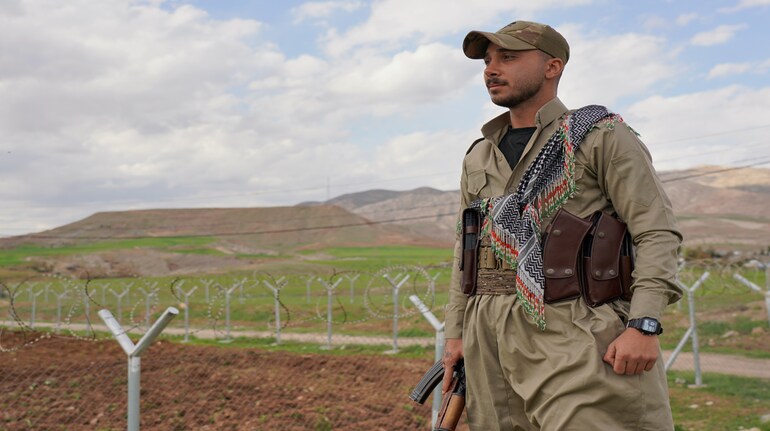
As the war spreading across West Asia intensifies, Iran’s Kurdish groups have once again moved into focus. Battle-hardened Kurdish fighters — many of whom have spent years in exile in northern Iraq — are now preparing for the possibility of a cross-border military campaign inside Iran, potentially with backing from the United States.
Iranian forces have already targeted Kurdish opposition groups since hostilities erupted following US and Israeli strikes on Iran over the weekend. Yet despite Washington’s long and complicated history with Kurdish movements, some factions now see the conflict as a rare opportunity to weaken the Islamic Republic and possibly align themselves with the United States.
Bringing Kurdish fighters into the conflict could further stretch Iran’s military as US and Israeli strikes continue. At the same time, it risks drawing Iraq — where several Kurdish groups are based — deeper into the war.
Here is a closer look at who the Kurds are and the role they could play in the conflict.
Who are the Kurds?
The Kurds, numbering roughly 30 million people, are widely regarded as one of the largest ethnic groups in the world without a state of their own. They primarily live across Turkey, Iraq, Iran and Syria, speak Kurdish in various dialects, and most follow Sunni Islam.
Although they have never established an independent state, the Kurds run a semi-autonomous region in northern Iraq and, for several years, effectively governed much of northeastern Syria. Many Kurdish factions have waged long-running insurgencies in pursuit of an independent homeland known as Kurdistan.
In Iran, around nine million Kurds live mainly along the country’s western border regions with Iraq and Turkey. The community has a long history of unrest and uprisings against both the current Islamic Republic and the monarchy that preceded it.
Kurdish opposition groups inside Iran
Several Kurdish organisations have taken up arms against Iranian authorities over the years. In the latest phase of the conflict, Iranian forces have struck positions belonging to some of these groups.
The attacks have pushed various Kurdish factions closer together, leading them to form an alliance aimed at challenging the Islamic Republic and eventually securing Kurdish self-determination.
Even before the war began, five Kurdish groups had formed a coalition dedicated to overthrowing the Iranian government and advancing Kurdish political rights. On March 5, a sixth group joined the alliance.
“For the first time, all major Kurdish parties have come together as one in a new coalition — a historic step toward shaping a new future for Kurds and a democratic Iran,” said Abdullah Mohtadi, secretary general of the Komala Party of Iranian Kurdistan.
An Iraqi security official told AFP that Iranian authorities have warned Baghdad that hundreds of armed Kurdish fighters may attempt to infiltrate Iran. So far, however, no such incursion has taken place.
Kalel Kani Sanani, spokesperson for the Kurdistan Freedom Party PAK, said Kurdish groups are watching developments closely.
“If the strikes on Iran continue, ‘the regime forces will be weakened’ and conditions will become ripe for a ‘popular uprising’.”
“The armed groups will then be able to confront what remains of the Iranian regime’s forces,” Sanani said preparations have already been made. “We are closely monitoring the course of the war, and if it continues like this, we are likely to witness an uprising in Iranian Kurdistan.”
A complicated relationship with Washington
Historically, Kurdish movements have often found themselves disappointed by US policy decisions.
In 1975, President Gerald Ford declined to intervene when Iraqi forces crushed Kurdish fighters. More than a decade later, in 1988, President Ronald Reagan did not act to stop Iraq from using chemical weapons against Kurdish populations.
In 1990, President George Bush encouraged Kurdish groups to rise up against Saddam Hussein after Iraq’s invasion of Kuwait, but later refrained from intervening as Iraqi forces suppressed the rebellion.
More recently, in January this year, Donald Trump allowed Syrian forces to retake Kurdish-controlled territory that had been secured during the Syrian civil war and battles against the Islamic State group.
Despite this history, some Kurdish leaders still view cooperation with the United States as a strategic opportunity.
Sanani said, “If they help us overthrow or weaken the regime in Iranian Kurdistan and protect us as they did in Iraqi Kurdistan in 1991, we will accept their aid”.
Renad Mansour from the Chatham House think tank said this “appears to be another chapter in a long history in which the US seeks different Kurdish militant groups… to support in various battles”.
The long quest for a Kurdish homeland
For many Kurds, the central aspiration remains unchanged — the chance for the people of Kurdistan to live freely.
Spread across mountainous regions spanning Turkey, Syria, Iraq and Iran, the Kurdish population has long sought a homeland of its own. Over the decades, however, their campaigns have frequently ended in military defeat or harsh repression.
The struggle continues today. Kurds remain one of the most significant non-Persian ethnic minority groups in Iran, and for many, the ongoing war may represent yet another turning point in their long pursuit of self-determination.
Discover the latest Business News, Sensex, and Nifty updates. Obtain Personal Finance insights, tax queries, and expert opinions on Moneycontrol or download the Moneycontrol App to stay updated!
Find the best of Al News in one place, specially curated for you every weekend.
Stay on top of the latest tech trends and biggest startup news.




