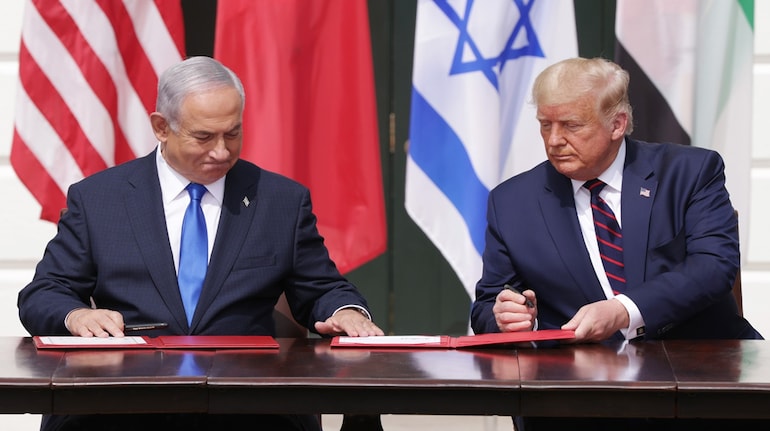
Prime Minister Benjamin Netanyahu began the week hoping that President Donald Trump had offered him a peace plan with a strong Israeli tilt. Hamas would be ordered to release all hostages within 72 hours, demilitarize, and consent to be barred from Gaza's next government — or Israel would have its hands untied to destroy the group militarily, the New York Times reported.
By Friday morning, things had turned around completely. Hamas offered to release the hostages but without a time frame, refused to give up arms, and demanded to negotiate the details. To Netanyahu's dismay, Trump volunteered to take Hamas's carefully worded declaration at face value as a flat-out "yes" and directed Israel to cease its bombing campaign over Gaza so hostages could be released unharmed.
Trump's wording puts Israel in a bind
Netanyahu's office responded cautiously, later at night and in the middle of the night in Israel, saying that the nation was prepared for the "immediate release of all hostages" and would assist Washington "in accordance with President Trump's vision." Omitted was any reference to Hamas's demands.
The U.S. president's spin — that Hamas had embraced peace and Israel now needed to back away — turned the diplomatic tables. Arab and Muslim countries were celebrating the news as though peace was nigh, embarrassing Netanyahu into being seemingly opposed to a deal the world came to welcome.
A blow to Netanyahu's coalition
Back home, the unfolding supported Netanyahu's right-wing coalition. His friends had envisioned a sweeping triumph: Hamas defeated, Palestinians expelled from Gaza, and Israelis able to settle the enclave. Trump's latest offer dashed such vision, citing that Hamas would, at least in the short term, still be standing and Israel has to retreat under international supervision.
Experts warned that this would be difficult for Netanyahu's base to accept. "They were hoping for an impossible story," said Shira Efron of the RAND Corporation, describing that members of the coalition were not going to allow Hamas survival or foreign takeover of Gaza's leadership.
Pressure from all sides
The shift has put Netanyahu under intense international scrutiny. Former Israeli national security official Eran Etzion explained that while the international community was applauding the notion of peace, Netanyahu would now be forced to explain why he opposed it. "He will be with the entire world applauding and he has to tell us why he's against it," Etzion said.
Trump's insistence that negotiation under a cease-fire was necessary was especially unwelcome in Jerusalem. Netanyahu had been anticipating for a long time maintaining military pressure during negotiations, using the momentum on the battlefield to extract concessions from the Palestinians. Now, Israel may be forced to negotiate without that bargaining tool, something Netanyahu has long sought to avoid.
Playing for time
Sceptics believe that Netanyahu and Hamas may both be playing largely to appease Trump and not to sign up for real peace. Israel's former national security adviser Eyal Hulata suggested that both sides may be fine-tuning their rhetoric for Washington while not holding back on flexibility to return to combat. "No intention of doing what it takes," he warned.
Still, there are optimists. Some believe Netanyahu's growing isolation could open the door to more profound change in Israeli politics, even a turn toward more accommodating leadership willing to initiate a new peace process. Arab nations, newly united behind Trump's initiative, have said they are willing to contribute to Gaza's reconstruction and management, raising hopes of an inclusive regional effort.
A fragile hope
The war, initiated following Hamas's October 7, 2023, attack on Israel, has dragged on for nearly two years and devastated Gaza and split up Israel's worldwide coalition. The prospect of the release of hostages and the suspension of hostilities, if fragile, has brought optimism to conflict-weary citizens on both sides.
For Netanyahu, the challenge is self-evident: balance intransigent home base voters against the diplomatic imperatives of Trump, navigate the unstable politics of coalition-building, and map out an increasingly concessionary international landscape. Whether he manages to cling to office in so doing will be as important as the fate of the Gaza peace plan itself.
Discover the latest Business News, Sensex, and Nifty updates. Obtain Personal Finance insights, tax queries, and expert opinions on Moneycontrol or download the Moneycontrol App to stay updated!
Find the best of Al News in one place, specially curated for you every weekend.
Stay on top of the latest tech trends and biggest startup news.