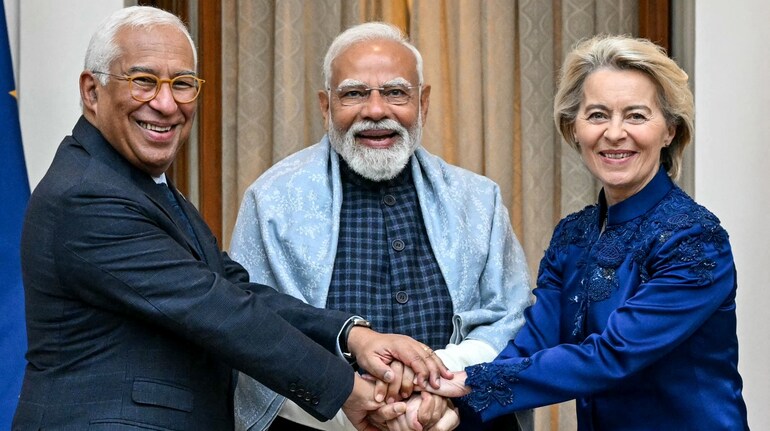

India and the European Union have concluded a long-awaited free trade agreement, a milestone that significantly strengthens India’s global trade footprint. The pact opens the doors of the EU’s combined market of 27 countries to Indian businesses, giving exporters access to nearly 450 million consumers with high purchasing power.
The agreement is being seen as one of India’s most consequential trade breakthroughs in recent years, offering long-term gains across manufacturing, services and investment flows.
Why the India-EU FTA is a major win for India
At its core, the deal reduces or eliminates tariffs on a wide range of Indian goods and services, making them more competitive in Europe. Sectors expected to benefit the most include pharmaceuticals, textiles and apparel, engineering goods, auto components, chemicals, electronics, IT services and gems and jewellery.
Indian pharmaceutical companies are likely to see strong gains due to easier market access and regulatory cooperation. Textile and apparel exporters stand to benefit from tariff reductions that help them compete more effectively with rivals from Bangladesh and Vietnam. Engineering goods, auto parts and machinery manufacturers are also expected to see increased demand from European buyers.
Beyond goods, the agreement boosts India’s services exports. Indian IT, digital services, consulting and professional services firms are expected to gain from smoother mobility norms, recognition of qualifications and improved access to EU clients.
The FTA is also expected to attract higher foreign direct investment into India, especially in manufacturing and clean technology, as European firms look to tap India’s scale, skilled workforce and growing domestic market.
The Carbon Tax clause and what it means
While the deal is broadly positive, one provision has drawn attention. The European Union has decided to levy a carbon tax on certain Indian exports, arguing that their production involves higher carbon emissions.
The levy will primarily affect carbon-intensive sectors such as steel, aluminium and cement. These products may become more expensive in the European market, potentially limiting export growth in these segments compared to earlier expectations.
The carbon tax is based on the amount of carbon dioxide equivalent emitted during production. Manufacturers with higher emissions will face higher charges, while cleaner production methods will attract lower costs.
Understanding Carbon Tax in global trade
A carbon tax is designed to discourage pollution by putting a price on emissions. It gained prominence after global climate agreements such as the Kyoto Protocol and has since been adopted by several advanced economies.
Today, around 30 to 40 countries impose some form of carbon pricing. Sweden introduced the tax in 1991 and continues to have one of the highest rates. Countries such as Germany, France, Denmark, Norway and Finland follow similar systems. Outside Europe, Canada, the UK, Japan, South Korea, New Zealand and Singapore have implemented carbon pricing mechanisms.
Revenues from these taxes are typically used to fund renewable energy, climate mitigation projects and social support schemes.
Opportunity hidden in the challenge
For India, the carbon tax is not just a hurdle but also a signal. It strengthens the case for accelerating the shift towards cleaner manufacturing, renewable energy and low-carbon technologies.
Indian companies that invest in green steel, clean aluminium, energy-efficient cement and renewable power are likely to remain competitive and even gain an edge in global markets. Over time, this transition could make Indian exports more resilient and future-ready.
The bigger picture
Despite the carbon levy, the India-EU FTA remains a strong strategic and economic win. It integrates India more deeply into global value chains, boosts exports, attracts investment and enhances India’s role as a trusted trade partner.
For India, the agreement is not just about immediate gains but about shaping long-term growth in a world where trade, sustainability and competitiveness are increasingly linked.
Discover the latest Business News, Sensex, and Nifty updates. Obtain Personal Finance insights, tax queries, and expert opinions on Moneycontrol or download the Moneycontrol App to stay updated!
Find the best of Al News in one place, specially curated for you every weekend.
Stay on top of the latest tech trends and biggest startup news.