






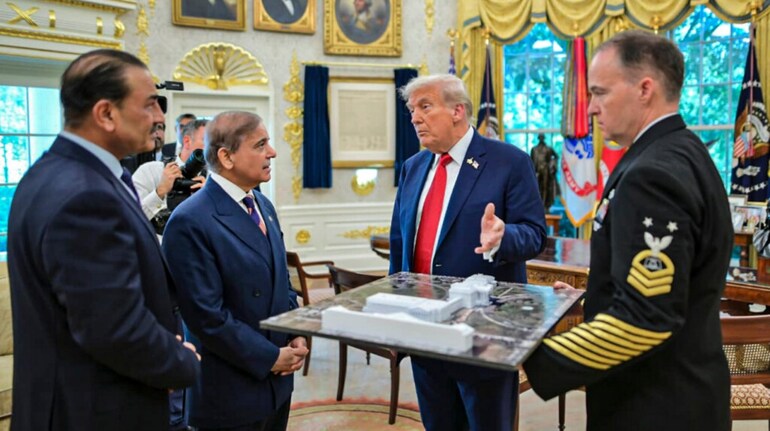

Pakistan Prime Minister Shehbaz Sharif’s visit to Washington for the inaugural meeting of US President Donald Trump’s proposed “Board of Peace” has pushed Islamabad into an uncomfortable diplomatic corner. While Pakistani officials privately expressed relief that Israeli Prime Minister Benjamin Netanyahu will not attend the February 19 meeting, the central dilemma remains unresolved. What happens if Pakistan is formally asked to deploy troops in Gaza?
That question has hovered over Islamabad for weeks and explains the unusually intense travel schedule of Pakistan’s army chief Asim Munir across the Middle East. From Oman and Saudi Arabia to Jordan and the UAE, Munir has been seeking political cover before joining Sharif in Washington, alongside Foreign Minister Ishaq Dar and senior Foreign Office officials.
A promise made too quickly
According to Pakistani observers and reports cited by Moneycontrol, Munir moved too fast in signalling Pakistan’s willingness to support Trump’s Gaza stabilisation plan. Trump was reportedly impressed by Pakistan’s military posture during the recent South Asia crisis and appears to believe Pakistani troops could help shoulder the burden in Gaza.
That early eagerness has now become a liability. Islamabad finds itself unable to say no to Washington outright, yet equally incapable of saying yes without igniting domestic backlash. Deploying Pakistani soldiers in Gaza would effectively mean policing a war-ravaged territory under conditions that would inevitably align with Israeli security priorities. That is a political red line for much of Pakistan’s public and a deeply sensitive issue within the armed forces themselves.
Fine print, price tags and quiet backtracking
As doubts grew, Pakistan began adding conditions. Reports indicate that Islamabad quietly introduced demands related to operational autonomy, a clear US command structure, financial compensation and an exit timeline. One Moneycontrol report said Munir’s camp even discussed figures running into thousands of dollars per soldier per month.
These transactional terms only deepened scepticism. Israel was reportedly unwilling to fund such deployments beyond symbolic levels, reinforcing Tel Aviv’s opposition to Pakistan playing any meaningful role in Gaza.
Munir’s regional outreach now appears less about leadership and more about damage control. Pakistan does not want to move alone and prefers to follow Saudi Arabia’s lead. Riyadh, however, has demanded clarity from Washington on Hamas de-weaponisation, governance in Gaza and a clear endgame. None of those answers currently exist.
Middle East ambitions collide with reality
The episode has exposed the limits of Munir’s ambition to position Pakistan as a Middle East power broker. Gaza is not an isolated problem. It is entangled with Israel’s domestic politics, worsening US-Iran tensions and rivalries among Arab states themselves.
Pakistan’s military leadership underestimated this complexity. What seemed like an opportunity to enhance Pakistan’s relevance to Washington has instead revealed how little leverage Islamabad actually holds once expectations turn concrete.
Domestic constraints and ideological baggage
Any move perceived as aiding Israel is politically toxic in Pakistan. Unlike former army chief Pervez Musharraf, who cautiously explored indirect engagement with Israel in the mid-2000s, Munir operates in a far more radicalised environment.
Past rhetoric from senior military leaders and jihadist narratives tolerated by the state have narrowed Islamabad’s options. Even financial incentives are unlikely to build consensus within the armed forces for a Gaza deployment. The risk of internal unease is real.
Israel’s resistance and Pakistan’s quiet hope
Israel, meanwhile, remains wary of both Pakistan and Turkey playing any role in a stabilisation force. Netanyahu’s government prefers arrangements it can fully control, especially with elections looming and far-right allies pushing maximalist policies in the West Bank.
For Pakistan, the most convenient outcome would be for Trump’s plan to stall altogether. With Arab states insisting on guarantees Washington cannot yet offer and Netanyahu escalating actions on the ground, the Board of Peace risks becoming another high-profile initiative that never materialises.
Until then, Pakistan’s delegation is expected to keep its head down in Washington, move in lockstep with Arab partners and avoid committing to a mission it cannot sustain. What is already clear is that Asim Munir’s gamble to elevate Pakistan’s strategic standing has instead exposed confusion, overreach and the limits of military diplomacy.
Discover the latest Business News, Sensex, and Nifty updates. Obtain Personal Finance insights, tax queries, and expert opinions on Moneycontrol or download the Moneycontrol App to stay updated!
Find the best of Al News in one place, specially curated for you every weekend.
Stay on top of the latest tech trends and biggest startup news.





