






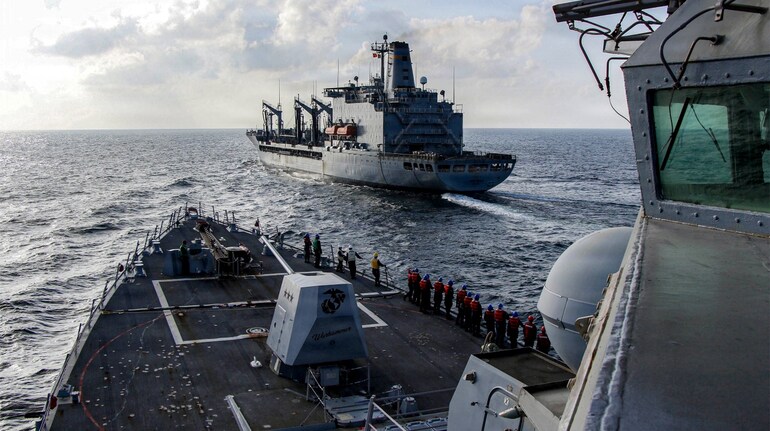

The United States is edging closer to a potential military confrontation with Iran after President Donald Trump ordered a large-scale deployment of American military forces to West Asia. While the show of force has intensified sharply, Washington’s long-term objective remains unclear.
In response to the rising tensions, Iran has warned it will retaliate if attacked. India has also reacted to the deteriorating security situation, urging its citizens to leave Iran immediately.
In an advisory, the Embassy of India in Iran asked Indian nationals to “leave Iran by available means of transport, including commercial flights”.
Trump’s timeline and military options
Last Thursday, Trump said he would decide within 10 to 15 days whether to authorise military action if talks over Iran’s nuclear programme fail.
According to Axios, Trump has several military options, including a direct strike targeting Iran’s supreme leader Ali Khamenei.
Although Trump has repeatedly said he prefers diplomacy, he has insisted that any agreement must address Iran’s nuclear activities, its ballistic missile programme and its support for groups such as Hezbollah and Hamas. Iran has rejected these conditions.
The US and Iran have held two rounds of indirect talks in Oman and Switzerland, with little progress. Talks are scheduled to resume on Thursday in Switzerland.
Trump’s special envoy Steve Witkoff said the president is “surprised” that Iran has not “capitulated,” despite the growing US military presence.
What Washington may be aiming for
Analysts say the Trump administration may be looking for a limited military campaign rather than a full-scale war.
“The Trump administration most likely aims for a limited conflict that reshapes the balance of power without trapping it in a quagmire,” said Alex Vatanka of the Middle East Institute.
Vatanka added that Iran is bracing for “a short, high-impact military campaign that would cripple Iran’s missile infrastructure, undermine its deterrent, and reset the balance of power after the 12-day war with Israel in June 2025.”
Why Trump is escalating pressure
Trump has long claimed that previous US strikes on uranium enrichment sites destroyed Iran’s nuclear programme. His rhetoric hardened after protests erupted in Iran in January, which were violently suppressed by security forces.
At the time, Trump repeatedly threatened to intervene to help the Iranian people but stopped short of action.
He has also argued that regime change in Iran could help stabilise West Asia. Trump often points to the Gaza ceasefire he brokered between Israel and Hamas as proof that his approach brings peace, even though the truce has been repeatedly violated.
Democrats, however, are warning that Trump is dragging the United States toward war without congressional approval. Under US law, only Congress has the authority to formally declare war.
US military buildup in West Asia
The scale of the US military presence in the region is substantial.
American forces now include the aircraft carrier USS Abraham Lincoln, nine destroyers and three frigates. More naval power is on the way.
The world’s largest aircraft carrier, USS Gerald Ford, was recently seen passing through the Strait of Gibraltar into the Mediterranean.
Alongside these warships, dozens of fighter jets have been deployed, and tens of thousands of US troops are stationed across West Asia. All of them could become targets if Iran decides to retaliate.
Uncertain outcomes and regional fears
Former Council on Foreign Relations president Richard Haass has cautioned that the consequences of any conflict remain unpredictable.
Writing on Substack, Haass said a war could either weaken Iran’s leadership or strengthen it, adding that there is no clear sense of what would follow if the regime collapsed.
US Secretary of State Marco Rubio echoed those concerns at a Senate hearing last month.
“No one really knows what will happen if Iran’s Supreme Leader falls,” Rubio said, adding that the hope is “there would be some ability to have somebody within their systems that you could work towards a similar transition.”
Arab monarchies in the Gulf have privately warned Trump against military action, fearing retaliation and broader instability.
Mona Yacoubian of the Center for Strategic and International Studies told AFP that Iran is far more complex than past US interventions.
She warned that Iran has multiple centres of power and that a “decapitation strike” could end up “really unleashing a mess inside of Iran.”
What comes next
With diplomacy stalled, troops deployed and warnings issued, the situation remains fluid and dangerous. Whether Trump chooses talks, limited strikes or a broader confrontation will shape not just US Iran relations but the future stability of West Asia.
Discover the latest Business News, Sensex, and Nifty updates. Obtain Personal Finance insights, tax queries, and expert opinions on Moneycontrol or download the Moneycontrol App to stay updated!
Find the best of Al News in one place, specially curated for you every weekend.
Stay on top of the latest tech trends and biggest startup news.





