






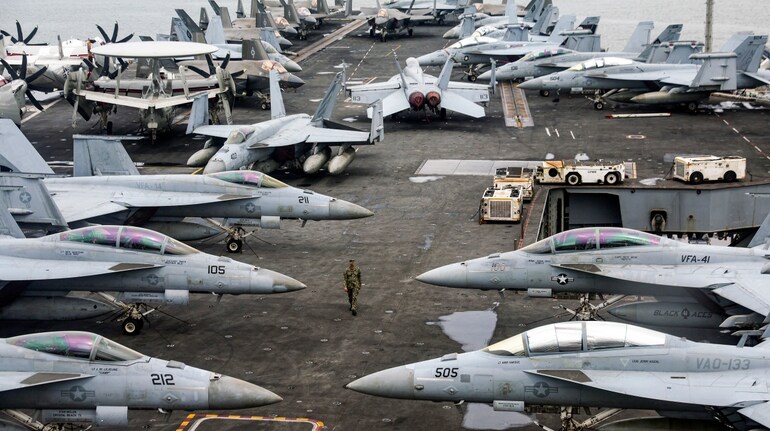

US President Donald Trump’s warning that a “massive armada” led by the aircraft carrier USS Abraham Lincoln is heading toward Iran has sharply escalated tensions in West Asia and revived a question long debated in military circles. As Washington presses Tehran to negotiate a deal involving “NO NUCLEAR WEAPONS,” with Trump insisting that “time is running out,” the standoff is no longer just diplomatic.
The deployment of a US carrier strike group places overwhelming American firepower within striking distance of Iran, but it also raises the risk of confrontation in a region where miscalculation can spiral quickly. Against this backdrop, attention has turned to whether Iran, with its growing missile and drone arsenal, could realistically threaten or even sink one of the most heavily defended symbols of US military power.
Military spending and overall strength
According to the Stockholm International Peace Research Institute (SIPRI) data on military expenditure, the United States is by far the world’s largest military spender, accounting for about 35.5% of global military expenditure in 2024.
Iran, by contrast, has relatively modest defence spending constrained by sanctions and economic limits. Recent SIPRI figures show Iran’s military spending was estimated at around $7.9 billion in 2024, down about 10% due to economic pressures.
This massive difference in spending translates into vast differences in training, technology, logistics, sustainment and modernisation.
Manpower and forces
Iran’s armed forces are large by regional standards, with about 610,000 active personnel and another 350,000 reserve and trained personnel that can be mobilised when needed.
However, sheer manpower does not overcome differences in equipment quality, integrated systems, naval and air power, and global force projection -- areas where the US has overwhelming advantages.
US naval power: The Abraham Lincoln carrier strike group
The USS Abraham Lincoln (CVN-72) is a Nimitz-class nuclear-powered aircraft carrier, one of the most powerful surface combatants ever built. It operates an air wing of fighter jets, early warning aircraft and helicopters.
Carrier strike groups also include guided-missile destroyers and cruisers equipped with advanced Aegis missile defence systems, Tomahawk land-attack missiles and anti-air weapons, giving them layered defences against aircraft, cruise missiles, ballistic threats and drones.
This group enables the US to project airpower and strike deep inland without local basing rights -- a capability unmatched by Iran.
Iran’s arsenal: Missiles and asymmetric tools
Iran’s conventional air force is limited, largely ageing and far smaller than what one US carrier can bring in planes.
Where Tehran has invested heavily is in missile technology. It possesses thousands of ballistic and cruise missiles with short, medium and intermediate range, and is believed to have developed hypersonic systems such as the Fattah-2 that travel faster than Mach 5.
Iran has also built large stockpiles of drones, which can be used in saturation attacks designed to overwhelm defences. Experts say low-cost drone swarms are a credible asymmetric threat to high-value naval targets such as carriers.
Some Iranian missiles have been adapted for anti-ship roles, and Tehran has supplied missiles and drones to proxies that have struck shipping in the Gulf and adjacent waters.
Can Iran sink a US carrier? The reality check
The US military’s layered defence, operational mobility, and integrated command and control make sinking a US carrier extremely difficult in practice. A carrier group’s defensive shield includes:
Iran could raise the cost of engagement by launching large numbers of drones and missiles to saturate defences, but reliably targeting a fast-moving carrier at sea requires real-time surveillance and precise targeting data that Iran does not yet possess.
Experts note that even if Iran’s missiles struck near a carrier, hitting and sinking one outright is extraordinarily improbable, though damaging engagements could carry political and strategic implications.
The strategic paradox
In military terms, Iran has modern asymmetric tools that can inflict damage or complicate US operations, particularly in confined seas where its missiles have greater reach. But in a modern naval theatre, the United States’ capability to defend and strike from long range remains far superior.
The USS Abraham Lincoln and its strike group project overwhelming force, but Iran’s arsenal can shape how a conflict unfolds. For now, the real question is not whether Iran can sink an aircraft carrier, but how much risk and cost it can impose on US forces, and whether both sides will seek to avoid a direct clash.
Discover the latest Business News, Sensex, and Nifty updates. Obtain Personal Finance insights, tax queries, and expert opinions on Moneycontrol or download the Moneycontrol App to stay updated!
Find the best of Al News in one place, specially curated for you every weekend.
Stay on top of the latest tech trends and biggest startup news.





