
West Asia has entered a new phase of military tension as the United States rapidly expands its troop presence, airpower and missile defences across the region. The surge, visible since January 2026, reflects Washington’s assessment that the risk of confrontation with Iran has risen sharply following domestic unrest inside Iran and the collapse of nuclear negotiations.
US officials describe the deployment as defensive in intent, aimed at protecting American forces, allies and critical energy infrastructure. However, the scale and speed of the buildup indicate that the Trump administration is also preparing for the possibility of retaliation, escalation or limited conflict involving Iranian forces or allied militias.
Rather than relying on a single forward base or strike group, the US has opted for a layered posture built around naval power, dispersed air assets and an expanded missile defence shield.
A carrier-centred posture in the Arabian Sea
At the centre of the US response is a major naval deployment positioned outside the immediate reach of Iran’s coastal missiles.
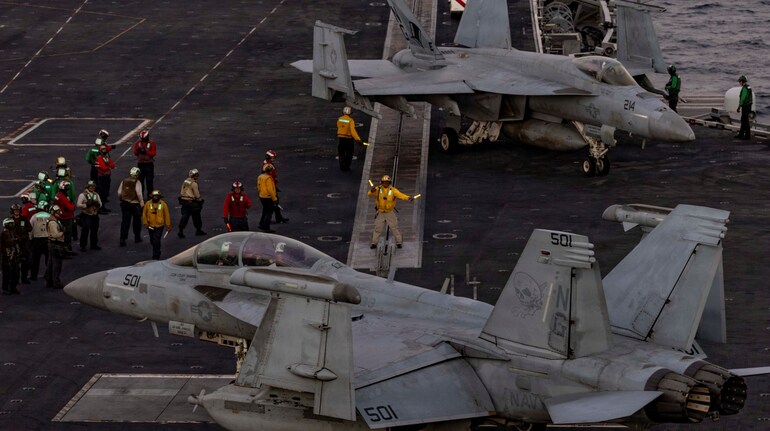
The USS Abraham Lincoln, a nuclear-powered aircraft carrier, has shifted operations from the Indo-Pacific to the Arabian Sea. Its presence gives Washington a mobile strike platform that can conduct air operations without relying on host-nation airfields.
The carrier’s air wing includes stealth aircraft capable of penetrating defended airspace and electronic warfare platforms designed to disrupt enemy radar and communications. Escorting destroyers equipped with missile defence systems and long-range cruise missiles provide both protection and offensive reach.
Operating from the Arabian Sea allows the carrier group to project power across the Persian Gulf, Iran’s southern coastline and the wider West Asian theatre while reducing vulnerability to short-range threats.
Airpower spread across multiple countries
Instead of concentrating aircraft at a single hub, the US Air Force has dispersed combat squadrons across several allied states, creating redundancy and flexibility.
F-15E Strike Eagles have been repositioned from Europe to Jordan, placing them closer to potential flashpoints in Iraq, Syria and Iran’s western approaches. These aircraft are optimised for long-range strike and deep penetration missions.
They are supported by F-16 fighters and A-10 attack aircraft that specialise in close air support and low-altitude operations. Together, these platforms provide options ranging from surveillance and deterrence to sustained combat.
Fifth-generation F-35A stealth aircraft have also been positioned in Europe as a rotational reserve. These jets can be rapidly deployed forward if air defence suppression or precision strikes become necessary.
This layered air posture allows the US to escalate or de-escalate without dramatic repositioning.
Missile defence takes priority
One of the clearest indicators of Washington’s threat perception is the deployment of advanced missile defence systems.
Additional THAAD batteries have been sent to several Gulf and Middle Eastern states, alongside reinforced Patriot missile systems. THAAD deployments are rare due to their limited numbers, suggesting US planners are seriously concerned about Iran’s ballistic missile capabilities.
These systems are designed to intercept missiles at different stages of flight, creating overlapping defensive coverage for US bases, allied cities and energy infrastructure.
By strengthening missile defences, the US aims to reduce Iran’s leverage from its missile arsenal and reassure regional partners that Washington is prepared to absorb and blunt retaliation.
The backbone: A dense network of bases
Supporting this posture is an extensive network of US bases that stretch across the region, enabling rapid movement, logistics and command coordination.
In Qatar, Al Udeid Air Base serves as the nerve centre of US air operations. It houses thousands of personnel and functions as the forward headquarters for US Central Command, coordinating missions across West Asia.
Bahrain hosts the US Navy’s Fifth Fleet, which oversees maritime security in the Persian Gulf and the Strait of Hormuz, a critical chokepoint for global energy supplies.
Jordan has emerged as a key air hub, with Muwaffaq Salti Air Base supporting surveillance and strike missions across the Levant.
Kuwait continues to function as the main logistics and staging area for ground forces, while Saudi Arabia hosts critical missile defence infrastructure protecting both US assets and the kingdom itself.
In the United Arab Emirates, Al Dhafra Air Base supports intelligence, surveillance and reconnaissance missions, providing situational awareness across Iran and surrounding regions.
Turkey’s Incirlik Air Base remains strategically important for refuelling, logistics and NATO coordination, even as regional politics remain complex.
What the buildup signals
The current posture signals a shift from symbolic deterrence to operational readiness. By dispersing forces, hardening defences and maintaining naval strike capability, the US is attempting to deny Iran a clear target while preserving escalation dominance.
It also sends a message to regional allies that Washington intends to remain deeply engaged despite domestic political debates over foreign commitments.
At the same time, the scale of deployments increases the risk of miscalculation. With tens of thousands of troops on high alert and multiple forces operating in close proximity, even limited incidents could spiral quickly.
The road ahead
The US military buildup in West Asia is not a short-term demonstration. It reflects a recalibration toward sustained deterrence at a moment when diplomatic channels have narrowed.
Whether this posture succeeds in preventing conflict or becomes the backdrop to one will depend on how Iran responds and whether diplomatic efforts re-emerge alongside military pressure.
Discover the latest Business News, Sensex, and Nifty updates. Obtain Personal Finance insights, tax queries, and expert opinions on Moneycontrol or download the Moneycontrol App to stay updated!
Find the best of Al News in one place, specially curated for you every weekend.
Stay on top of the latest tech trends and biggest startup news.