February 25, 2026 / 16:15 IST
US Supreme Court to rule on Trump’s emergency tariffs today: Meet the justices on the bench - US Supreme Court to rule on legality of Trump-era emergency tariffs today
- Decision may redefine presidential authority over trade and emergency powers
- Ruling will set precedent for future use of emergency powers in economic policy
Did our AI summary help?

The US Supreme Court is set to deliver a landmark ruling today in a closely watched case challenging the legality of tariffs imposed by President Donald Trump under emergency economic powers.
The decision could reshape the limits of presidential authority over trade policy, the use of national emergency powers, and Congress’s role in regulating tariffs.
Story continues below Advertisement
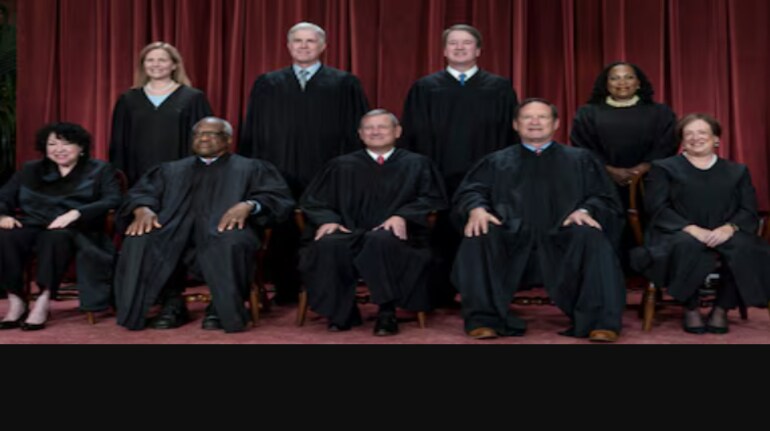
The case questions whether a president can unilaterally impose broad tariffs citing national security or emergency powers, or whether such actions exceed statutory and constitutional limits. The Court’s full nine-member bench will hear the case, and the justices’ past rulings offer insight into their potential approach.
- Chief Justice John G. Roberts Jr: He was appointed in 2005 by George W. Bush, is a conservative known for his cautious approach and emphasis on the Court’s institutional credibility. While supportive of executive authority in many cases, Roberts has limited presidential power when necessary to maintain constitutional balance, such as in Department of Commerce v. New York (2019), where he blocked the Trump administration’s attempt to add a citizenship question to the census.
- Justice Clarence Thomas: He was appointed in 1991, is the Court’s most committed originalist. He consistently challenges broad administrative authority and favors strict adherence to the Constitution’s text. Thomas’s skepticism of expansive executive power and long-standing precedents has made him a decisive figure in cases involving presidential discretion.
- Justice Samuel Alito: He was appointed in 2006, is a leading conservative voice who often supports strong executive discretion, especially in national security and administrative matters. He authored the majority opinion in Dobbs v. Jackson Women’s Health Organization (2022) and sided with the Trump administration in security-related cases like Trump v. Hawaii (2018).
- Justice Sonia Sotomayor: She was appointed in 2009 by Barack Obama and is a liberal advocate for civil liberties who frequently warns against unchecked executive power. She has dissented in cases where she believes executive overreach undermines constitutional protections, including Trump v. Hawaii.
- Justice Elena Kagan: He was appointed in 2010, is a pragmatic liberal who balances statutory interpretation with institutional insight. She has defended executive or regulatory power when authorized by Congress but insists courts must ground their decisions in clear statutory text, as seen in her dissent in West Virginia v. EPA (2022).
Story continues below Advertisement
- Justice Neil Gorsuch: He was appointed in 2017, is a conservative textualist with libertarian instincts. He often challenges broad executive and administrative authority, arguing that Congress cannot delegate sweeping lawmaking powers to the president. His opinions, such as in Gundy v. United States (2019), show his focus on statutory limits and textual interpretation.
- Justice Brett Kavanaugh: He was appointed in 2018, generally favors strong presidential authority, particularly in foreign and economic policy, but stresses that presidents remain accountable under congressional oversight. In Trump v. Mazars (2020), he recognized limits on executive power while emphasizing flexibility when statutes permit.
- Justice Amy Coney Barrett, Appointed in 2020, is a conservative originalist who emphasizes statutory clarity. She has blocked government overreach when executive agencies exceed Congress’s explicit authorization, as in NFIB v. OSHA (2022), a principle directly relevant to evaluating Trump’s emergency tariff powers.
- Justice Ketanji Brown Jackson, appointed in 2022, brings a civil-liberties perspective shaped by her experience as a public defender. While cautious about executive overreach, she also recognizes the scope of authority Congress grants the president, making her opinion potentially pivotal in evaluating the balance between emergency powers and legislative oversight.
Today’s ruling will determine the fate of Trump’s tariffs and set a precedent for how future presidents, Republican or Democrat, can invoke emergency powers to shape economic policy. Analysts expect the decision to hinge on the Court’s interpretation of statutory authority versus presidential discretion, making this a landmark case in executive-legislative relations.
Discover the latest Business News, Sensex, and Nifty updates. Obtain Personal Finance insights, tax queries, and expert opinions on Moneycontrol or download the Moneycontrol App to stay updated!