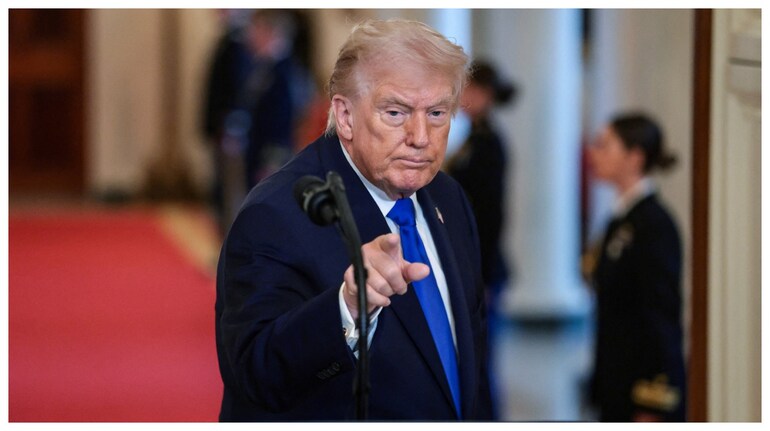

Washington has offered differing signals about the likely duration of its military campaign against Iran, as hostilities intensify across the Middle East with new waves of airstrikes, missile barrages and drone attacks.
While US Defence Secretary Pete Hegseth dismissed suggestions that the conflict could drag on indefinitely, President Donald Trump has declined to put a timeline on the operation. Israeli Prime Minister Benjamin Netanyahu has described the offensive as forceful and targeted, but cautioned that it may not be over quickly. Meanwhile, US Secretary of State Marco Rubio has portrayed the campaign as a pre-emptive move aimed at neutralising an imminent threat.
The lack of clarity over how long the fighting could continue comes as violence spreads throughout the region. US and Israeli forces have stepped up strikes on Iranian territory, while Tehran has responded with attacks on Israel and on sites linked to the US in several Gulf states.
Trump: No deadline, all options open
Speaking at the White House, Trump said the mission would not be governed by a fixed schedule. “Whatever the time is, it’s okay — whatever it takes,” he said, adding that early estimates suggested the campaign could last four to five weeks, but stressing that US forces are prepared to operate far beyond that if required.
In his first comprehensive remarks since the strikes began, Trump laid out four central goals: dismantling Iran’s missile arsenal, crippling its naval forces, ensuring Tehran cannot develop a nuclear weapon, and halting its support for militant groups operating beyond its borders.
Rubio provided additional context, saying the US chose to act after learning Israel was preparing military action and assessing that Iran was positioning to strike American forces in the region. He characterised the intervention as a pre-emptive step taken in coordination with Israel to head off a broader threat. Rubio also noted that the US military presence in the Middle East has surged to levels not seen since the 2003 Iraq invasion, underscoring the scale of the operation.
The US President claimed operations were advancing “substantially” faster than anticipated, yet underscored that Washington is ready for a drawn-out engagement if necessary. He has declined to rule out deploying American ground troops, saying the US military is fully capable of sustaining an extended campaign.
Hegseth, however, sought to draw a distinction between the current conflict and past prolonged wars. “This is not Iraq. This is not endless,” he said, even as he acknowledged that additional American casualties are likely in the weeks ahead.
Netanyahu: Not a forever war
Netanyahu has similarly rejected the notion of an open-ended war but avoided offering a clear timeframe. In a television interview, he described the operation as “quick and decisive,” while conceding it “may take some time.” He emphasised that the campaign would not stretch into years, signalling expectations of a limited — though potentially lengthy — effort.
Evacuation warning and rising casualties
As the conflict widens, the US State Department has urged American citizens to leave much of the Middle East immediately, citing serious security risks. The advisory applies to 14 countries: Bahrain, Egypt, Iran, Iraq, Israel and the Palestinian territories, Jordan, Kuwait, Lebanon, Oman, Qatar, Saudi Arabia, Syria, the United Arab Emirates and Yemen.
With no ceasefire in sight and leaders declining to define a clear end point, the duration of the war remains uncertain as the region braces for further escalation.
Discover the latest Business News, Sensex, and Nifty updates. Obtain Personal Finance insights, tax queries, and expert opinions on Moneycontrol or download the Moneycontrol App to stay updated!
Find the best of Al News in one place, specially curated for you every weekend.
Stay on top of the latest tech trends and biggest startup news.