






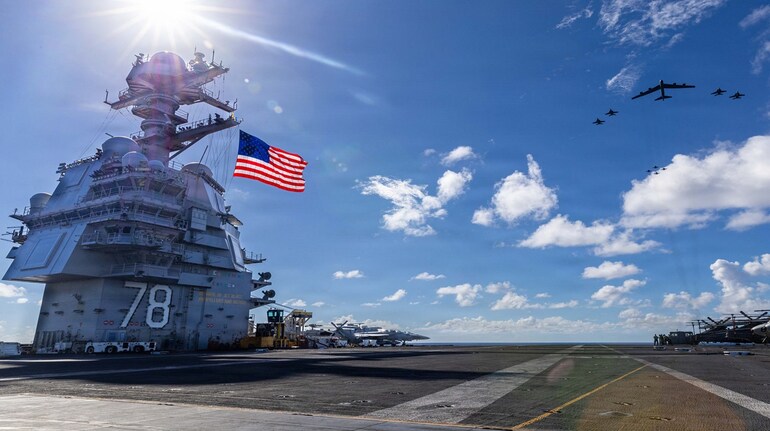

The decision by US President Donald Trump to extend the deployment of the aircraft carrier USS Gerald R. Ford for a second time is reportedly taking a mounting emotional and operational toll on thousands of sailors and their families.
The nuclear-powered carrier, the largest warship in the US fleet, has been at sea since June last year.
What began as a scheduled Mediterranean deployment has evolved into a prolonged, globe-spanning mission that has kept its roughly 5,000 crew members away from home for eight months, with the possibility of stretching to 11 months, potentially the longest continuous deployment for a US Navy ship.
In October, the Pentagon redirected the Ford from the Mediterranean to the Caribbean to support US operations targeting oil-tanker seizures and efforts linked to then-Venezuelan leader Nicolas Maduro. Earlier this year, sailors were informed that the ship’s deployment would be extended again, this time sending it back across the Atlantic toward the Middle East, reported The Wall Street Journal.
The carrier transited the Strait of Gibraltar heading east, positioning itself amid rising tensions between Washington and Tehran.
The US-Iran relationship has deteriorated sharply in recent months.
The Biden and Trump administrations alike have grappled with Iran’s advancing nuclear programme, regional proxy conflicts, and escalating maritime confrontations in the Gulf. Iran-backed militias have targeted US assets in Iraq and Syria, while Yemen’s Houthi rebels have attacked commercial shipping in the Red Sea, prompting American retaliatory strikes.
Inside Iran, the government continues to face periodic internal unrest driven by economic hardship, sanctions pressure, and political dissent. Western officials have warned that regional instability could widen if direct US-Iran hostilities erupt.
Against that backdrop, US carrier strike groups, including the Ford and the USS Abraham Lincoln, have been deployed as deterrence platforms capable of launching air operations at short notice.
"The sting" of extension
Carrier deployments during peacetime typically last about six months, with contingency buffers built in, said retired Rear Adm. Mark Montgomery, according to interviews conducted by the Journal. Extending beyond that window strains both personnel and hardware.
Capt. David Skarosi, the Ford’s commanding officer, acknowledged the emotional impact of the second extension in a February 14 letter to families.
He described the "sting" of the additional time at sea and wrote that even he had expected to be home within weeks, "fixing the fence in his backyard".
"I’ve spoken to many of your Sailors who are coming to terms with missing Disney World plans, weddings they already RSVP’d to attend, and spring break trips to Busch Gardens," Skarosi has been cited by the Journal. But “when our country calls, we answer,” he concluded.
For some sailors, that sacrifice has become increasingly difficult to bear.
One crew member told the Journal she is strongly considering leaving the Navy at the end of the deployment. She said she misses her toddler daughter deeply, but the hardest part is not knowing when she will next see her family.
Extensions have meant missed funerals, birthdays and major life events. One sailor was unable to attend his great-grandfather’s funeral. Others have missed family health crises and milestones back home.
Families left waiting
Jami Prosser of Pennsylvania said it is typical not to hear from his son, a flight deck controller aboard the Ford, for two or three weeks at a time when the ship operates in “ghost mode.” Then, without warning, “one night the phone will ring at 3 a.m.”
Prosser’s son, who has two children, missed his great-grandfather’s death and other family hardships during the current deployment. He also hasn’t been able to handle routine home repairs.
Scott Tomlin, another parent, said his son frequently requests care packages of macaroni and cheese, spam and hot sauce. His son’s girlfriend periodically starts his truck to keep it running.
Operational strain and shipboard issues
Extended deployments also weigh heavily on equipment. After eight months at sea, maintenance backlogs grow and shipyard schedules are disrupted, Montgomery noted.
Moroever, the Ford has faced technical challenges as well.
According to a Navy official, the carrier’s vacuum-based sewage system, which services roughly 650 toilets, has averaged about one maintenance call per day during the deployment. While the situation is improving and has not affected mission capability, NPR reported earlier that a number of toilets were temporarily out of service.
Sailors told the Journal that such inconveniences, combined with high operational tempo, have compounded fatigue.
Commitment amid uncertainty
Not all aboard the Ford, however, express frustration.
One sailor said that although exhaustion is widespread, crew members understood the demands of naval service when they enlisted. Their mission, he said, is to ensure that conflict does not reach American shores, even if that means months away from home.
Adm. Daryl Caudle, chief of naval operations, has acknowledged both the financial and human cost of extended deployments.
As geopolitical tensions simmer in the Middle East and uncertainty clouds the US-Iran trajectory, the Ford remains at sea. For its crew and their families, meanwhile, the strategic calculus is measured not only in deterrence and readiness, but also in missed milestones, midnight phone calls and the hope of a homecoming date that holds firm.
Discover the latest Business News, Sensex, and Nifty updates. Obtain Personal Finance insights, tax queries, and expert opinions on Moneycontrol or download the Moneycontrol App to stay updated!
Find the best of Al News in one place, specially curated for you every weekend.
Stay on top of the latest tech trends and biggest startup news.





