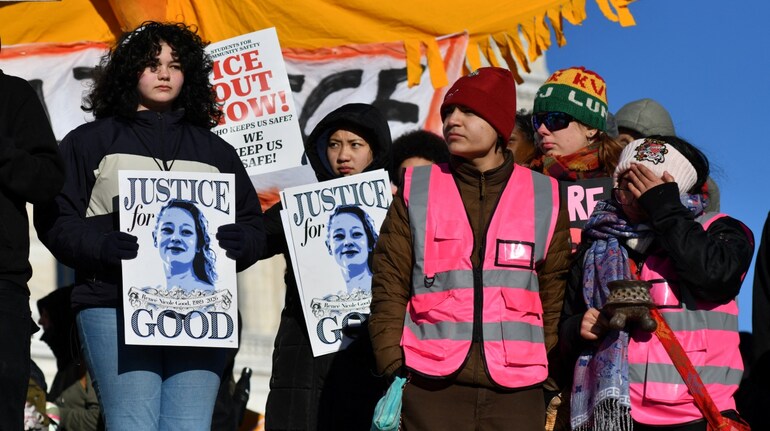

US President Donald Trump has warned that he could invoke the Insurrection Act, a centuries-old law that allows the deployment of the US military on American soil, as protests and clashes continue in the state of Minnesota.
The warning came after unrest in Minneapolis, following the fatal shooting of a woman by a federal immigration agent last week and a separate incident in which another federal officer shot and injured a man during a confrontation on Wednesday.
What Trump said
In a post on his Truth Social platform, Trump accused Minnesota’s political leadership of failing to control the situation and warned of federal action.
“If the corrupt politicians of Minnesota don’t obey the law and stop the professional agitators and insurrectionists from attacking the Patriots of I.C.E., who are only trying to do their job, I will institute the INSURRECTION ACT, which many Presidents have done before me, and quickly put an end to the travesty that is taking place in that once great state," Trump wrote.
The remarks mark the latest instance of Trump threatening to use the Insurrection Act. He made similar threats last year during unrest in Portland, Oregon, and Chicago, when legal disputes arose over National Guard deployments.
What triggered the protests
Tensions in Minneapolis have been building for days amid a stepped-up federal immigration crackdown. The situation escalated last week after an agent from US Immigration and Customs Enforcement shot and killed a woman in the city.
Fresh protests erupted on Wednesday evening following another confrontation involving federal officers. According to CNN, the incident occurred around 6:50 pm when a federal officer attempted a “targeted traffic stop” involving a Venezuelan national.
Authorities said the man tried to flee after crashing into a parked car, resisted arrest, and violently assaulted the officer. During the scuffle, two other individuals allegedly attacked the officer using a snow shovel and a broom handle. The officer then fired a defensive shot, wounding the Venezuelan national in the leg.
All three men were later taken into custody. Both the officer and the injured man were hospitalised. Protesters soon gathered at the scene, clashing with law enforcement as tear gas and flashbang grenades were used to disperse crowds. US Customs and Border Protection Commander Gregory Bovin has since been deployed to Minneapolis.
Response from city leaders
Local officials have urged calm and warned that escalating violence would only worsen the situation.
“For those who have peacefully protested, I applaud you. For those who are taking the bait, you are not helping, and you are not helping the undocumented immigrants of our city. You are not helping the people who call this place home,” Minneapolis Mayor Jacob Frey said.
He also highlighted the standoff between different levels of government. “We have two governmental entities that are literally fighting one another,” Frey said, adding that the situation is “not sustainable.”
Why Trump is threatening military deployment
The Trump administration has sent hundreds of federal agents to Minneapolis as part of its immigration enforcement drive. Critics argue that the increased federal presence has inflamed tensions and created conditions that could be used to justify military intervention.
Trump has now said he is prepared to invoke the Insurrection Act if protests continue and federal agents are attacked. The law allows the president to deploy active-duty military forces inside the US to restore order.
The Insurrection Act was last used in 1992, when then President George H W Bush sent troops to Los Angeles at the request of California’s governor during widespread riots.
What is the Insurrection Act
The Insurrection Act is a set of laws passed between 1792 and 1871 and commonly referred to as the Insurrection Act of 1807. It allows the US president to deploy military forces to suppress civil disorder, rebellion or insurrection.
Normally, the 1878 Posse Comitatus Act bars the US military from performing civilian law enforcement duties. The Insurrection Act is a key exception to that rule.
Under the law, the president can act if state authorities are unable or unwilling to enforce federal law or protect constitutional rights. While the Act is often invoked after a request from a state governor or legislature, it also allows the president to act on his own authority in certain circumstances.
Section 252 permits the president to use the armed forces to enforce federal law when it becomes impracticable to do so through normal judicial processes. Section 253 allows military deployment to suppress insurrection or domestic violence that deprives citizens of constitutional rights or obstructs the execution of US laws.
Why the law is controversial
Legal experts and civil rights groups warn that the Insurrection Act’s broad language makes it vulnerable to misuse. Critics argue that invoking it against protesters risks militarising domestic law enforcement and undermining democratic norms.
Some opponents of the Trump administration claim that the heavy federal presence in Minneapolis is aimed at escalating tensions. They accuse Trump of seeking a pretext to deploy troops domestically and have described him as a “dictator-in-waiting.”
Concerns have also resurfaced because senior figures in Trump’s first administration reportedly discussed using the Insurrection Act after he lost the 2020 election, as a way to challenge the transfer of power to Joe Biden.
For now, the Act has not been invoked. But Trump’s warning has placed Minnesota at the centre of a national debate over federal power, protest policing and the limits of presidential authority inside the United States.
Discover the latest Business News, Sensex, and Nifty updates. Obtain Personal Finance insights, tax queries, and expert opinions on Moneycontrol or download the Moneycontrol App to stay updated!
Find the best of Al News in one place, specially curated for you every weekend.
Stay on top of the latest tech trends and biggest startup news.