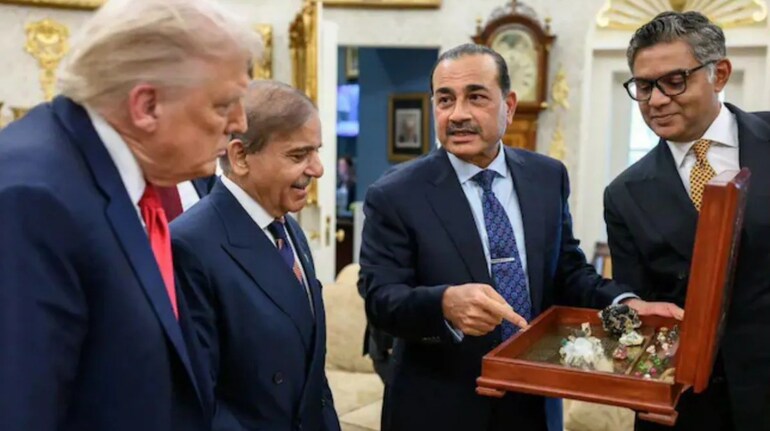
Pakistan Army chief Asim Munir is facing a crisis of his own making, caught between appeasing Washington and managing an increasingly volatile domestic audience at home. The immediate trigger is a push from the United States, led by President Donald Trump, for Pakistan to contribute troops to an International Stabilisation Force in Gaza. For Munir, the decision carries political, religious and strategic risks, all of which expose how deeply Pakistan’s military leadership is entangled in external dependencies.
Munir’s dilemma comes as he prepares for yet another visit to Washington, his third in less than six months, to meet Trump. The US president has unveiled a 20-point plan to stabilise Gaza, a framework that has received United Nations backing and places pressure on Muslim countries, especially those with strong militaries, to shoulder responsibility on the ground.
What is the Gaza stabilisation force?Trump’s Gaza plan envisages an International Stabilisation Force drawn largely from Muslim nations to oversee a transition period focused on reconstruction, economic revival and security after more than two years of Israeli military operations. According to Axios, Trump plans to appoint a two-star US general to lead the force, with coordination headquarters already set up in Israel. While Washington is taking charge of planning and oversight, the White House has stressed there will be no US boots on the ground.
A recent conference in Qatar discussed how the force could be structured. Countries invited included Pakistan, Egypt, Indonesia, Qatar, Jordan, the UAE, Italy, France, the UK and Azerbaijan, according to The Times of Israel. Notably absent was Turkey, a vocal backer of Hamas and a regional rival of Israel.
Many of the invited Muslim states are wary of being dragged into direct confrontation with Hamas over demilitarisation. Pakistan stands out in this group, not only because of its large and battle hardened army but also because it is the world’s only Muslim country with nuclear weapons.
Pakistan’s long hostility towards IsraelPakistan has never recognised Israel and has historically positioned itself as a staunch supporter of the Palestinian cause. This stance dates back to 1948, when Pakistan’s founding leadership under Muhammad Ali Jinnah opposed the creation of a Jewish state. Islamabad still bars travel to Israel on Pakistani passports and views Israel as a close strategic partner of India.
Unlike the UAE, Bahrain, Morocco and Sudan, Pakistan stayed out of the US-backed Abraham Accords, insisting that normalisation can only follow the creation of a Palestinian state with East Jerusalem as its capital. Over decades, this position has hardened into domestic orthodoxy.
The Gaza war that began in October 2023 has further inflamed public opinion. Pakistan has repeatedly described Israeli actions as genocide, labelled Prime Minister Benjamin Netanyahu a terrorist, and accused him of war crimes, accusations Israel has rejected. Anti-Israel sentiment runs deep among Islamist parties, clerics and large sections of the public, many of whom have the street power to mobilise protests at short notice.
Even though Islamabad banned a powerful and often violent Islamist party in October and arrested more than 1,500 of its supporters, its ideology remains influential. At the same time, supporters of jailed former prime minister Imran Khan, whose party emerged as the single largest force in the 2024 elections, remain openly hostile to Munir.
Why Munir is boxed inSince becoming army chief, Munir has carefully cultivated an image as a devout Muslim and guardian of Islamic values. Sending Pakistani troops to Gaza under a US led framework that ultimately secures Israel’s interests would directly contradict that image. Domestically, such a move would likely be portrayed as Pakistan’s army doing Israel’s bidding, a charge that could ignite unrest.
The risk is not hypothetical. Islamist parties and clerics could quickly turn public anger against Munir, especially at a time when resentment over Imran Khan’s imprisonment is already high. Pakistan could also face diplomatic backlash from countries like Turkey, Oman and Qatar, which have historically taken more sympathetic positions towards Hamas.
Experts say Munir has little room to manoeuvre. “Not contributing (to the Gaza stabilisation force) could annoy Trump, which is no small matter for a Pakistani state that appears quite keen to remain in his good graces -- in great part to secure US investment and security aid,” said Michael Kugelman, Senior Fellow for South Asia at the Atlantic Council.
Ayesha Siddiqa, author and defence analyst, pointed out that Pakistan’s military capacity cuts both ways. Its strength means “there is a greater pressure on Munir to deliver his capacity.” Abdul Basit, Senior Associate Fellow at Singapore’s S. Rajaratnam School of International Studies, warned that the fallout could be swift if violence escalates once the force is deployed. “People will say ‘Asim Munir is doing Israel’s bidding’; it will be foolhardy of anyone not to see it coming,” he said.
Even Pakistan’s foreign minister Ishaq Dar has tried to hedge. Last month, Dar said Islamabad could consider contributing troops for peacekeeping but made it clear that disarming Hamas “is not our job.” The statement underlined Pakistan’s attempt to keep both Washington and domestic opinion at bay, a balancing act that looks increasingly untenable.
The Trump-Munir equationDespite these risks, Munir is unlikely to walk away from Washington’s demands easily. He has invested heavily in rebuilding ties with Trump after years of mistrust between the US and Pakistan. That effort paid off in June, when Munir was hosted for a White House lunch, the first time a US president met Pakistan’s army chief alone without civilian leaders.
This bonhomie has raised alarms in India, especially after the US cleared a 686 million dollar F 16 sustainment package for Pakistan, reinforcing concerns about a transactional US-Pakistan military relationship driven by short-term interests. Analysts see Trump’s engagement with Munir as part of a broader pattern in which Washington prioritises utility over accountability, even as Pakistan’s record on terrorism and regional stability remains deeply problematic.
Munir’s personal power has also expanded dramatically. Earlier this month, he was appointed chief of the defence forces, bringing the air force and navy under his command, and granted an extension until 2030. Under recent constitutional amendments pushed through by Pakistan’s civilian government, Munir enjoys lifetime immunity from criminal prosecution and will retain his field marshal title permanently.
“Few people in Pakistan enjoy the luxury of being able to take risks more than Munir. He has unbridled power, now constitutionally protected,” Kugelman said. “Ultimately, it will be Munir’s rules, and his rules only.”
A familiar patternPakistan’s military establishment has long sought external validation and resources, often at the cost of internal stability and regional credibility. Munir’s Gaza dilemma fits that pattern. Over the past weeks, he has met leaders from Indonesia, Malaysia, Saudi Arabia, Turkey, Jordan, Egypt and Qatar, engagements that analysts like Siddiqa believe are consultations on the Gaza force.
Yet the reality is stark. Whether Munir sends troops or refuses, Pakistan stands to lose. Compliance risks domestic backlash and further exposes the army’s dependence on Washington. Refusal risks angering Trump at a time when Islamabad is desperate for US investment, military aid and diplomatic cover.
For Pakistan and Asim Munir, the Gaza stabilisation force is not just a foreign policy challenge. It is a mirror reflecting the contradictions of a military-dominated state that wants to play the role of Islamic defender at home while cutting transactional deals abroad.
Discover the latest Business News, Sensex, and Nifty updates. Obtain Personal Finance insights, tax queries, and expert opinions on Moneycontrol or download the Moneycontrol App to stay updated!
Find the best of Al News in one place, specially curated for you every weekend.
Stay on top of the latest tech trends and biggest startup news.