






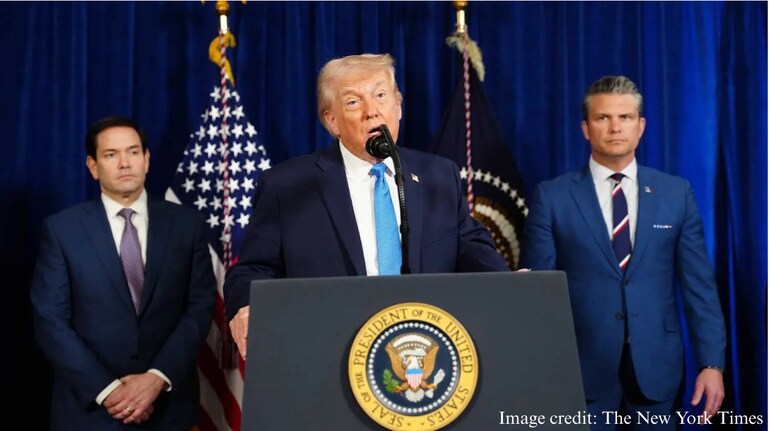

US President Donald Trump on Sunday shared a chart highlighting welfare and public assistance usage among immigrant households in the United States, drawing attention to wide disparities between countries of origin. Notably, India was absent from the list, even as several of its neighbours, including Pakistan, Bangladesh, Bhutan, China, and Nepal, were prominently featured.
The chart, titled “Immigrant Welfare Recipient Rates by Country of Origin,” was posted on Trump’s Truth Social platform and covered nearly 120 countries and territories. It listed the percentage of immigrant households receiving some form of government assistance, though it did not specify the type or duration of benefits included.
President Trump posts data outlining Immigrant Welfare Recipient Rates by Country of Origin. The Top Three: -Bhutan: 81.4% -Yemen Arab Republic (North): 75.2% -Somalia: 71.9% pic.twitter.com/it9uBVnXFo— America (@america) January 4, 2026
Among South Asian countries, Bangladesh was listed with 54.8 per cent of immigrant households receiving assistance, followed by Pakistan at 40.2 per cent and Nepal at 34.8 per cent. China appeared at 32.9 per cent, while Bhutan recorded the highest welfare participation overall at 81.4 per cent. Ukraine was listed at 42.7 per cent, and a broader category labelled “Asia (not elsewhere classified)” stood at 38.8 per cent.
India’s absence stood out given the size of the Indian-origin population in the US. The omission comes as Trump continues to foreground immigration, welfare dependence, and economic contribution as key political issues.
The data shared also highlighted countries with the highest and lowest levels of welfare usage. At the top were Bhutan, Yemen, Somalia, the Marshall Islands, Afghanistan, and the Dominican Republic, all with more than two-thirds of immigrant households receiving assistance.
At the lower end of the scale were Bermuda, Saudi Arabia, Israel/Palestine, Argentina, and Korea, all hovering around the 25–27 per cent range. No country listed fell significantly below the 25 per cent mark.
Indian Americans among the top earners in the US
Separate research consistently shows that Indian Americans are among the most economically successful immigrant groups in the United States. According to the Pew Research Centre, Indian Americans are the second-largest Asian-origin group in the country, accounting for about 21 per cent of the Asian population.
Pew data from 2023 shows the median annual income of Indian-headed households at USD 151,200, significantly higher than the USD 105,600 median for Asian-headed households overall. Immigrant-headed Indian households reported even higher median earnings of USD 156,000, compared with USD 120,200 for US-born Indian households.
On an individual level, Indian Americans aged 16 and above had median annual earnings of USD 85,300, far exceeding the USD 52,400 median for Asians overall.
Experts attribute these figures to selective immigration pathways such as H-1B visas, high levels of education, and concentration in professional fields including technology, medicine, and engineering. These factors have contributed to low reliance on public assistance among Indian immigrants, likely placing India well below the apparent threshold used in Trump’s chart.
The chart did not explain why certain countries were excluded or clarify the methodology behind the welfare data. However, India’s absence reinforces long-standing data showing Indian Americans as one of the most financially self-sufficient immigrant communities in the United States.
Discover the latest Business News, Sensex, and Nifty updates. Obtain Personal Finance insights, tax queries, and expert opinions on Moneycontrol or download the Moneycontrol App to stay updated!
Find the best of Al News in one place, specially curated for you every weekend.
Stay on top of the latest tech trends and biggest startup news.





