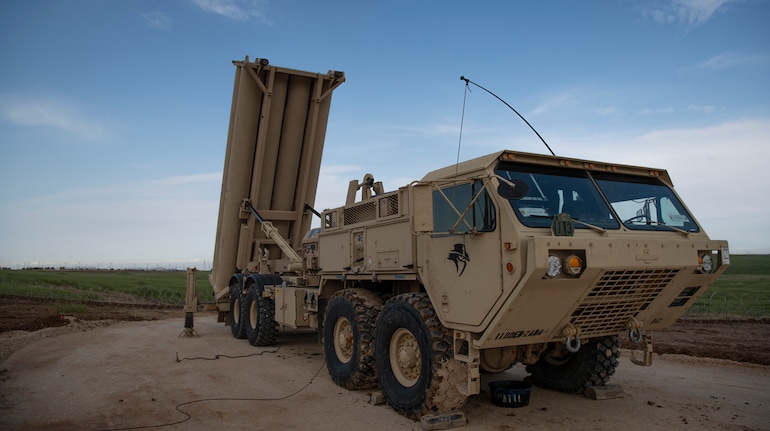

As Iran steps up drone and cruise missile strikes across the Gulf, air defence systems across the region are being activated to intercept incoming threats before they hit the ground and cause large-scale destruction. Designed to detect, track and neutralise aerial targets within seconds, these missile shields form the first line of defence during such high-intensity attacks.
Here is a look at some of the air defence systems that are prominently used in different parts of the world to counter evolving aerial threats.
THAAD (Terminal High Altitude Area Defense)
Terminal High Altitude Area Defense (THAAD) is a transportable system that intercepts ballistic missiles during their final, or terminal, phase of flight. It incorporates an X-band radar, the AN/TPY-2, and a single-stage, hit-to-kill interceptor to defeat ballistic missiles inside or outside of the atmosphere.
THAAD operates in the middle layer of the United States’ broader Ballistic Missile Defense System (BMDS). It covers a larger defended area than Patriot and serves as an underlayer to more advanced exoatmospheric systems like Aegis BMD and Ground-Based Midcourse Defense (GMD).
THAAD consists of four major components: the interceptor, launch vehicle, radar and fire control system.
The THAAD system defend targets at ranges of 150-200 km. Unlike other missile defense systems, THAAD can intercept targets within (endoatmospheric) and outside (exoatmospheric) the atmosphere.
Patriot missile system (MIM-104 Patriot)
The MIM-104 Patriot is the U.S. Army’s primary air and missile defense system. While initially designed as an antiaircraft system, newer variants of Patriot are capable of engaging ballistic and cruise missiles, loitering munitions, and aircraft.”
A typical Patriot battery includes a radar set, engagement control station, power units and multiple launch stations. Today, 18 countries operate the system.
The Patriot missile defense system consists of six major components: a 1) missile, 2) launcher, 3) radar set, 4) control station, 5) power generator unit, and 6) high-frequency antenna mast.
Iron Dome
Iron Dome is an Israeli mobile missile defense system designed to intercept short-range rockets and artillery.
It forms the lowest tier of Israel’s multi-layered missile defence architecture, primarily countering rocket and drone threats.
The system consists of three main elements: the Tamir interceptor and its launcher, the ELM 2084 Multmission Radar (MMR), and a battle management and weapon control system (BMC).
An Iron Dome battery typically includes three to four launchers, each capable of carrying up to 20 Tamir interceptors.
Each Iron Dome battery can defend an area of up to 150 square kilometers against short-range missiles, mortars, and rockets.
The system is designed to conserve interceptors by distinguishing between projectiles headed toward populated areas and those likely to land in open terrain.
David's Sling
David’s Sling is an Israeli air and missile defense system designed to defeat short-range ballistic missiles, large-caliber rockets, and cruise missiles.
Co-developed with the United States, David’s Sling occupies the middle tier of Israel’s missile defence structure between Iron Dome and the long-range Arrow systems.
The David’s Sling Weapon System (DSWS) incorporates a vertical missile firing unit, an ELM-2084 fire control radar, a battle management/operator station, and the Stunner interceptor.
It is designed to intercept threats at ranges between 40 and 300 km.
S-300 and S-200
The S-200 is a Russian medium to high altitude surface-to-air missile (SAM) system. A highly-proliferated weapon, it is currently in service in at least 12 countries.
The S-300 family, meanwhile, represents a more advanced generation.
The S-300 is a family of Russian-made surface-to-air missile (SAM) systems capable of engaging aircraft and UAVs in addition to providing some cruise and ballistic missile defense capability.
Variants such as the S-300V include anti-ballistic missile features, giving it limited missile defence capabilities alongside traditional air defence roles.
S-400 Triumf
The S-400 Triumf (NATO: SA-21 Growler) is a mobile, surface-to-air missile system (SAM) designed by Russia.
It represents the fourth generation of long-range Russian SAMs and the successor to the S-200 and S-300 systems.
It is capable of engaging aircraft, UAVs, cruise missiles, and has a terminal ballistic missile defense capability.
The S-400’s mission profile and capabilities are often compared with the U.S. Patriot system.
Aegis Ballistic Missile Defense System
The Aegis Ballistic Missile Defense (BMD) System, is the sea-based component of the Ballistic Missile Defense System (BMDS). It uses the SPY-1 radar and variants of Standard Missile-3 (SM-3) or Standard Missile-6 to intercept ballistic missiles during midcourse or terminal phases of flight.
Unlike land-based systems, Aegis BMD operates from naval vessels, providing flexible and mobile missile defence coverage across strategic maritime regions.
Discover the latest Business News, Sensex, and Nifty updates. Obtain Personal Finance insights, tax queries, and expert opinions on Moneycontrol or download the Moneycontrol App to stay updated!





Find the best of Al News in one place, specially curated for you every weekend.
Stay on top of the latest tech trends and biggest startup news.