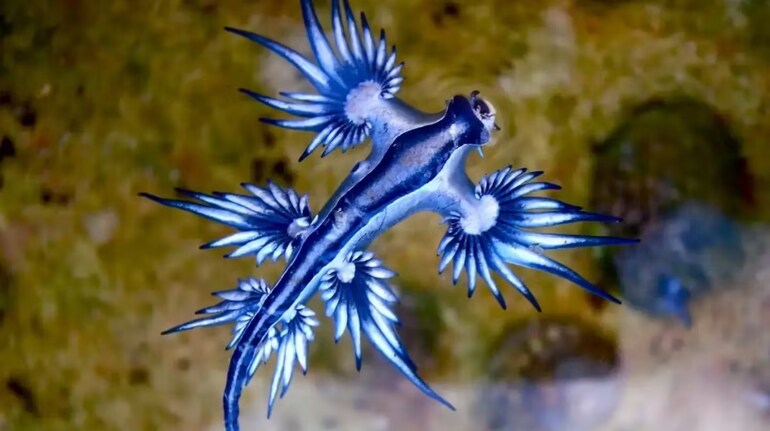
Authorities in Spain have urged residents and tourists to avoid swimming at some beaches after the discovery of rare, venomous sea slugs known as Blue Dragons.
The striking creatures, scientifically named Glaucus atlanticus, appeared on the shore of Guardamar del Segura in Alicante, Costa Blanca, leading officials to shut beaches for a day as a precaution. The “most beautiful killer in the ocean” feeds on the Portuguese man o’ war and stores its venom in a more concentrated form, making it highly dangerous.
What we know about Blue Dragons
Recognisable by their vivid dark and light blue stripes, Blue Dragons have three pairs of appendages tipped with tendrils that spread out like wings, giving them a floating, almost flying appearance.
According to the US Bureau of Ocean Energy Management, these sea slugs are foraging predators, drifting on ocean currents while staying buoyant with the help of a gas bubble in their stomachs. Their unique colouring helps camouflage them -- blue undersides blend with the sea from above, while silvery-grey backs make them less visible from below.
Native to warm and temperate waters of the Atlantic, Pacific and Indian Oceans, they have also been spotted off Australia, South Africa, and, more recently, on the Texas Gulf Coast in 2022.
How dangerous are they?
The sting of a Blue Dragon is as powerful as that of its prey, the Portuguese man o’ war. The sea slug consumes the venom of its prey and stores it at the tips of its appendages, releasing it in bursts when threatened.
Jace Tunnell, director of community engagement at the Harte Research Institute for Gulf of Mexico Studies, told the BBC: “That’s what makes them so dangerous, since they can release the stinging cells all at one time. It can be three times the intensity as a man-o-war due to that.”
Despite their delicate appearance, Blue Dragons can also attack one another, sometimes displaying cannibalistic behaviour in captivity, according to The Sun UK.
Stings can cause severe skin reactions, pain, nausea and vomiting.
Spain’s warning for tourists
Jose Luis Saez, mayor of Guardamar del Segura, posted on X: “Bathing is prohibited following the appearance on Vivers Beach of two specimens of Glaucus atlanticus, known as the Blue Dragon… people should stay away from this animal because of its sting.”
A day later, he said the alert had been downgraded to yellow following a “special surveillance operation,” though tourists are still being warned not to touch the creatures.
It is not the first time that dangerous sea life has alarmed Costa Blanca beaches. In 2018, Portuguese men o’ war sightings prompted similar restrictions, with one 11-year-old boy hospitalised after a sting.
Discover the latest Business News, Sensex, and Nifty updates. Obtain Personal Finance insights, tax queries, and expert opinions on Moneycontrol or download the Moneycontrol App to stay updated!
Find the best of Al News in one place, specially curated for you every weekend.
Stay on top of the latest tech trends and biggest startup news.