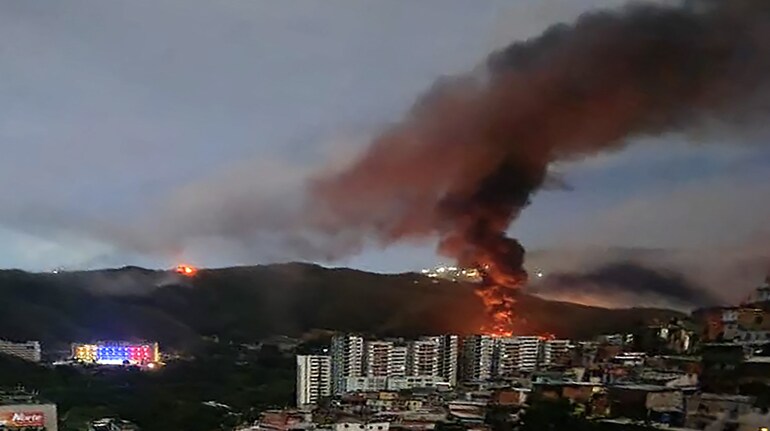

The American military operation that captured Nicolás Maduro and his wife in Caracas has sent shock waves through capitals around the world, triggering a mix of outrage, unease and reluctant acceptance. While the United States has framed the raid as a necessary action against a criminal regime, many governments see it as a troubling act of unilateral force that risks destabilising an already fragile region, the New York Times reported.
The reaction was most hostile in Latin America, where memories of US military interventions run deep. Several regional leaders denounced what they called a violation of sovereignty, warning that Washington had crossed a dangerous line.
“This recalls the worst moments of interference in the politics of our region,” said Luiz Inácio Lula da Silva, condemning the operation as an unacceptable assault on Venezuela’s independence.
Latin America reacts with anger
In neighbouring Colombia, President Gustavo Petro rejected what he described as aggression against both Venezuela and Latin America. He announced that Colombian forces were being deployed to the border in anticipation of possible refugee flows.
Chile’s president, Gabriel Boric, also criticized the US action, calling for dialogue rather than military force. Mexico’s government issued a strongly worded statement urging respect for international law and warning that unilateral action could fuel regional instability.
In Cuba, a close ally of Maduro, President Miguel Díaz-Canel denounced what he called a criminal attack and urged an urgent global response.
Europe walks a careful line
European reactions were notably more cautious. Many leaders expressed little sympathy for Maduro, widely viewed as an illegitimate ruler, while stopping short of endorsing the American operation.
Germany’s chancellor, Friedrich Merz, described the intervention as “complex” and said the priority must now be an orderly transition to an elected government. France’s president, Emmanuel Macron, said Venezuelans could “rejoice” at the end of dictatorship but avoided addressing the legality of the US raid.
France’s foreign minister, however, was more explicit, warning that the operation violated the principle against the use of force enshrined in international law.
The European Union echoed that caution. Its foreign policy chief said the bloc was monitoring the situation closely, urging restraint and emphasizing the safety of European citizens in Venezuela.
Britain’s prime minister, Keir Starmer, said London would consult allies and establish the facts, later adding that while few would mourn Maduro’s departure, any transition should be peaceful.
Russia and Iran condemn, despite their own records
Russia, a longtime supporter of Maduro, condemned the US action as armed aggression and called for an emergency meeting of the UN Security Council. The statement drew pointed criticism from diplomats who noted Moscow’s own invasion of Ukraine.
Iran also denounced the raid, accusing Washington of violating the UN Charter.
Some regional support for Washington
Not all responses were negative. Javier Milei, a close ideological ally of President Trump, welcomed the capture of Maduro, writing simply: “Liberty advances.”
Ukraine, locked in its own war with Russia, also voiced support. Its foreign minister argued that the US action defended the right of nations to live free from dictatorship.
Canada took a middle position. Prime Minister Mark Carney avoided condemnation, instead calling for respect for international law and a Venezuelan-led democratic transition.
Echoes of past interventions
The raid has revived comparisons to the 1989 US invasion of Panama, when American forces captured Manuel Noriega and brought him to the United States to face drug trafficking charges. That episode, too, divided global opinion and left a lasting imprint on Latin America’s relationship with Washington.
Critics of the current operation argue that even if Maduro’s removal is welcomed, the precedent is deeply unsettling.
As Jordan Bardella, a leading figure on France’s far right, put it: “No one will miss the Maduro regime. But international law cannot be applied selectively.”
A moment of uncertainty
For now, the world is watching to see what comes next. The United States has promised a transition, but the manner of Maduro’s removal has reopened old debates about power, sovereignty and the limits of military force.
Whether the operation ultimately stabilises Venezuela or deepens global mistrust may shape diplomatic relations far beyond Latin America — and long after the shock of the raid fades.
Discover the latest Business News, Sensex, and Nifty updates. Obtain Personal Finance insights, tax queries, and expert opinions on Moneycontrol or download the Moneycontrol App to stay updated!
Find the best of Al News in one place, specially curated for you every weekend.
Stay on top of the latest tech trends and biggest startup news.