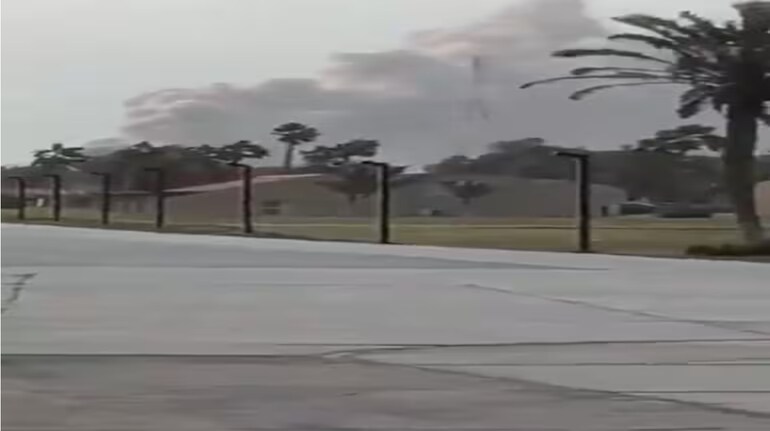
Saudi Arabia’s state oil giant Saudi Aramco has shut its Ras Tanura refinery following a drone strike, an industry source said on Monday, marking a significant escalation as Tehran expands retaliatory strikes across the region after the US-Israeli attack on Iran.
The Ras Tanura complex, located on Saudi Arabia’s Gulf coast, houses one of the Middle East’s largest refineries with a capacity of 550,000 barrels per day (bpd) and serves as a key export terminal for Saudi crude. The temporary closure has raised concerns over global oil supply and energy security.
Saudi defence intercepts drones
Two drones targeting the facility were intercepted, Saudi authorities said. Two drones targeting Saudi Arabia’s Ras Tanura refinery were intercepted and destroyed, Saudi defense ministry spokesperson Turki Al-Malki was cited as saying by state-run Al Ekhbariya TV.
The refinery is one of Saudi Arabia’s largest and has a capacity of 550,000 barrels a day. According to reports, Iran’s Shahed-136 drone struck the facility early Monday, triggering what was described as a “small and controlled” fire. There were no immediate reports of casualties. Saudi officials said additional drones attempting to strike the refinery were successfully repelled.
Strategic importance of Ras Tanura
Ras Tanura, located in Saudi Arabia’s Eastern Province, is among the world’s most important oil export hubs. Operated by Saudi Aramco, the facility integrates refining operations with a major export terminal capable of loading millions of barrels of crude onto tankers bound for Asia, Europe and the United States.
The complex includes large-scale refining units, storage tanks, pipeline networks and port infrastructure designed to support global crude shipments. Given its strategic significance, the site is heavily fortified and equipped with advanced surveillance and security systems.
Any disruption at Ras Tanura can have immediate implications for global oil markets, potentially tightening supply and driving up crude prices.
Regional impact and oil market reaction
The attack comes as tensions escalate across the Gulf, with strikes reported in Abu Dhabi, Dubai, Doha, Manama and Oman’s commercial port area of Duqm. Shipping activity in parts of the United Arab Emirates and Oman has reportedly been disrupted.
Brent crude futures surged roughly 10% on Monday following the attacks, reflecting market fears over supply instability.
Separately, most oil production in Iraq’s Kurdistan region, which exported around 200,000 bpd to Turkey in February, was reportedly halted over the weekend as a precaution.
History of attacks on Saudi energy infrastructure
Saudi Arabia’s energy facilities have been targeted in the past. In September 2019, drone and missile attacks on the Abqaiq and Khurais plants temporarily knocked out more than half of the kingdom’s crude production, causing sharp volatility in global markets.
Ras Tanura was also targeted in 2021 in what Saudi officials described as a failed attack on global energy security. Aramco did not immediately respond to requests for comment.
Discover the latest Business News, Sensex, and Nifty updates. Obtain Personal Finance insights, tax queries, and expert opinions on Moneycontrol or download the Moneycontrol App to stay updated!
Find the best of Al News in one place, specially curated for you every weekend.
Stay on top of the latest tech trends and biggest startup news.