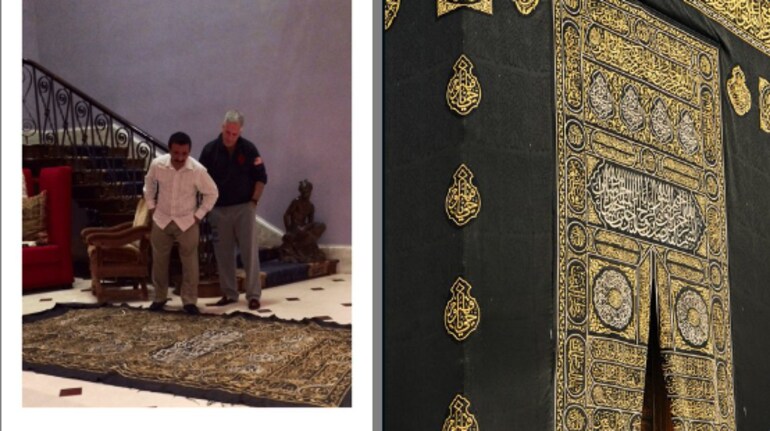

A newly surfaced image from the latest batch of US Department of Justice documents linked to the Jeffrey Epstein files has triggered widespread anger and disbelief across Muslim communities after what appears to be a portion of the Kaaba’s sacred cloth, the Kiswa, was seen laid out on the floor with Emirati billionaire Sultan Ahmed bin Sulayem and Epstein standing over it.

(Photograph: X)
The cloth, identifiable by its black fabric and gold Quranic embroidery, is part of the covering of the Kaaba in Mecca and is regarded as one of Islam’s most revered religious symbols.
Reports had earlier indicated that fragments of the Kiswa were sent to Epstein years ago, a revelation that had already caused unease. The emergence of a photograph allegedly showing the cloth placed on the floor has now intensified the backlash.
What the DOJ documents reveal
According to documents unsealed under the Epstein Files Transparency Act, three pieces of the Kiswa were shipped in 2017 to Epstein’s residence in the United States through international air freight.
The parcel was reportedly declared as “artwork” for customs purposes. Emails cited in the files describe coordination between a UAE-based contact and a Saudi intermediary, including invoices, customs paperwork and delivery logistics.
One of the messages referenced in the correspondence described the cloth as having been “touched by millions of pilgrims, carrying their prayers, hopes and tears,” underscoring its spiritual importance before its transfer.
Religious significance of the Kiswa
The Kiswa is replaced annually on the first day of the Islamic New Year in the month of Muharram. The previous covering is traditionally preserved and distributed under strict custodial oversight to selected dignitaries and institutions.
Religious scholars note that while fragments may be shared under controlled circumstances, such transfers are rare and typically bound by protocol rather than private exchange.
Backlash across social media
Social media platforms have since been flooded with expressions of grief, anger and calls for accountability. Many users questioned how a sacred artefact associated with the holiest site in Islam could have reached a private residence, particularly one linked to a convicted sex offender.
Others debated the ethical and cultural implications of removing religious objects from their ritual context and placing them in non-religious settings.
Despite the public release of the correspondence, several questions remain unresolved. The files do not clearly state the precise purpose of the shipment, the depth of the relationships between intermediaries involved, or the formal approvals, if any, behind the transfer.
As of now, there have been no detailed official statements from Saudi or UAE authorities confirming or disputing the specifics contained in the documents.
Discover the latest Business News, Sensex, and Nifty updates. Obtain Personal Finance insights, tax queries, and expert opinions on Moneycontrol or download the Moneycontrol App to stay updated!
Find the best of Al News in one place, specially curated for you every weekend.
Stay on top of the latest tech trends and biggest startup news.