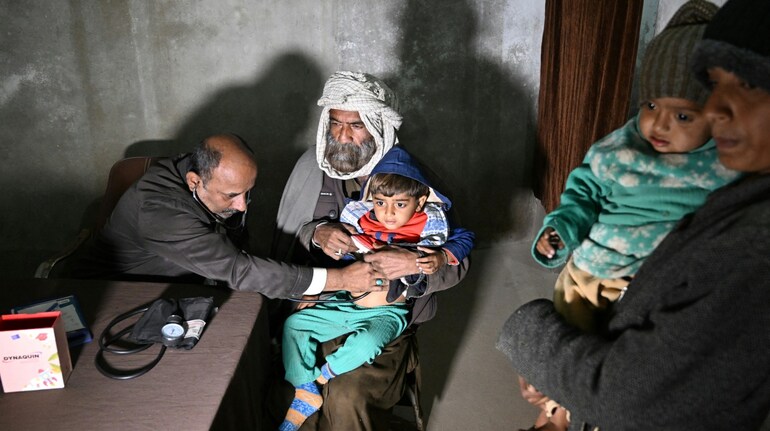

In Pakistan’s vast informal healthcare network, a clinic does not need a licence, a degree, or even basic hygiene. Sometimes, all it needs is a few wooden tables, a handful of chairs, and rusted nails holding used infusion tubes against a wall.
That is the reality in parts of Sindh, where unqualified individuals freely run roadside clinics and act as doctors for poor communities who have nowhere else to go.
One such clinic operates outside Hyderabad city, run by Abdul Waheed, a man with no legal authorisation to practise medicine. During the day, Waheed works at a private hospital. In the evenings, he opens his roadside clinic in Tando Saeed Khan, charging 300 rupees per consultation.
“These patients have faith in me. They believe I can treat them well,” Waheed said.
There is no signboard outside his clinic. No registration number. No proof that he is allowed to diagnose or prescribe. Waheed has a diploma in homeopathy and a four-year nursing course, which in Pakistan appears to be more than enough to play doctor.
“I have spent so much time in this field. I have worked with several doctors. Thanks to God, I have confidence to diagnose a patient and treat the disease,” he told AFP.
Confidence, it seems, matters more than competence.
A country of fake doctors
Waheed is not an exception. He is part of a vast parallel system. According to Abdul Ghafoor Shoro, secretary general of the Pakistan Medical Association, there are more than 600,000 fake doctors operating across the country.
This figure has been confirmed by the Sindh Healthcare Commission, based on data from the Pakistan Medical and Dental Council.
Calling it a public health epidemic, Shoro said these practitioners typically learn a few things while working under real doctors and then set up their own clinics.
“Unqualified doctors don’t know the side effects and exact dosage of medicines. If a disease is not properly diagnosed, it can become dangerous,” he said.
“The instruments they use are not sterilised. They simply wash them with water and continue using them. They reuse syringes, which increases the spread of hepatitis and Aids.”
As AFP reporters visited Waheed’s area, another fake doctor reportedly shut his clinic immediately and vanished. That, too, appears routine.
Poor patients, high risks
For many villagers, these clinics are the first and often only point of care.
“None of them have qualified doctors. People aren’t educated and can’t recognise qualified doctors,” said Ali Ahmed, a 31-year-old villager.
The result is predictable. Patients arrive at major hospitals only after irreversible damage has been done.
“They misdiagnose and mistreat patients. Our hospital is overloaded. Most of the cases we receive are those ruined by them,” said Khalid Bukhari, head of Civil Hospital Karachi.
“These people are playing with the lives of poor citizens. If people go to proper doctors and receive precise treatment, they will not need to come to us.”
Regulators admit defeat
Even Pakistan’s regulators admit they are losing the battle.
“We have limited resources. This practice cannot be eliminated easily. If we shut down 25 outlets, 25 new ones will open the very next day,” said Ahson Qavi Siddiqi, head of the Sindh Healthcare Commission.
He recently sealed a bungalow in Karachi that was operating as a full-fledged hospital with intensive care units, without registration.
“The law against it is weak. We file cases, but the accused get bail the next day because it is a bailable offence,” Siddiqi said.
Enforcement comes with risks too.
“These people are influential in their areas. In many cases, our teams are taken hostage. We are fired upon. I don’t have the force to take strong action,” he added.
The cost of a broken system
The final cost is borne by families who can least afford it.
“Many people die or become disabled, and their families suffer for the rest of their lives,” Shoro said.
In a country where fake doctors outnumber real ones and regulators openly concede defeat, Pakistan’s healthcare crisis is no accident. It is the outcome of neglect, weak laws, and a system where rusted nails and blind faith replace medical science.
Discover the latest Business News, Sensex, and Nifty updates. Obtain Personal Finance insights, tax queries, and expert opinions on Moneycontrol or download the Moneycontrol App to stay updated!
Find the best of Al News in one place, specially curated for you every weekend.
Stay on top of the latest tech trends and biggest startup news.