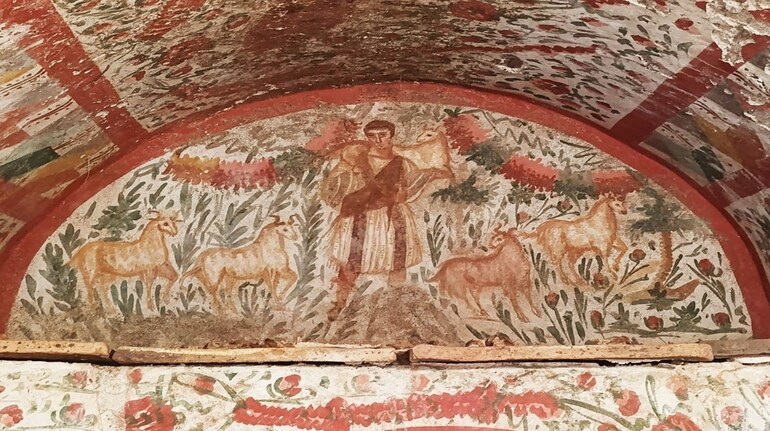
Archaeologists working near Iznik in northwestern Turkey have revealed a rare early Christian fresco that depicts Jesus in a way many modern viewers would not immediately recognise: young, clean-shaven, and dressed in a Roman-style toga, carrying a goat across his shoulders. The artwork was found inside an underground tomb in the village area of Hisardere, close to Iznik, the ancient city of Nicaea, which later became central to Christian history.
What the painting shows
The image is an example of the “Good Shepherd” motif, an early Christian symbol associated with protection and salvation. Researchers say the Iznik fresco stands out because of its distinctly Roman visual language and because well-preserved depictions of Jesus from this early period are uncommon in the region. Alongside the central figure, the tomb’s interior also includes decorative motifs such as plants and birds, and painted figures that appear to reflect the social world of the time.
Why a beardless Jesus matters
In later centuries, especially after Christianity gained legal status in the Roman Empire, Jesus was more commonly portrayed with the familiar beard, longer hair and halo. Earlier art could look different: symbolic, coded, and influenced by the surrounding Greco-Roman style. Finds like this help historians track how Christian iconography evolved, and how communities expressed faith during periods when Christians could face persecution and had incentives to keep religious messages subtle.
The Iznik link and why the timing drew attention
Iznik is widely known for the Council of Nicaea in A.D. 325 and the Nicene Creed, and the fresco’s emergence has gained additional visibility because of renewed international attention around the site’s Christian heritage. Reports note that the discovery has been discussed in the context of high-profile visits connected to Nicaea’s legacy, highlighting how archaeological finds can quickly enter modern cultural and political conversation.
For archaeologists, the immediate priority now is careful conservation: stabilising pigments, documenting the full painted programme inside the tomb, and placing the artwork in its precise historical setting. For the wider public, the appeal is simpler and immediate. It is a glimpse of a very early Jesus image, rooted in the visual world of the Roman Empire, and preserved long enough to surprise people 1,700 years later.
Discover the latest Business News, Sensex, and Nifty updates. Obtain Personal Finance insights, tax queries, and expert opinions on Moneycontrol or download the Moneycontrol App to stay updated!
Find the best of Al News in one place, specially curated for you every weekend.
Stay on top of the latest tech trends and biggest startup news.