






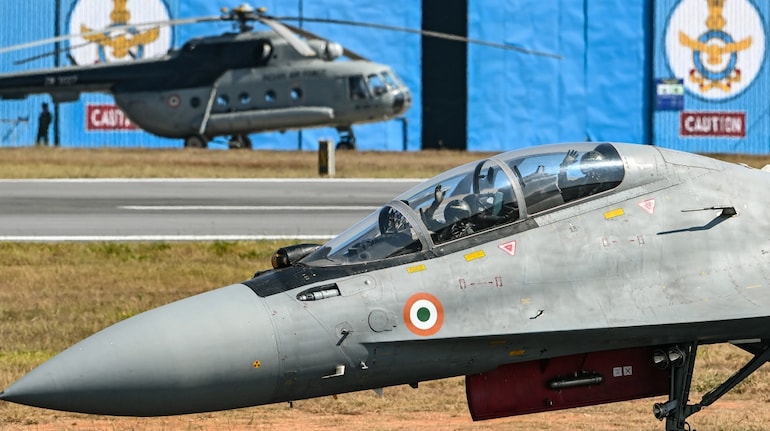
As Russian President Vladimir Putin prepares for a high-profile visit to India later this year, a key item expected to dominate discussions is Moscow’s renewed pitch to co-produce Sukhoi fighter jets in Nashik, Maharashtra. This proposal, which has been under quiet negotiation for several months, is now gaining strategic urgency, especially as both nations look to deepen defence ties amid shifting geopolitical alignments.
The offer is not limited to production of existing aircraft like the Su-30MKI, but now reportedly includes technology transfer and joint production of newer and more advanced platforms, aimed at bolstering India's self-reliance in defence manufacturing and reinvigorating the aging fighter fleet of the Indian Air Force (IAF).
In May this year, Putin accepted Prime Minister Narendra Modi's invitation to visit India for the annual high-level meeting between the two countries.
The Nashik proposal
The core of the proposal is centred around Hindustan Aeronautics Limited’s (HAL) Nasik division, which has long served as the domestic assembly line for the Su-30MKI under license from Russia.
CNBC-TV18 had last month reported that India is considering an offer from the Russian government to collaborate on manufacturing SU-57 fighters.
The government is seriously considering Russia's proposal partly because HAL already has a Su-30 production line in Nashik. It is also exploring domestic development of fifth-generation fighter jet engines. Meanwhile, Safran and Rolls-Royce have offered 100% technology transfer, the report added.
Russia has now offered to co-produce next-generation variants — and potentially parts of the Su-57E — in Nashik, leveraging the existing industrial base and skilled workforce. The upgraded production line would not only create local jobs but also allow for customization of jets to IAF requirements, local servicing, and potentially exports to third-party countries under a joint Indo-Russian defence export mechanism.
The co-production pitch aligns with India’s ‘Make in India’ and ‘Atmanirbhar Bharat’ (self-reliant India) initiatives and could offer a more attractive alternative to full import of aircraft, especially as India faces ongoing delays and negotiations with other foreign suppliers.
A new two-jet package: Su-35M + Su-57E
In a significant development reported by Defence Blog, Russia has broadened its fighter jet offer to India by bundling the Su-35M and the fifth-generation Su-57E into a dual-package proposal.
The Su-35M is a heavily upgraded 4++ generation fighter with advanced avionics, radar-evading capabilities, and long-range strike potential. It offers immediate combat readiness and is viewed as a reliable stop-gap solution for India’s fast-depleting squadron numbers.
The Su-57E, on the other hand, is the export version of Russia’s stealth-capable fifth-generation platform. Though the IAF had earlier withdrawn from the FGFA (Fifth Generation Fighter Aircraft) program — a joint initiative to develop a variant of the Su-57 — Russia is now reviving the deal in a new form, reportedly with greater openness to technology sharing and localized manufacturing.
Together, the Su-35M and Su-57E form a complementary duo, offering India both short- and long-term capability enhancement.
Defence Blog reports that this dual-jet offering is Russia’s attempt to secure a long-term, high-value contract with the Indian Air Force, positioning itself as a counterweight to ongoing negotiations with Western fighter jet makers like Dassault (Rafale), Boeing (F-15EX), and Saab (Gripen E).
India needs: Why now?
The IAF currently operates only 31-33 squadrons, which is well below the sanctioned strength of 42 squadrons required to counter threats from both China and Pakistan. With aging MiG-21s and early model Jaguars being phased out, India needs urgent replenishment of airpower.
While the acquisition of 36 Rafales from France filled part of the gap, India has yet to finalize additional large-scale purchases. Indigenous programs like the Tejas Mk2 and Advanced Medium Combat Aircraft (AMCA) are promising but still years away from full deployment.
In this context, Russia’s offer is both strategically timed and potentially cost-competitive.
Discover the latest Business News, Sensex, and Nifty updates. Obtain Personal Finance insights, tax queries, and expert opinions on Moneycontrol or download the Moneycontrol App to stay updated!
Find the best of Al News in one place, specially curated for you every weekend.
Stay on top of the latest tech trends and biggest startup news.









