







The world’s security architecture is quietly but decisively changing. With the United States under Donald Trump turning inward and treating alliances as transactional, long-standing assumptions about who guarantees stability are eroding. Washington’s focus on tariffs, border security and Western Hemisphere dominance has left power vacuums elsewhere. In West Asia, the eastern Mediterranean and the western Indian Ocean, regional players are no longer waiting for cues from the White House.
Out of this churn, two loose but increasingly visible strategic currents are emerging. One revolves around Pakistan, Saudi Arabia and Turkey, often described by analysts as an “Islamic NATO”. The other brings together India, the United Arab Emirates and Israel, with Greece and Cyprus edging closer. These are not formal blocs yet, but the signals are too consistent to ignore.
Saudi-Pakistan-Turkey alignment
Speculation about a Saudi-Pakistan-Turkey security axis intensified after Riyadh and Islamabad signed a Strategic Mutual Defence Agreement in 2025. Modelled loosely on Nato’s Article 5, it treats an attack on one as an attack on both. For Saudi Arabia, this marked a sharp shift away from decades of near-total reliance on US security guarantees. For Pakistan, it was a diplomatic lifeline after its isolation deepened following repeated terror incidents and the brief but costly military clash with India in May 2025.
Turkey’s reported interest in joining this framework added muscle and symbolism. Under Recep Tayyip Erdogan, Ankara has long sought strategic autonomy, balancing Nato membership with independent military interventions and defence exports. A trilateral arrangement would theoretically combine Saudi financial power, Turkish military technology and Pakistani nuclear and missile capabilities.
But ambition does not equal coherence. Analysts point out that Pakistan is the weakest link in this chain. Its economy is near collapse, its defence exports have failed to attract real buyers, and its credibility is undermined by persistent links to extremist groups. Even within the Muslim world, enthusiasm for Pakistan’s leadership role is limited. Several Gulf states remain wary of being drawn into Islamabad’s disputes with India or its ideological posturing under army chief Asim Munir.
Pakistan’s own rhetoric reveals the problem. Munir’s frequent invocations of Islamic destiny and civilisational struggle play well domestically but unsettle partners who are focused on stability, trade and investment. The so-called Islamic Nato, critics argue, looks more like a political narrative designed to mask Pakistan’s economic desperation than a credible collective security system.
Why Pakistan is pushing hard and why India is watching closely
For Islamabad, the push for a broader Muslim military alignment serves multiple purposes. It seeks leverage against India after New Delhi suspended the Indus Waters Treaty following terror attacks. It also aims to reassure creditors and donors that Pakistan still matters geopolitically, even as its economy survives on bailouts.
Yet this strategy is risky. Pakistan’s pitch increasingly asks partners to underwrite its security while tolerating its internal contradictions. Its failure to secure firm export orders for the JF-17 fighter jet, despite aggressive marketing, has already exposed the limits of its defence-industrial narrative. Gulf capitals are pragmatic. They want returns, not liabilities.
India, by contrast, has read the moment differently.
India-UAE-Israel: a quieter, capability-driven alignment
If the Saudi-Pakistan-Turkey axis is loud and ideological, the India-UAE-Israel triangle is discreet and transactional. It is built not on slogans but on interoperability, technology and shared threat perceptions.
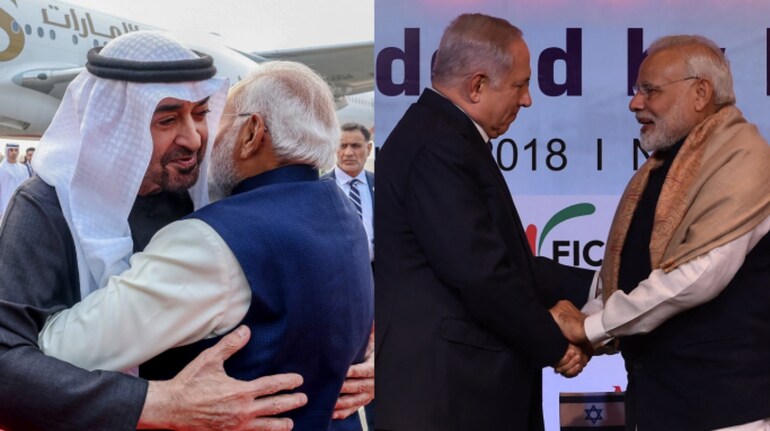
India’s defence and intelligence cooperation with Israel is deep and long-standing, spanning drones, missiles, electronic warfare and cyber capabilities. The UAE, meanwhile, has steadily emerged as one of India’s most important strategic partners in West Asia. The January 2026 visit of UAE President Sheikh Mohamed bin Zayed Al Nahyan to New Delhi, though brief, produced a letter of intent on a strategic defence partnership that went far beyond symbolism.
This partnership aligns neatly with the post-Abraham Accords landscape, where Israel and key Arab states now cooperate openly. For Abu Dhabi, India offers a counterweight to Saudi influence and a reliable partner that does not export ideology. For India, the UAE is a gateway to West Asia, Africa and global capital.
American journalist Michael Vatikiotis captured this shift succinctly when he wrote that India is shaping a new geopolitical axis with the UAE and Israel to counter the Turkey–Saudi–Pakistan configuration, adding that these realignments are “a direct result of shrinking US and European power”.
From the Gulf to the Mediterranean: expanding the arc
This alignment does not stop at the Arabian Sea. It stretches westward into the eastern Mediterranean, where Greece, Cyprus and Israel have been coordinating closely to counter Turkey’s assertiveness over maritime boundaries and energy resources.
India’s growing engagement with Greece and Cyprus adds a new dimension. Participation in trilateral and “3+1” formats signals New Delhi’s interest in securing its western maritime flank and protecting trade routes linked to the India–Middle East–Europe Economic Corridor. For Athens and Nicosia, India’s involvement brings diplomatic heft and strategic depth against Ankara.
Retired Indian Air Marshal Anil Chopra has warned that a Turkey–Pakistan–Saudi axis could threaten not just India but also Israel, Armenia and Cyprus. From this perspective, India’s westward strategic outreach is less about bloc-building and more about balancing power across connected theatres.
What experts say and what Pakistan gets wrong
Several international relations scholars argue that Pakistan overestimates its ability to lead or even anchor a Muslim military bloc. Its domestic instability, reliance on the military in economic governance and continued tolerance of extremist networks make it an unreliable partner.
In contrast, India’s approach leverages its strengths. As a large, diversified economy and a functioning democracy, India does not need to promise ideological solidarity. It offers markets, technology and strategic steadiness. As Fareed Zakaria has noted elsewhere, this seriousness may not flatter transactional leaders, but it pays dividends over time.
Even within the Gulf, there is little appetite for an explicitly anti-Israel or anti-India military formation. Saudi Arabia’s interests increasingly align with economic diversification and regional de-escalation. Turkey’s ambitions often clash with Arab priorities. Pakistan’s attempts to position itself as the ideological glue only highlight its isolation.
Are these real alliances or strategic hedging?
It is important to be precise. There is no formal India-UAE-Israel military alliance today, just as Turkey has not formally joined any Saudi-Pakistan defence bloc. What exists is strategic hedging.
Yet hedging itself reshapes geopolitics. Regular joint exercises, defence industrial cooperation, intelligence sharing and diplomatic coordination create habits of alignment. Over time, these habits harden into expectations and, eventually, into structures.
The bigger picture
The United States is less predictable. Europe is inward-looking. Regional powers are filling the gaps with pragmatic partnerships. In this environment, Pakistan’s push for an Islamic Nato looks more like a gamble born of weakness than a project rooted in strength.
India’s emerging alignment with the UAE, Israel and Mediterranean partners reflects the opposite instinct. It is incremental, interest-based and anchored in capability. That difference matters.
Whether or not these axes ever formalise, the direction of travel is clear. Loud ideological coalitions struggle to endure. Quiet strategic convergence tends to last. In that contest, India appears better positioned than a Pakistan still trying to substitute grand narratives for hard power and economic credibility.
Discover the latest Business News, Sensex, and Nifty updates. Obtain Personal Finance insights, tax queries, and expert opinions on Moneycontrol or download the Moneycontrol App to stay updated!
Find the best of Al News in one place, specially curated for you every weekend.
Stay on top of the latest tech trends and biggest startup news.





