






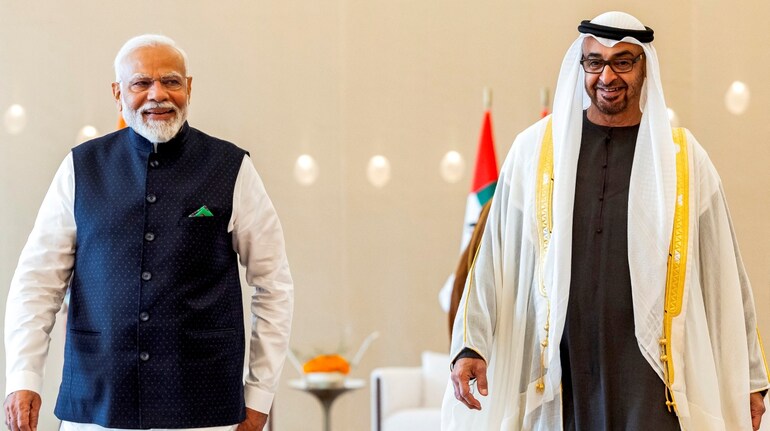

UAE President Sheikh Mohamed bin Zayed Al Nahyan’s visit to India on Monday comes at a critical geopolitical moment, both for the region and for India’s expanding footprint in West Asia. The Ministry of External Affairs has said the visit will focus on strengthening the India-UAE comprehensive strategic partnership, with discussions expected on trade, investment, defence industry cooperation, energy initiatives, and regional developments.
The visit is taking place amid heightened tensions in West Asia, including strained Iran-US relations, continued instability in Gaza, and the unresolved conflict in Yemen involving Saudi Arabia and the UAE. Officials have indicated that these regional developments are likely to feature prominently in Sheikh Mohamed’s talks with the Indian leadership.
Held at the invitation of Prime Minister Narendra Modi, this is Sheikh Mohamed’s third official visit to India since assuming office as UAE President and his fifth visit to the country in the past decade, underlining the priority Abu Dhabi places on ties with New Delhi.
India and the UAE have seen a sharp expansion in bilateral trade and people-to-people ties since the signing of the Comprehensive Economic Partnership Agreement in 2022. CEPA has significantly boosted trade flows and investment, turning the UAE into one of India’s top trading and investment partners. The relationship is further reinforced by a local currency settlement system and a bilateral investment treaty, which together signal long-term economic trust.
The MEA has described the relationship as warm, close, and multi-faceted, rooted in strong political, cultural, and economic ties. Recent high-level exchanges, including visits by Abu Dhabi Crown Prince Sheikh Khaled bin Mohamed bin Zayed Al Nahyan and UAE Deputy Prime Minister and Defence Minister Sheikh Hamdan bin Mohammed bin Rashid Al Maktoum, have already laid the groundwork for deeper strategic engagement.
Sheikh Mohamed’s visit is expected to build on this momentum and help both leaders chart new directions for cooperation in an increasingly volatile regional environment.
Defence cooperation gains strategic weight
From India’s perspective, the defence component of the relationship carries growing strategic significance. Talks during the visit are expected to cover defence industry cooperation, an area where New Delhi has been actively pushing indigenous manufacturing, technology partnerships, and joint production.
This becomes particularly relevant at a time when India is carefully assessing shifting military alignments in West Asia, especially as Pakistan seeks to expand its defence footprint in the Arab world. Islamabad has been aggressively pitching itself as a security provider, pursuing arms deals and military partnerships with Gulf countries despite its own internal instability and economic distress.
Pakistan’s expanding defence outreach raises red flags
Pakistan’s recent defence diplomacy in the Arab world stands in sharp contrast to India’s model of engagement. Islamabad has been linked to efforts aimed at creating a NATO-like Islamic military bloc, while simultaneously negotiating arms deals and defence cooperation arrangements across the Middle East and Africa. These moves appear less about regional stability and more about exporting Pakistan’s military influence at a time when its economy remains on life support.
More troubling is Pakistan’s increasing reliance on the UAE to manage its financial crisis. Reports indicate that Pakistan has shifted substantial UAE debt into army-run entities such as the Fauji Foundation, blurring the line between state finances and military control. This manoeuvre underscores how deeply Pakistan’s economic survival is now intertwined with its military establishment, even as it attempts to present itself as a reliable defence partner abroad.
For India, these developments reinforce the importance of consolidating ties with trusted partners like the UAE, where cooperation is driven by economic complementarities, shared interests, and mutual respect rather than transactional military dependency.
India-UAE ties as a counterweight to regional instability
Against this backdrop, Sheikh Mohamed’s visit serves as a strategic counterpoint to Pakistan’s increasingly opaque defence engagements. India’s relationship with the UAE is not narrowly military but comprehensive, combining trade, energy security, investment, technology, and regional diplomacy.
The MEA has stressed that the visit will allow both leaders to exchange views on regional and global issues where India and the UAE share a high degree of convergence. For New Delhi, this includes ensuring stability in West Asia, safeguarding energy supplies, protecting Indian diaspora interests, and preventing the region from becoming a playground for destabilising actors.
A signal of strategic alignment
Ultimately, Sheikh Mohamed bin Zayed Al Nahyan’s visit is about reinforcing India’s role as a dependable and forward-looking partner in West Asia. At a time when Pakistan is attempting to leverage military ties to compensate for economic weakness, India’s engagement with the UAE reflects a more sustainable model built on growth, trust, and long-term strategic alignment.
For India, the visit is not just diplomatic routine. It is a signal that New Delhi’s partnerships in the Gulf are deepening even as it keeps a close watch on disruptive manoeuvres by Pakistan in the same strategic space.
Discover the latest Business News, Sensex, and Nifty updates. Obtain Personal Finance insights, tax queries, and expert opinions on Moneycontrol or download the Moneycontrol App to stay updated!
Find the best of Al News in one place, specially curated for you every weekend.
Stay on top of the latest tech trends and biggest startup news.





