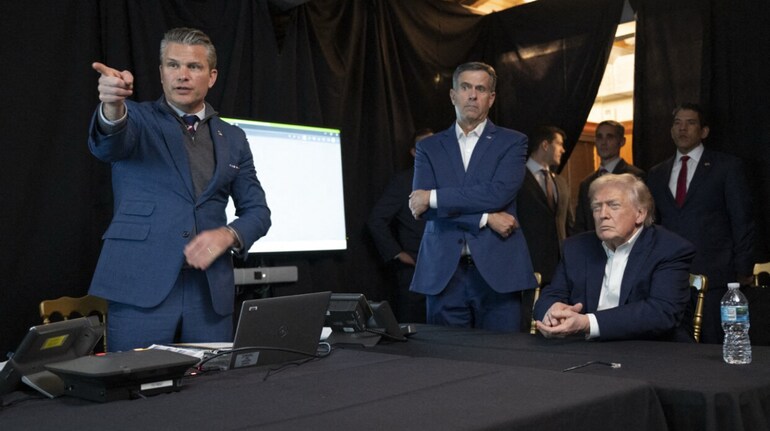
US Defense Secretary Pete Hegseth said on Tuesday that American military operations against Iran are set to intensify, describing the coming hours as potentially the most aggressive phase of the campaign so far.
Speaking at a press conference at the Pentagon alongside Gen. Dan Caine, chairman of the Joint Chiefs of Staff, Hegseth said, “Today will be, yet again, our most intense day of strikes inside Iran.”
Tuesday would bring the most fighter jets and bombers against Iran, he added.
He also claimed that Iran’s military response has weakened in recent days. “Iran stands alone, and they are badly losing,” Hegseth said.
According to the defense secretary, the pace of Iranian missile launches has declined significantly. He said that in the past 24 hours the United States had observed “Iran firing the lowest number of missles they’ve been capable of firing yet.”
Hegseth avoided giving a clear timeline for how long the military campaign against Iran could last, saying the decision ultimately rests with Trump.
Speaking about the progress of the war, Hegseth said it was not his role to determine the stage of the conflict. “It’s not for me to posit whether it’s the beginning, the middle or the end,” he said, adding that the pace and direction of the campaign would be decided by the president.
When asked directly how long the conflict might continue, Hegseth declined to provide an estimate and said Trump “gets to control the throttle.” His remarks reflect the administration’s position that the president retains full authority over the timing and scale of the operation.
Hegseth said the US military is working to provide the president with a range of strategic options. In carrying out strikes against Iranian targets, he said the armed forces are giving Trump “maximum options” to conduct the war.
The defence secretary had previously suggested the conflict could last between three and eight weeks. However, he appeared to step back from that prediction on Tuesday, again emphasising that determining the length of the campaign is up to the president.
At the same time, Hegseth indicated that the United States does not intend to widen the scope of the war significantly. “We know exactly what we’re attempting to achieve here, scoped properly, and the American people can count on that for sure,” he said.
Earlier, US President Donald Trump warned Tehran against attempting to block oil shipments through the Strait of Hormuz, prompting a sharp response from a senior adviser to Iran’s supreme leader.
In a post on social media, Trump cautioned that any move by Iran to disrupt traffic through the crucial maritime corridor would trigger a powerful military response from Washington.
He said the United States would retaliate “twenty times harder" than previous strikes if Tehran attempted to halt oil flows through the strait. Trump also warned that the United States could target Iranian assets in ways that would make it “virtually impossible" for the country to rebuild.
The American president framed the issue as a matter of global economic stability, noting that several major oil-importing nations rely heavily on shipments passing through the waterway. He pointed to countries such as China that depend on energy supplies transported through the strait.
Iran quickly pushed back against the warning. Ali Larijani, a senior adviser to Iran’s supreme leader, responded with a message posted in Arabic dismissing what he described as threats from Washington.
“The Iranian people of Ashura do not fear your empty threats," Larijani wrote.
He added that powerful adversaries had historically failed to destroy Iran and warned the United States to “beware lest you be the ones who disappear."
Discover the latest Business News, Sensex, and Nifty updates. Obtain Personal Finance insights, tax queries, and expert opinions on Moneycontrol or download the Moneycontrol App to stay updated!
Find the best of Al News in one place, specially curated for you every weekend.
Stay on top of the latest tech trends and biggest startup news.