







As the United States and Israel intensify their military campaign against Iran, concerns are emerging within the Pentagon over how long American stockpiles of key munitions can sustain the conflict.
Senior military officials had already warned US President Donald Trump about the risks of a prolonged operation before the strikes began. One of the key issues flagged was the size of the US arsenal of air defence interceptors and precision strike weapons, according to a report by The Wall Street Journal.
Now, as Iranian missiles and drones continue to target US and allied positions, American forces are racing to degrade Tehran’s offensive capabilities before defensive supplies are significantly depleted. According to The Wall Street Journal, US and allied forces have been targeting Iran’s missile launchers, drone infrastructure and airfields since the start of the operation to limit Tehran’s ability to retaliate.
Strikes aim to blunt Iran’s retaliatory capacity
The exact size of the United States’ stockpile of interceptors remains classified. However, repeated conflicts with Iran and its regional proxies have steadily reduced the available supply of air defence munitions in the Middle East, current and former officials told The Wall Street Journal.
Since Saturday morning in Tehran, US and Israeli forces have struck a range of Iranian leadership and military targets. A senior official told the newspaper that one reason Washington and Jerusalem launched early strikes was to blunt Iran’s ability to retaliate using its missiles and drones.
US President Donald Trump signalled that the operation could continue for days.
“The heavy and pinpoint bombing, however, will continue, uninterrupted throughout the week or, as long as necessary to achieve our objective of PEACE THROUGHOUT THE MIDDLE EAST AND, INDEED, THE WORLD!” Trump wrote on social media on Saturday.
Hundreds of Iranian attacks intercepted
Iran’s retaliation has so far been less intense than during previous confrontations. In an earlier 12-day conflict, Tehran fired more than 500 missiles and numerous attack drones.
US Central Command said American and allied forces have already mounted a large-scale defence against hundreds of Iranian missile and drone attacks. Some projectiles still managed to hit targets, particularly in Gulf states located close to Iran.
The Israeli claim that Iran’s Supreme Leader Ayatollah Ali Khamenei was killed in an airstrike could also influence how the conflict evolves, though it remains unclear who might succeed him.
Interceptors being used faster than they can be replaced
Analysts say the most pressing issue is the speed at which air defence interceptors are being consumed.
“One of the challenges is you can deplete these really quickly,” Kelly Grieco, a senior fellow at the Stimson Center think tank who previously taught at the Air Command and Staff College, told The Wall Street Journal. “We’re using them faster than we can replace them.”
Among the systems currently deployed are THAAD antimissile batteries, which were sent to Israel in 2024 along with US Army personnel to operate them. Another Thaad battery has been positioned in Jordan, where many US combat aircraft are stationed.
Pentagon planners are also concerned about maintaining sufficient Thaad interceptors for deployments in South Korea and Guam, where they are needed to deter North Korea and China.
Patriot and SM-3 systems defending against missiles
The United States is also relying heavily on Patriot and Standard Missile interceptors to defend against Iranian missile and drone attacks.
Patriot systems are designed to intercept lower altitude threats, while SM-3 missiles can destroy ballistic missiles outside the Earth’s atmosphere.
Offensive weapons also being expended rapidly
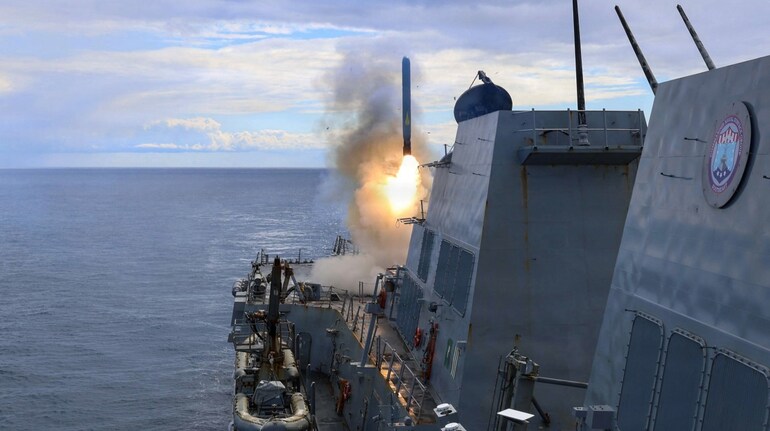
Defensive interceptors are not the only weapons being used at a high rate. US forces are also firing Tomahawk cruise missiles and aircraft-delivered precision weapons against Iranian targets.
According to The Wall Street Journal, these strikes follow earlier campaigns such as Operation Rough Rider, when US forces used long-range precision weapons against Houthi militants in Yemen.
“The Trump administration has fired TLAMs at an extraordinary rate in operations around the globe, in the Middle East against Iran and the Houthis as well as in Nigeria on Christmas Day,” Becca Wasser, a senior fellow at the Center for a New American Security, told the newspaper.
Tomahawk missiles critical for future conflicts
Tomahawk cruise missiles are considered particularly important for striking infrastructure and military targets in the early stages of a major conflict.
“When we wargame, TLAMS are some of the first munitions to go within that first week of a U.S.-China conflict,” Wasser said. She added that replenishing stocks would require increased procurement and production.
Israel also facing munition shortages
The strain on American supplies could be partially eased by Israel’s participation in the campaign. Israeli forces have carried out many of the strikes targeting Iranian military leadership and infrastructure.
However, Israel is facing shortages of its own. US officials cited by The Wall Street Journal said Israel is running low on Arrow 3 air defence interceptors and certain air-launched ballistic missiles.
A war of numbers
Jonathan Conricus, a former spokesman for the Israel Defense Forces who is now a senior fellow at the Foundation for Defense of Democracies, said the outcome may ultimately depend on which side can sustain its resources longer.
“I was underwhelmed so far by the amount of missiles that the Iranians have been able to fire,” Conricus said.
“Eventually it boils down to numbers,” he added. “How many interceptors will we have versus how much launchers will they be able to field and fire.”
Pentagon moves to reinforce supplies
To sustain operations, the United States has moved additional missiles and interceptors into the region, including supplies from allied partners.
If the conflict drags on and demand for interceptors increases further, the Pentagon may also consider drawing from stockpiles positioned in the Pacific, a US official told The Wall Street Journal.
Discover the latest Business News, Sensex, and Nifty updates. Obtain Personal Finance insights, tax queries, and expert opinions on Moneycontrol or download the Moneycontrol App to stay updated!
Find the best of Al News in one place, specially curated for you every weekend.
Stay on top of the latest tech trends and biggest startup news.





