







Pakistan’s foreign policy appears to have entered a new phase of public spectacle, political desperation and strategic confusion. The latest episode unfolded at the World Economic Forum in Davos, where Islamabad eagerly signed up for US President Donald Trump’s ambitious and controversial Board of Peace, an initiative that many see as a parallel structure meant to dilute the authority of the United Nations. In doing so, Pakistan once again signalled its willingness to bend, align and adapt to Trump’s worldview, regardless of diplomatic optics, domestic backlash or long-term consequences.
From lobbying campaigns to Nobel Peace Prize endorsements, from mineral deals to Gaza diplomacy, Pakistan’s leadership seems determined to stay in Trump’s good books at any cost. The result is growing discomfort at home, raised eyebrows abroad, and a foreign policy increasingly driven by personal courtship rather than national interest.
Pakistan joins Trump’s inner circle at Davos
On Thursday, US President Donald Trump unveiled his much-touted Board of Peace at Davos, surrounded by a carefully curated group of political loyalists and ideological fellow travellers. On stage were Argentina’s libertarian President Javier Milei, Indonesia’s former general Prabowo Subianto, Hungary’s Viktor Orban, and Belarus leader Alexander Lukashenko, widely described as Europe’s last dictator.
Standing among them was Pakistan Prime Minister Shehbaz Sharif.
The symbolism was hard to miss. Pakistan, a country battling economic collapse, political unrest and security crises, appeared eager to associate itself with a controversial bloc led personally by Trump. The board, initially projected as a mechanism for Gaza’s reconstruction, now claims a far broader mandate covering global conflict resolution and security.
Trump described the leaders on stage as “in most cases very popular leaders, some cases not so popular”.
“That’s the way it goes in life,” he added. “Every one of them are friends of mine. I like every single one of them. Just about every country wants to be a part of it. We sent out the letters a couple of days ago and countries that are here just happened to be in Davos.”
Pakistan signed the charter despite mounting concerns over the board’s structure, the $1 billion price tag attached to permanent membership, and Trump’s insistence on retaining chairmanship even after leaving office.
Islamabad sells it as Gaza diplomacy
Pakistan’s Foreign Office attempted to justify the move by framing it as a humanitarian gesture.
It said Islamabad hoped that the framework would help ensure “concrete steps will be taken towards the implementation of a permanent ceasefire, further scaling up of humanitarian aid for the Palestinians, as well as reconstruction of Gaza”.
The explanation did little to reassure critics, especially as Trump’s own statements and the board’s draft charter suggest ambitions far beyond Gaza, including reshaping global peace architecture outside UN mechanisms.
Backlash erupts at home
The domestic response was swift and furious.
Senate opposition leader Allama Raja Nasir Abbas condemned the decision, calling it “morally incorrect and indefensible, both on principle and on policy”.
“The initiative was problematic from the outset. Conceived as an externally managed arrangement for post-war Gaza, it effectively removes the right of governance from the Palestinian people themselves. By placing reconstruction, security and political oversight in the hands of outside actors, the project carries the unmistakable imprint of a neo-colonial enterprise,” he said.
He added, “Trump’s initiative will, over time, erode the very right to self-determination it claims to safeguard.”
Abbas also warned that Pakistan risked long-term damage by aligning with a framework that sidelines the United Nations.
“Foreign policy decisions driven by short-term calculation often produce lasting consequences. By associating itself with a project that undermines both Palestinian agency and the UN system, Pakistan risks diluting its moral standing and strategic coherence. It is a decision Pakistan will regret,” he said.
Political and intellectual pushback grows
Imran Khan’s Pakistan Tehreek-e-Insaf demanded immediate withdrawal from the board.
“Decisions of such international significance must always be undertaken with full transparency and inclusive consultation with all major political stakeholders,” the party said, calling for a national referendum on the issue.
Former senator Mustafa Nawaz Khokhar accused the government of bypassing parliament, saying the decision “smacks of the disregard this regime has of the Pakistani nation”.
“What the h*** are we binding ourselves to?” he asked.
Former ambassador Maleeha Lodhi termed the move an “unwise decision”.
“The government has overlooked the fact that Trump wants states to join the board to secure international support and legitimacy for what are and will be unilateral actions by him,” she wrote, adding that the board’s remit was “v broad and beyond Gaza, another reason not to join”.
Author and journalist Zahid Hussain told Dawn, “Pakistan has done it in a hurry. They should have waited. It raises questions about Pakistan’s foreign policy: do we just want to follow Trump’s diktat? We seem to only want to be in Trump’s good books.”
Activist and writer Fatima Bhutto was even sharper, saying, “So Pakistan will be sitting with Israel on this ‘board of peace’, very perpetrators of the Palestinian Holocaust? What a disgrace.”
A pattern of persistent Trump courtship
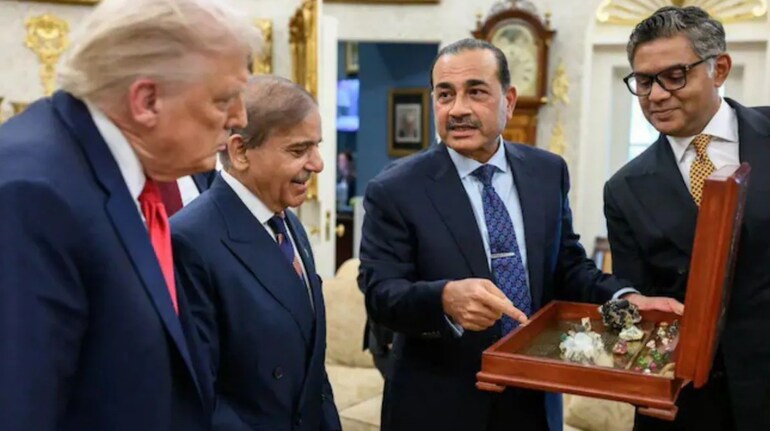
Pakistan’s Davos performance is only the latest chapter in its increasingly visible effort to woo Trump.
Since India’s Operation Sindoor last May, Islamabad has sharply escalated lobbying in Washington, spent millions on political consultants, endorsed Trump for the Nobel Peace Prize, and publicly praised his diplomatic claims.
Last October, Shehbaz Sharif even backed Trump’s assertion that he had mediated peace between India and Pakistan.
“Today is one of the greatest days in contemporary history because peace has been achieved after untiring efforts led by President Trump, who is genuinely a man of peace,” Sharif declared.
“Pakistan has nominated President Donald Trump for the Nobel Peace Prize for his extraordinary efforts to first stop the war between India and Pakistan and then achieve a ceasefire,” he added.
The praise continued with deals on rare earth minerals, critical mining cooperation, and exploratory crypto ventures. Even Pakistan’s army chief Asim Munir has been actively courting Trump, seeking strategic alignment and security cooperation.
Is it working and at what cost?
Trump recently imposed only a 19 percent tariff on Pakistani goods, the lowest among South Asian countries. In Islamabad, this is being quietly projected as proof that the charm offensive is paying off.
But critics argue that Pakistan is trading long-term diplomatic credibility for short-term political optics.
By repeatedly bending towards Trump’s personal agenda, Islamabad risks reinforcing its image as a transactional state willing to shift principles for proximity to power.
The bigger question remains unanswered. How far will Pakistan go in its pursuit of Trump’s favour, and what will it sacrifice along the way?
Discover the latest Business News, Sensex, and Nifty updates. Obtain Personal Finance insights, tax queries, and expert opinions on Moneycontrol or download the Moneycontrol App to stay updated!
Find the best of Al News in one place, specially curated for you every weekend.
Stay on top of the latest tech trends and biggest startup news.





