






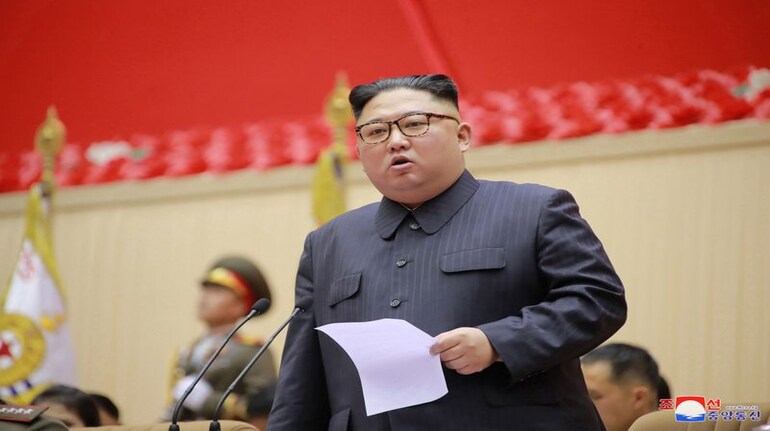
North Korea has released photographs showing what it claims are 50 nuclear-capable rocket launchers lined up in formation, one of the largest single displays of such systems ever made public by the regime. The images, carried by South Korea’s Yonhap news agency, show dozens of heavy vehicles arranged in tight rows, surrounded by crowds and senior officials, with leader Kim Jong-un inspecting the launchers in person.
Kim praised the systems, saying they were “wonderful” and “attractive”, before shifting to more familiar rhetoric. When these weapons are used, he said, no force could expect divine protection. He described the launchers as being ideal for “concentrated super-powerful attack”, clearly pointing to use on a battlefield rather than symbolic deterrence.
What makes this unveiling notable is not just the number, but the type of weapon being emphasised. These are not intercontinental ballistic missiles meant to threaten the United States mainland. They appear to be large-calibre multiple rocket launch systems mounted on mobile platforms, designed for short-range strikes. Analysts believe such systems can be used to carry nuclear warheads, aimed especially at South Korea and the
United States forces stationed there.
By showing 50 launchers at once, Pyongyang is highlighting scale and redundancy. Mobile rocket systems are harder to track and destroy than fixed launch sites. In a conflict, they could be dispersed, hidden, and fired in salvos, overwhelming missile defences. This fits a long-standing North Korean strategy: offset conventional military weaknesses with the ability to escalate quickly and unpredictably.
The timing is deliberate. The display comes amid continued US–South Korea joint military exercises, which North Korea routinely portrays as preparation for invasion. Pyongyang has increasingly responded not with test launches alone, but with carefully staged visual messaging that combines weapons, crowds, and leader-centric imagery.
There is also a domestic purpose. These events reinforce Kim’s image as a leader delivering strength and technological progress despite sanctions and economic isolation. The mass turnout and choreographed setting are meant to project control and inevitability, not just military capability.
For Seoul and Washington, the message is uncomfortable. Tactical nuclear systems lower the threshold for use compared to strategic weapons. They are designed to be used early in a conflict, not held in reserve. That complicates deterrence and crisis management, especially on a peninsula where warning times are already short.
No technical details were released, and North Korea’s claims are difficult to independently verify. But the intent of the display is clear. Pyongyang wants to be seen as ready not just to deter, but to fight, and to do so with weapons that blur the line between conventional and nuclear war.
The photographs may look like theatre. The doctrine they point to is not.
Discover the latest Business News, Sensex, and Nifty updates. Obtain Personal Finance insights, tax queries, and expert opinions on Moneycontrol or download the Moneycontrol App to stay updated!
Find the best of Al News in one place, specially curated for you every weekend.
Stay on top of the latest tech trends and biggest startup news.




