






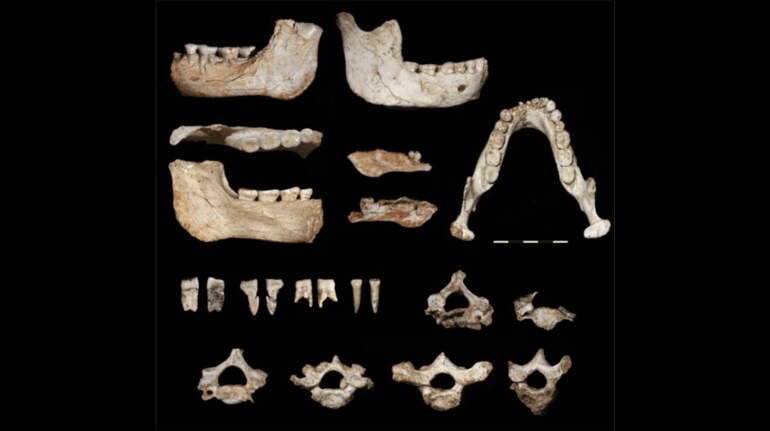

The remains, described this week in a study published in Nature, were unearthed at a site known as Grotte à Hominidés in Casablanca. Together, they form one of the most important African hominin finds from a period between 600,000 and one million years ago — a stretch of time for which the continent’s fossil record is unusually thin.
A rare window into a missing period
The fossil collection includes a nearly complete adult jawbone, half of another adult jaw, a child’s jaw, several vertebrae and isolated teeth. These remains come from a time when scientists believe the African lineage that eventually produced Homo sapiens began to separate from Eurasian hominins that later gave rise to Neanderthals and Denisovans.
That makes the discovery particularly significant. Very few African fossils have been securely dated to this crucial interval, leaving a major gap in the story of how modern humans emerged.
The cave itself once overlooked a rich coastal landscape where wetlands, swamps and savannas supported hippos, crocodiles, hyenas, jackals and large cats. Researchers believe the site may originally have been a carnivore den before becoming a natural trap for bones and sediment.
Not modern humans, but something close
The Moroccan fossils are clearly older and more primitive than the famous Jebel Irhoud remains, also from Morocco, which at about 300,000 years old represent the earliest widely accepted evidence of Homo sapiens.
Instead, the new jawbones show a mix of archaic and more modern features. In fact, they closely resemble fossils attributed to Homo antecessor, a species discovered in the 1990s at the Gran Dolina site in Spain and dated to roughly the same period.
Those Spanish fossils were themselves controversial because they pushed back the timeline of human occupation in western Europe and suggested that early hominins had spread widely across both Africa and Europe much earlier than previously thought.
A shared story across the Mediterranean
The similarities between the Moroccan and Spanish finds suggest that populations on both sides of the Mediterranean were already linked during the Middle Pleistocene, an ice age period that lasted from about 774,000 to 129,000 years ago.
Jean-Jacques Hublin of the Max Planck Institute for Evolutionary Anthropology, the lead author of the study, said the new fossils support the idea of a deep African origin for modern humans, while also showing that the evolutionary split between African and Eurasian branches was already underway at this early date.
Scott A. Williams of New York University, who was not involved in the study, said the research also reinforces the idea that movement between northern Africa and southern Europe was likely common during this period.
How scientists pinned down the age
Earlier attempts to date the fossils produced confusing results. The breakthrough came when researchers used high-resolution magnetostratigraphy, a technique that reads ancient reversals in Earth’s magnetic field recorded in rock layers.
The sediment containing the fossils aligned with the most recent major magnetic reversal, allowing scientists to assign a highly reliable age of about 773,000 years — one of the most precise dates ever obtained for African hominin fossils from this era.
A glimpse of a lost population
Could these fossils belong to the last common ancestor of modern humans, Neanderthals and Denisovans? Scientists estimate that this ancestor lived sometime between about 550,000 and 765,000 years ago, but the fossil evidence remains fragmentary and hotly debated.
Hublin is cautious about making any firm claims. Human evolution, he notes, is filled with extinct branches, and it is impossible to know whether this small Moroccan population left any descendants. Still, the fossils offer a valuable picture of what such an ancestral population may have looked like.
The site also contains a sobering reminder of how precarious life was for early humans. A nearby femur bears gnaw marks from a large carnivore, probably a hyena, showing that hominins were sometimes prey as well as predators.
Even so, the discovery marks a major step toward understanding one of the most mysterious and formative chapters in humanity’s deep past.
Discover the latest Business News, Sensex, and Nifty updates. Obtain Personal Finance insights, tax queries, and expert opinions on Moneycontrol or download the Moneycontrol App to stay updated!
Find the best of Al News in one place, specially curated for you every weekend.
Stay on top of the latest tech trends and biggest startup news.





