






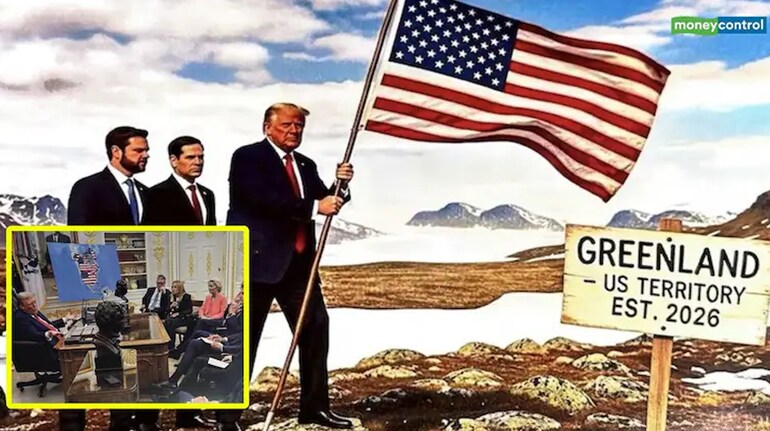
One year after US President Donald Trump revived the 19th-century doctrine of ‘Manifest Destiny’ in his January 2025 inauguration address, an idea long associated with America’s continental expansion has returned to Washington’s rhetoric on Greenland, Canada and the Arctic.
As the High North becomes a new arena of global competition, a belief many assumed belonged to history has re-entered policy debates with real geopolitical consequences. Greenland is facing pressure unseen since the early Cold War, Canada is re-evaluating its Arctic sovereignty, and European allies have issued rare warnings about territorial integrity within NATO.
Over the past year, US officials have shifted from framing the Arctic as a zone of cooperation to speaking in terms of ownership. The change became visible in February–March, when the White House sent an uninvited delegation led by Vice President JD Vance to Greenland — a visit local authorities rejected outright.
Rather than reading the rebuff as diplomatic resistance, Trump escalated. By late 2025, he declared: “We’ll get Greenland. Yeah, 100%.” The remark was framed as inevitability rather than negotiation, alarming Copenhagen and raising questions about whether US policy was being driven by ideology rather than strategy.
The tone hardened further in January this year. White House Deputy Chief of Staff and Trump’s closest aide Stephen Miller told CNN that Greenland “should have” belonged to the US and insisted, “Nobody’s going to fight the United States militarily over the future of Greenland.” Louisiana governor Jeff Landry reinforced the message, saying the administration was focused on “solidifying the Western Hemisphere … and Greenland is in the Western Hemisphere”. Together, the remarks pushed the debate firmly into ideological territory.
Canada entered the conversation for similar reasons. Trump has previously called the US–Canada boundary an “artificial” border and floated the idea of Canada becoming the 51st state. In early 2025, then prime minister Justin Trudeau dismissed the suggestion, saying there “isn’t a snowball’s chance in hell” it would ever happen. Yet concern deepened later that year when former officials Bob Rae and Jean Charest warned that Trump may have Canada “back in his crosshairs”, particularly amid renewed US challenges to Canadian Arctic sovereignty and the Northwest Passage.
This rhetoric has unsettled allies because it draws on ideas largely absent from modern US strategy. Manifest Destiny emerged in the 1840s as the belief that the United States was destined — by history, providence and the presumed superiority of its political system — to expand across North America. Coined in 1845 by journalist John L. O’Sullivan, the doctrine portrayed territorial acquisition as both inevitable and morally justified.
Under President James K. Polk, it drove America’s most rapid expansion. Between 1845 and 1849, the US annexed Texas, seized California and the Southwest after war with Mexico, and secured Oregon through negotiation, reaching the Pacific within a generation. This transformation came at devastating cost to Indigenous peoples, who were displaced or destroyed through warfare, forced removals and settler expansion.
Although commonly associated with westward expansion, Manifest Destiny also had a northern dimension. American thinkers envisioned the absorption of British North America and greater influence in the Arctic. By the mid-19th century, US policymakers openly speculated about continental political unification. Economic uncertainty in Canada even led some Montreal businessmen to call for union with the United States. William Seward, later Secretary of State and architect of the Alaska Purchase, believed Canada “would ultimately” join the American federation if Washington simply waited.
After acquiring Alaska in 1867, Seward’s circle turned its attention further north. His ally Robert J. Walker commissioned a report advocating the purchase of Greenland and Iceland from Denmark, arguing that Greenland’s fisheries, minerals and coal made it valuable — and that acquiring it would “greatly increase [Canada’s] inducements, peacefully and cheerfully, to become a part of the American Union.”
The proposal alarmed Britain. That same year, London created the Dominion of Canada, partly to deter American expansionism. In this sense, Canadian confederation itself can be seen as a response to the logic of Manifest Destiny. Greenland, however, remained unresolved. After the Second World War, the US secretly offered to buy the island from Denmark, but the proposal was rejected. While Washington maintained military bases there during the Cold War, the idea of acquisition lay dormant until Trump revived Manifest Destiny in political speech in 2025.
At his second inauguration on 20 January 2025, Trump pledged that the United States would “expand our territory” and pursue its “Manifest Destiny into the stars”. The language marked a sharp departure from decades of US policy focused on alliances, influence and economic leadership rather than territorial growth.
Within Trump’s political base, the rhetoric found receptive audiences. Figures across the MAGA movement embraced what they called “Manifest Destiny 2.0”, arguing that the US had a natural right to consolidate dominance across the Western Hemisphere, particularly in strategic or resource-rich territories such as Venezuela, Cuba, Colombia and Greenland. On NBC News, former Trump strategist turned MAGA influencer Steve Bannon described it as “Manifest Destiny 2.0.” Commentators like Matt Walsh argued that “expansion is the American way”, while Mike Cernovich spoke of pursuing “the orderly governance of the world via American imperialism.”
Greenland sits at the centre of this debate because it combines strategic utility, resource potential and historical symbolism. It anchors US early-warning and space-surveillance systems in the Arctic, holds rare-earth deposits, and sits near the western entrance of the Northwest Passage. Yet Denmark already permits extensive defence cooperation, and Washington could deepen its Arctic presence through negotiation rather than ownership.
What elevates Greenland in contemporary American rhetoric is its resemblance to past acquisition targets — vast, sparsely populated, resource-rich territories on the edge of a strategic frontier. In the 19th century, it periodically appeared in US thinking as the northern counterpart to the Louisiana and Alaska purchases. That vision has now resurfaced, drawing global scrutiny.
The revival of Manifest Destiny has produced one of the most unusual intra-NATO tensions in decades. Denmark has flatly rejected any suggestion of US acquisition, while European allies have reiterated that sovereignty and territorial integrity cannot be set aside even among allies. The backlash extended beyond NATO in January, when Washington faced a rare rebuke at an emergency UN Security Council meeting, followed by warnings from European governments that they would “not stop defending” the principles of sovereignty and territorial inviolability.
Whether Manifest Destiny remains rhetorical symbolism or evolves into a more assertive guiding principle will shape Arctic geopolitics, NATO cohesion and North American stability in the years ahead.
Discover the latest Business News, Sensex, and Nifty updates. Obtain Personal Finance insights, tax queries, and expert opinions on Moneycontrol or download the Moneycontrol App to stay updated!
Find the best of Al News in one place, specially curated for you every weekend.
Stay on top of the latest tech trends and biggest startup news.




