






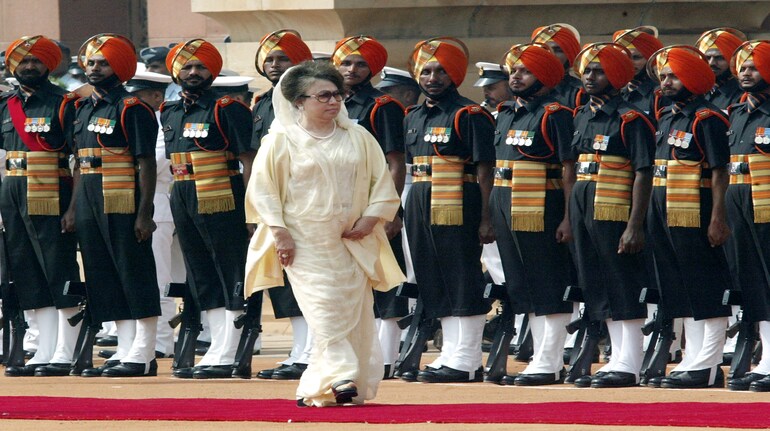

Begum Khaleda Zia, Bangladesh’s first woman prime minister and long-time chairperson of the Bangladesh Nationalist Party (BNP), died at the age of 80 after a prolonged illness. She passed away at 6 a.m. at Dhaka’s Apollo Hospital, according to A.K.M. Wahiduzzaman, BNP’s ICT Affairs Secretary and head of its Online Activists Network.
Her death marks the end of a long and controversial political career that shaped Bangladesh’s domestic politics and its relations with neighbours, particularly India.
A tense relationship with India
Khaleda Zia’s relationship with India was often tense and politically charged, particularly when compared to her rival, Sheikh Hasina, who generally pursued closer ties with New Delhi.
As BNP leader, Zia frequently criticised the Awami League government’s engagement with India, framing it as a threat to Bangladesh’s sovereignty and national interest. In 2017, she accused Sheikh Hasina of effectively “selling out” Bangladesh to India to retain power, a statement that resonated strongly with nationalist sentiment within her party.
She opposed the renewal of the 1972 Indo-Bangladesh Friendship Treaty, a pact widely regarded as strategically significant, particularly from a military standpoint. She argued that the agreement constrained Bangladesh’s sovereignty and left the country “shackled” in its dealings with India.
This approach was evident during a rally in Dhaka in 2018, when Sheikh Hasina was prime minister, and Zia served as Leader of the Opposition. Criticising Hasina’s decision to exempt India from transit duties, Zia warned against deeper economic and strategic dependence, declaring, “We will resist the move to turn Bangladesh into a state of India.”
Statements on insurgency in India’s Northeast
During her tenure as prime minister, Khaleda Zia made remarks that drew attention in India, particularly regarding insurgent movements in the country’s northeastern states.
At a public meeting in Bangladesh’s Feni district, she said, “They are fighting for independence. We also fought for it, so we are always in favour of any independence movement.”
She also indicated that Bangladesh would not deploy its army against insurgency in India’s seven northeastern states. This position was reiterated by BNP secretary general Abdul Mannan Bhuiyan.
Zia also criticised Sheikh Hasina for restricting insurgents’ movement, lamenting that the Awami League government was not allowing them easy transit through Bangladesh.
Allegations of BNP’s role and ISI links
Concerns over militancy during the BNP’s rule were raised by security analysts over the years. Writing in August 2005, strategic analyst Nitin A. Gokhale stated, “ISI exerts on north-east militant groups. This effort has been greatly boosted with the Bangladesh Nationalist Party (BNP) assuming power in Dhaka in 2001. Dominated by policy-makers who advocate an anti-India line, Khaleda Zia’s government has been a silent abettor of the ULFA-NDFB-ATTF-NLFT-ISI nexus.”
Such assessments contributed to India’s long-standing unease over security cooperation during BNP-led governments.
‘India Out’ campaign and BNP rhetoric
The BNP has historically maintained a strong anti-India political posture. In recent years, party leaders supported calls to boycott Indian products.
The ‘India Out’ campaign in Bangladesh, modelled on a similar movement in the Maldives, was publicly backed by BNP senior joint secretary general Ruhul Kabir Rizvi. The campaign, however, was curtailed following steps taken by the Sheikh Hasina government.
Imtiaz Ahmed, professor of political science at Dhaka University, told Frontline magazine, “It is mainly being driven by the Bangladeshi diaspora who are either BNP members or closely associated with the party.”
Anti-Hindu rhetoric and minority concerns
Khaleda Zia was repeatedly accused by critics of using anti-minority rhetoric to consolidate support among Muslim hardliners.
In 1996, she claimed that if the Awami League came to power, the Muslim call to prayer (Azaan) would be replaced by Shankhadhoni, the blowing of conch shells by Hindus.
Her tenure also coincided with episodes of communal violence, including attacks on Hindu communities following the demolition of the disputed structure in Ayodhya in December 1992.
Violence after the Babri Masjid demolition
On December 6, 1992, mobs attempted to storm a cricket match between India and Bangladesh at Dhaka’s National Stadium. Police used tear gas and rubber bullets to disperse the crowd.
According to a United Press International report, a mob entered a Hindu Shiva temple in Dhaka’s Thatari Bazar area and demolished it. Other temples were attacked in Narinda, and an 88-year-old Hindu priest was seriously injured in a bomb attack. Attempts were also made to breach the Dhakeswari Mandir.
Shops and vehicles belonging to Hindus were looted and vandalised during the unrest.
The Human Rights Congress for Bangladesh Minorities stated that the violence was carried out by Jamaat-e-Islami, an ally of the ruling BNP at the time.
Attacks during the 2001 and 2014 periods
In 2001, following the general elections, large-scale attacks on the Hindu community were reported. About 25,000 Islamists, including BNP MPs and ministers, were accused of involvement.
A BBC report quoted Hindu leaders as saying, “There were a series of attacks against them, including murder, looting and rape which began as the results were announced. They said Islamist parties and the BNP targeted them because they supported the rival Awami League political party.”
Many members of the Hindu community fled Bangladesh in the aftermath. In 2014, BNP members and Jamaat-e-Islami supporters were accused of carrying out at least 160 attacks on Hindu communities during political unrest.
A legacy under scrutiny
Khaleda Zia’s political legacy remains deeply divisive. While supporters view her as a nationalist leader who resisted foreign influence, critics point to her record on India relations, militancy, and minority rights as among the most controversial chapters in Bangladesh’s political history.
Her death has revived debate over these issues as Bangladesh continues to reassess its political past and future trajectory.
Discover the latest Business News, Sensex, and Nifty updates. Obtain Personal Finance insights, tax queries, and expert opinions on Moneycontrol or download the Moneycontrol App to stay updated!
Find the best of Al News in one place, specially curated for you every weekend.
Stay on top of the latest tech trends and biggest startup news.





