






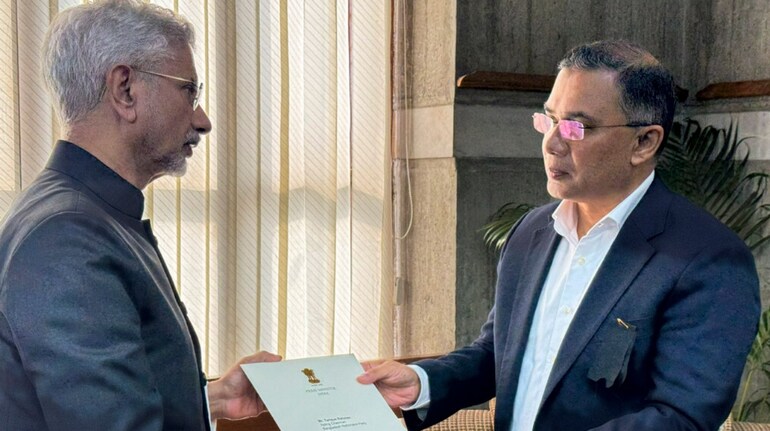

Diplomacy is often loud when it is declaratory and quiet when it is strategic. India’s recent outreach to Bangladesh’s opposition leadership belongs firmly in the latter category. When External Affairs Minister S. Jaishankar personally handed over a condolence letter from Prime Minister Narendra Modi to Tarique Rahman in Dhaka, the moment carried far greater political weight than its sombre optics suggested.
On paper, it was an act of courtesy following the death of former Bangladeshi prime minister Khaleda Zia, a towering and deeply polarising figure in Bangladesh’s history. In practice, it was a calculated signal that New Delhi is preparing for a political transition in Dhaka and is no longer willing to anchor its Bangladesh policy solely to a past that is rapidly receding.
India’s message was subtle but unmistakable. The era of Sheikh Hasina’s dominance is over. The interim government led by Muhammad Yunus has proved unreliable, unstable and strategically troubling. And with the Bangladesh Nationalist Party increasingly positioned to return to power, India is choosing engagement over inertia.
This shift does not come from nostalgia or trust. India remembers the BNP’s anti-India record too well to indulge in sentimentality. Instead, the recalibration reflects cold strategic realism. Bangladesh matters too much to India’s security, its eastern flank, and its regional influence to be left hostage to a faltering interim regime drifting toward Pakistan and China.
By engaging Tarique Rahman at a moment of national mourning, New Delhi has quietly acknowledged a political reality taking shape in Dhaka. It is an attempt to shape the future relationship early rather than react defensively later. What follows is not a change of loyalties, but a change of method, driven by the recognition that India-Bangladesh ties cannot afford further deterioration at a moment of regional flux.
Yunus, instability and the erosion of trust
India’s unease with the Yunus-led setup has grown steadily over the past year. While Yunus enjoys a carefully cultivated global image as a man of peace, governance on the ground in Bangladesh has told a different story.
One of the most alarming developments has been the surge in attacks on Hindus and other minorities. The killing of Osman Hadi and the violence that followed brought these concerns into sharp focus. Indian agencies have repeatedly flagged how law and order failures, selective policing, and political messaging have emboldened extremist elements. For New Delhi, minority safety in Bangladesh is not an internal footnote. It is a core test of state responsibility.
Equally troubling has been Dhaka’s foreign policy drift. Under Yunus, Bangladesh has moved closer to Pakistan and China, reopening channels that India believed had been firmly shut during the Hasina years. Pakistani outreach has returned quietly but steadily, particularly in the security and information domains. China’s footprint, already deep in infrastructure and debt, has expanded into political signalling.
India reads this not as strategic autonomy but as dangerous opportunism. Bangladesh, once a pillar of India’s eastern security architecture, has begun to look like a state willing to hedge against India by leaning toward its adversaries.
This is the context in which India has started to look beyond Yunus.
BNP’s past is a problem, but the present is shifting
There is no romanticism in New Delhi about the BNP’s record. Under Khaleda Zia, India-Bangladesh relations were often strained. Cross-border insurgent groups found space. Anti-India rhetoric was routine. Pakistan’s influence grew, not receded.
Tarique Rahman’s own past is controversial. His reputation as the “dark prince” of Bangladeshi politics did not emerge in a vacuum. India has not forgotten this history.
And yet, India is also pragmatic.
In his recent speech in Dhaka, Tarique Rahman struck a notably different tone from the Yunus administration. He spoke of unity among Muslims, Hindus, Christians and Buddhists. He made no reference to Pakistan. He avoided the familiar BNP reflex of externalising Bangladesh’s politics through India-baiting.
That omission mattered. In South Asian politics, what is not said is often as important as what is.
For India, this suggested a symbolic but meaningful shift. Tarique Rahman appears keenly aware that governing Bangladesh in today’s geopolitical environment requires stabilising relations with India, not antagonising it. Whether this reflects conviction or calculation is secondary. Outcomes matter more than motives.
Why India needs a reset as much as Bangladesh does
India’s recalibration is not about choosing BNP over Awami League. It is about recognising that Bangladesh’s political landscape has changed and that clinging to old alignments at the cost of strategic interests would be self-defeating.
Bangladesh is critical to India’s eastern security, connectivity to the Northeast, and regional trade corridors. Prolonged instability or an adversarial Dhaka directly affects India’s internal security, especially in border states.
New Delhi also understands that a confrontational approach toward a likely BNP government would only push Dhaka further toward Pakistan and China. That would repeat past mistakes.
By opening channels early, India is seeking leverage, not validation. It is signalling that relations can improve if certain red lines are respected. Minority safety. No tolerance for anti-India militancy. No use of Bangladesh as a staging ground for hostile powers.
These are not unreasonable expectations. They are baseline requirements for a functional partnership.
Pakistan’s shadow and why India is wary
One reason India remains cautious is Pakistan. Islamabad has never hidden its desire to regain influence in Dhaka. Under Yunus, it sensed an opening. Under BNP, it will try again.
India’s outreach to Tarique Rahman is partly designed to blunt that effort. By engaging early, New Delhi hopes to reduce the space for Pakistan to present itself as Bangladesh’s alternative partner.
The fact that Tarique avoided invoking Pakistan in his public messaging has not gone unnoticed in New Delhi. It contrasts sharply with Yunus’ indulgence of Islamabad and reinforces India’s assessment that the interim regime has been the bigger strategic problem.
A quiet but consequential shift
Jaishankar’s meeting with Tarique Rahman and Modi’s tribute to Khaleda Zia were not just emotional gestures; they were calibrated signals. India is preparing for a post-Yunus Bangladesh and does not intend to be caught flat-footed. This does not mean India trusts the BNP. It means India is realistic about power.
For Bangladesh, the choice ahead is stark. Continue down a path of instability, minority alienation and proxy politics under Yunus, or attempt a reset with India under a new leadership that understands the costs of antagonism.
Discover the latest Business News, Sensex, and Nifty updates. Obtain Personal Finance insights, tax queries, and expert opinions on Moneycontrol or download the Moneycontrol App to stay updated!
Find the best of Al News in one place, specially curated for you every weekend.
Stay on top of the latest tech trends and biggest startup news.





