






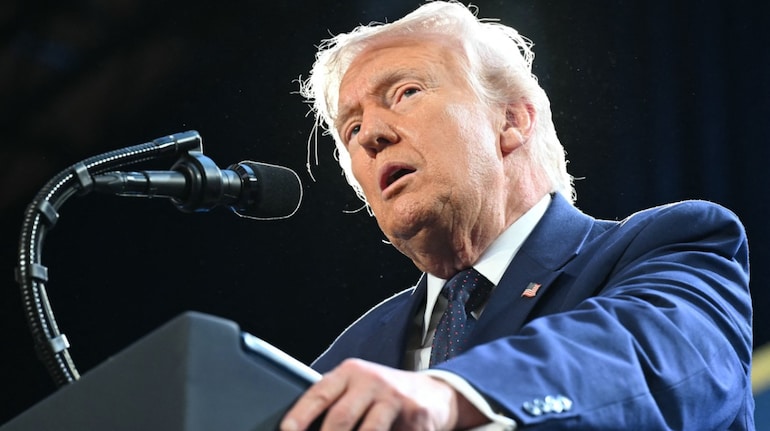

US President Donald Trump said on Monday that the US Navy has sunk 46 “top-of-the-line” Iranian naval ships, describing the scale of American strikes against Iran’s naval capabilities during the ongoing conflict in West Asia.
Speaking at a gathering of Congressional Republicans in Washington DC, Trump recounted a conversation with a US military official about the naval campaign against Iran’s fleet.
According to Trump, when he asked whether American forces could capture Iranian ships and reuse them instead of sinking them, the official responded: “It’s more fun to sink them.”
Trump signals mixed messages on war timeline
Trump’s remarks came hours after he offered contradictory assessments of the war’s progress during separate public appearances on Monday.
In an interview with CBS News earlier in the day, Trump suggested the conflict was nearing its end and that US forces had already achieved their main objectives.
“I think the war is very complete, pretty much,” Trump told the outlet. “They have no navy, no communications, they’ve got no Air Force.”
He also said the United States was “very far ahead” of the four-to-five-week timeline he had initially estimated for the conflict.
However, speaking later to Republican lawmakers, Trump indicated that the campaign would continue.
According to Trump, the United States had “not won enough” yet and the war would proceed until Iran was “totally and decisively defeated.”
Iran’s Revolutionary Guards respond
Iran’s Islamic Revolutionary Guard Corps (IRGC) pushed back against Trump’s remarks about the conflict potentially ending soon.
In a statement responding to the US president’s comments, the IRGC said it would be the force to “determine the end of the war.”
The organisation also warned that it would not allow “one litre of oil” to leave the region if attacks by the United States and Israel continue.
Strait of Hormuz disruption deepens energy shock
The conflict has effectively shut the Strait of Hormuz, one of the world’s most critical maritime energy corridors.
The narrow waterway handles roughly a fifth of global oil and liquefied natural gas shipments, and the disruption has left tankers unable to transit the route for more than a week.
Producers across the Gulf have also halted pumping in several locations as storage facilities reach capacity, according to officials monitoring the situation.
Background: how the conflict escalated
The latest phase of the war began on February 28, when the United States and Israel launched coordinated strikes on Iran.
Iran responded with missile and drone attacks targeting Israel and Gulf states hosting US military bases, widening the confrontation across the region.
While both Washington and Israel are involved in military operations against Iran, the two countries have stated different objectives for the campaign.
Israel has said its goal is to overthrow Iran’s clerical leadership, while the United States has said it aims to destroy Iran’s missile capabilities and nuclear programme.
Discover the latest Business News, Sensex, and Nifty updates. Obtain Personal Finance insights, tax queries, and expert opinions on Moneycontrol or download the Moneycontrol App to stay updated!
Find the best of Al News in one place, specially curated for you every weekend.
Stay on top of the latest tech trends and biggest startup news.





