







Pakistan’s reaction to the US–Israel strikes on Iran has exposed once again how fragile the country’s internal balance really is. Instead of acting like a responsible regional state, Islamabad found itself battling violent protests, diplomatic embarrassment and the fallout of its own contradictory policies.
At the centre of this confusion sits Pakistan Army chief General Asim Munir, whose strategic posture has long oscillated between courting Washington and appeasing hardline Islamist sentiment at home. The result is a state that appears perpetually trapped between ideology and pragmatism, often choosing the path that harms its own stability the most.
Official outrage, predictable rhetoric
When the United States and Israel struck Iranian targets and reportedly killed Iran’s Supreme Leader Ayatollah Ali Khamenei, Pakistan reacted with predictable outrage. Islamabad condemned the military action and called it an unjustified escalation.
Pakistan’s Deputy Prime Minister and Foreign Minister Ishaq Dar described the attacks as “unwarranted attacks” and demanded an immediate halt to hostilities.
But while the official line was diplomatic condemnation, events inside Pakistan told a very different story.
Streets on fire inside Pakistan
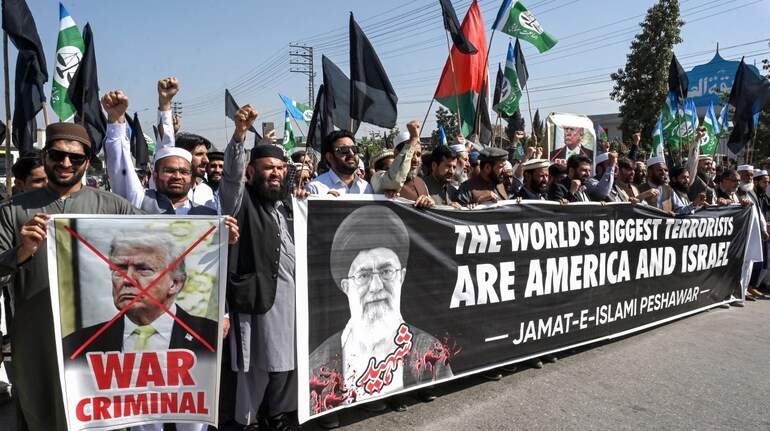
Violent protests erupted across the country, especially among sections of the Shia population angered by the killing of Iran’s top cleric. Demonstrators stormed diplomatic premises, attacked government buildings and clashed with security forces.
At least 22 people were killed and more than 120 injured as protesters attempted to storm the US consulate in Karachi and attacked UN and government offices elsewhere.
The chaos was not limited to one city. Demonstrations spread to Gilgit-Baltistan and Islamabad, forcing authorities to deploy troops and impose curfews in several areas as the unrest spiralled out of control.
For Pakistan, this was not simply a spontaneous public reaction to events in the Middle East. It was also the product of years of political signalling that blurred the lines between state policy and ideological mobilisation.
The Asim Munir contradiction
That contradiction has often been encouraged or tolerated by the country’s powerful military establishment led by General Asim Munir.
Munir’s leadership has repeatedly projected Pakistan as a defender of Islamic causes while simultaneously seeking favour in Western capitals. This dual messaging is not new. Pakistan has long tried to balance relationships with the United States, Gulf states and Iran while also accommodating domestic religious groups that view regional conflicts through sectarian or ideological lenses.
But such balancing acts are rarely sustainable. When the Iran crisis erupted, Pakistan found itself caught between its diplomatic compulsions and the sentiments it had helped nurture at home.
The protests were not merely expressions of solidarity with Iran. They were also demonstrations of how quickly public anger can erupt when a state spends decades allowing foreign conflicts to seep into domestic politics.
Ideology over strategy
Munir’s critics argue that this contradiction is rooted in the worldview that dominates Pakistan’s security establishment. The military leadership often frames geopolitical issues through ideological narratives rather than pragmatic statecraft.
This approach may rally domestic audiences, but it also makes Pakistan more vulnerable to internal instability whenever regional crises erupt.
The irony is that Pakistan had little direct stake in the US-Israel operation against Iran. Yet the country ended up paying a domestic price for it. The violence damaged diplomatic relations, forced security crackdowns and exposed the deep sectarian sensitivities within Pakistani society.
A familiar pattern for Pakistan
In many ways, the turmoil reflects a broader pattern. Pakistan’s leaders frequently project themselves as central players in regional conflicts even when they lack the leverage to influence outcomes.
The result is a cycle in which Islamabad amplifies crises abroad only to face unrest at home.
Under General Asim Munir, that pattern appears to be continuing. Pakistan’s reaction to the Iran strikes was not the response of a stable regional actor. It was the reaction of a state that still struggles to separate ideology, military strategy and domestic politics.
And as the recent unrest shows, that confusion often ends up setting Pakistan’s own house on fire.
Discover the latest Business News, Sensex, and Nifty updates. Obtain Personal Finance insights, tax queries, and expert opinions on Moneycontrol or download the Moneycontrol App to stay updated!
Find the best of Al News in one place, specially curated for you every weekend.
Stay on top of the latest tech trends and biggest startup news.





